







Your Reading Power by Age: A Decade-by-Decade Guide
TL;DR: Quick Guide to Reading Power by Age
Presbyopia, the gradual loss of your eye's ability to focus on nearby objects, is a natural part of aging. While a comprehensive eye exam is the best way to get a precise prescription, this guide provides a reliable starting point for understanding the reading power you might need.
| Age Range | Typical Power (Diopters) | Common Activities & Experience |
|---|---|---|
| Early 40s | +0.75 to +1.25 D | You might start needing to hold menus or your phone slightly farther away. Reading glasses are helpful for small print or in dim lighting. |
| Mid/Late 40s | +1.25 to +1.75 D | Reading for extended periods becomes tiring without glasses. You likely need them for books, labels, and detailed tasks. |
| 50s | +1.75 to +2.25 D | Reading glasses become a daily necessity for most near tasks, including computer work and reading. You might notice a stronger pair is needed for very close work. |
| 60s & Beyond | +2.25 to +2.75 D | Your prescription stabilizes. You'll rely on your reading glasses for all near-vision activities. It's common to have multiple pairs for different distances. |
Understanding Presbyopia: Why Your Near Vision Changes with Age
Have you found yourself holding your phone at arm's length to read a text? Or do you need brighter light than you used to for reading a book comfortably? This is a classic, and incredibly common, experience known as presbyopia. It’s not a disease, but a natural and gradual process that affects everyone, usually starting in our early to mid-40s.
At its core, presbyopia is the result of the natural lens inside your eye becoming harder and less flexible over time. As explained in clinical resources from the National Center for Biotechnology Information (NCBI), this age-related sclerosis prevents the lens from changing shape as easily as it once did, making it difficult to focus on objects up close. The muscle fibers that control the lens also change, contributing to this focusing challenge.
It’s crucial to distinguish this normal aging process from more serious eye conditions. According to Johns Hopkins Medicine, presbyopia is a refractive error—a problem with how the eye focuses light. Low vision, on the other hand, is a loss of sight from conditions like macular degeneration or glaucoma that cannot be corrected with standard glasses. If your vision isn't clear even with reading glasses, it's a sign you need to see an eye doctor.
The Common Signs of Presbyopia
The onset is often subtle. According to the Mayo Clinic, you might notice one or more of the following symptoms:
- A tendency to hold reading material farther away to make the letters clearer (the "trombone effect").
- Blurred vision at a normal reading distance.
- Eye strain, headaches, or fatigue after doing close-up work like reading, sewing, or using your computer.
- Needing brighter lighting when reading or doing other close activities.
If these sound familiar, you’re in good company. Presbyopia is a universal condition, and understanding your reading power is the first step toward clear and comfortable vision.
A Better Way to Choose Your Power: Your Decade-by-Decade Guide
While age is a useful heuristic for estimating reading power, a more precise method I recommend to people is to consider your personal "working distance." The power you need is directly related to how far your eyes are from the task at hand. A phone is held closer than a computer monitor, and that difference matters.
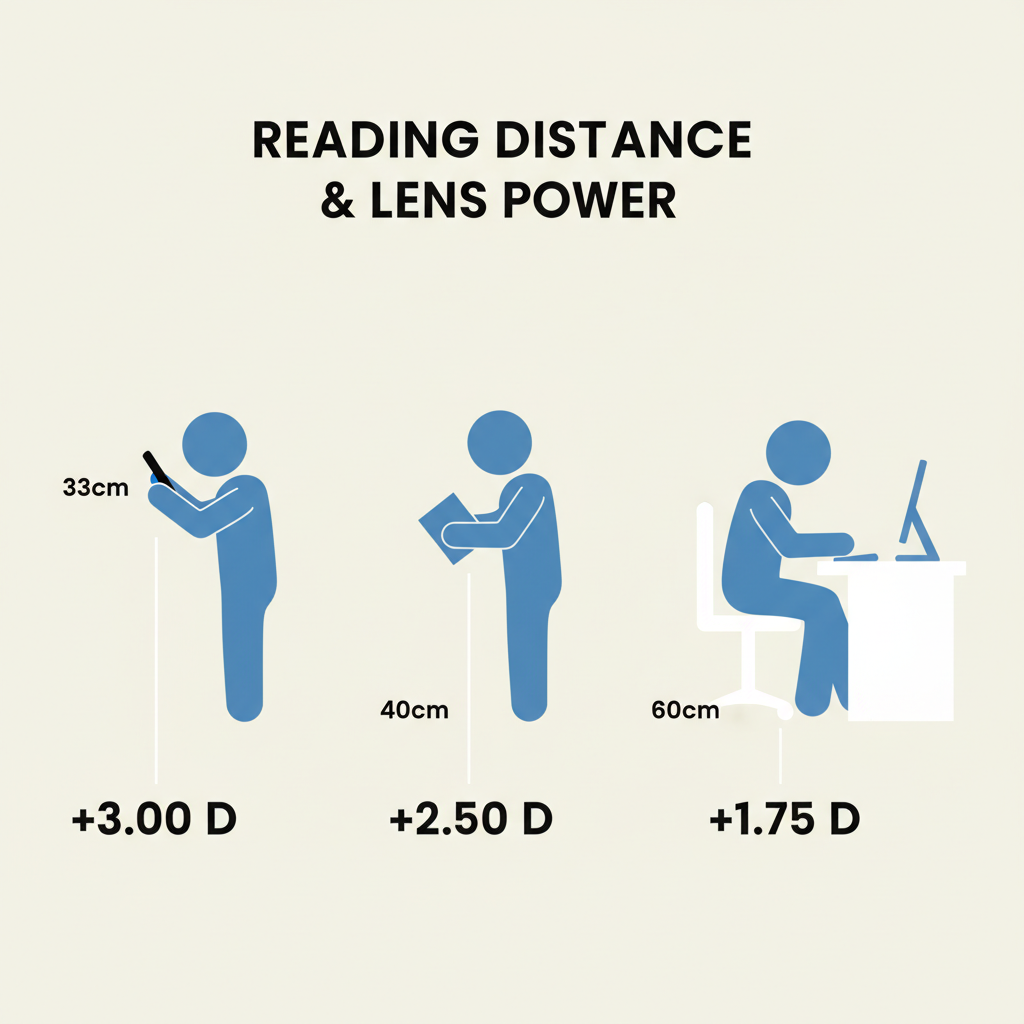
Pro Tip: Measure Your Working Distance for Better Accuracy
Before picking a power based on age alone, grab a ruler or measuring tape. Sit comfortably and measure the distance from your eyes to where you naturally hold your phone, a book, or where your computer screen sits. This measurement provides a much more accurate starting point.
- Computer Use (~24 inches / 60 cm): Often requires a lower power, around +1.50 to +1.75 D.
- Book Reading (~16 inches / 40 cm): This is a standard reading distance, often mapping to +2.50 D.
- Phone/Hobby Work (~13 inches / 33 cm): Very close tasks may require a stronger power, like +3.00 D.
Using this insight, you can better understand the age-based estimates and even decide if you need more than one pair—for instance, one for your desk and another for reading in bed.
Common Pitfalls When Buying Reading Glasses (and How to Avoid Them)
The convenience of drugstore readers is tempting, but it comes with significant trade-offs. Understanding these limitations is key to avoiding the headaches and eye strain that many users experience.
Myth Debunked: "Any Cheap Pair of Readers Will Do"
A common misconception is that all reading glasses are the same. In reality, the one-size-fits-all approach of over-the-counter (OTC) readers can create new problems. The American Academy of Ophthalmology (AAO) points out two major limitations:
- They are the same power in both eyes. Many people have slight variations in the prescription between their left and right eyes (a condition called anisometropia). Wearing a generic pair can cause one eye to work harder, leading to strain.
- They do not correct for astigmatism. Astigmatism is a common imperfection in the curvature of the eye that causes blurred distance and near vision. If you have even a small amount of astigmatism, OTC readers won't fully correct your vision, leaving you with persistent blurriness and discomfort.
Common User Error #1: Ignoring Your Pupillary Distance (PD)
Your Pupillary Distance (PD) is the measurement between the centers of your pupils. For glasses to work correctly, the optical center of each lens must be aligned directly in front of your pupil. OTC readers are manufactured with a generic, average PD. If your PD is wider or narrower than this standard, you will be looking through a suboptimal part of the lens. This misalignment can induce blur, double vision, and headaches. For this reason, getting an accurate PD measurement is one of the most important steps for buying any glasses online. You can learn how to measure your PD at home for a much better fit.
Common User Error #2: Forgetting to Factor in Your Distance Prescription
If you already wear glasses for nearsightedness (myopia), you can't just buy readers based on your age. Your final reading prescription is a combination of your distance prescription and the "add" power needed for near vision. For example, if your distance prescription is -2.00 D and you require a +1.50 D "add" for reading, your single-vision reading glasses would be -0.50 D. Trying to wear +1.50 D readers over your distance contacts, or on their own, will result in blurry vision. A proper prescription from an eye doctor will specify this "add" value separately.
Expert Warning: When Reading Glasses Aren’t the Answer
Reading glasses are designed to solve one problem: presbyopia. If you try a pair that seems appropriate for your age and are still experiencing issues, it’s a red flag. See an optometrist or ophthalmologist if you experience:
- Significantly different vision in each eye.
- Distorted or wavy lines.
- Poor vision that isn't improved with readers.
- Eye pain, excessive tearing, or flashes of light.
These can be signs of other underlying conditions that require medical attention.
Wrapping Up: Your Path to Clear, Comfortable Reading
Navigating the changes that come with presbyopia doesn’t have to be frustrating. By understanding the connection between age, working distance, and reading power, you can make informed decisions about your eyewear. Here are the key takeaways:
- Presbyopia is a normal, predictable part of aging that begins in your 40s due to the hardening of your eye's lens.
- Use age as a starting point, but measure your typical working distances for a more accurate idea of the power you need. You may benefit from multiple pairs for different tasks.
- Recognize the limits of generic, over-the-counter readers. They don't account for differences between your eyes, correct for astigmatism, or align with your unique Pupillary Distance (PD). This can lead to unnecessary eye strain and headaches.
- Always start with a comprehensive eye exam. It's the only way to get a truly accurate prescription and rule out more serious eye health issues.
By following this guidance, you can choose reading glasses that provide the clear, comfortable vision you need to enjoy all of your favorite close-up activities.
Frequently Asked Questions (FAQ)
Can wearing reading glasses weaken my eyes? No, this is a common myth. Reading glasses do not change the anatomy of your eyes or worsen presbyopia. They are simply a tool that helps your eyes focus, reducing strain and providing clear vision.
Do I need different glasses for my computer and for reading a book? Often, yes. As noted by sources like AARP, most people sit farther from their computer screen than they hold a book. This difference in distance may require two different reading powers for optimal comfort and clarity. This is sometimes called a "computer" or "occupational" prescription.
What if I need a different power in each eye? If you need a different strength for each eye, you will require custom-made prescription reading glasses. Over-the-counter readers will not be sufficient and will likely cause eye strain.
How often will I need to update my reading glasses power? Presbyopia is progressive, so your reading power will likely increase throughout your 40s and 50s. It’s common to need an updated prescription every one to two years. The progression typically slows and stabilizes around age 60.
Disclaimer: This article is for informational purposes only and does not constitute professional medical advice. The information provided is intended to help you understand your options for vision correction but is not a substitute for a comprehensive eye examination by a qualified optometrist or ophthalmologist. Always consult with your eye care provider to determine your specific vision needs and to rule out any underlying medical conditions.


