








Rimless Frames for High Prescriptions: Material Choice Matters
The Challenge of High Prescriptions in Rimless Frames
Rimless eyeglasses offer a minimalist, lightweight aesthetic that many people love. They seem to disappear on the face, putting the focus on you, not your frames. However, for those with high-strength prescriptions, this dream of barely-there eyewear can quickly become a cycle of frustrating repairs. The very nature of a rimless design—where lenses are held in place by drill-mounts or tension wires—creates immense stress on the lens material itself.
This guide breaks down why material choice is the single most important factor for a successful, long-lasting pair of high-prescription rimless glasses. We will explore which materials are built to withstand the pressure and why others are destined to fail, ensuring your investment results in durable, reliable vision.
TL;DR: Key Takeaways
- Material is Non-Negotiable: For any drill-mount or semi-rimless frame, you must choose either Polycarbonate or Trivex lenses. Their impact resistance is essential for preventing cracks at the mounting points.
- Avoid Standard Plastics: Standard CR-39 and most high-index plastic lenses are too brittle. They will almost certainly develop "spiderweb" cracks around the drill holes under normal use.
- Craftsmanship Matters: The manufacturing process, including the type of drill bit used, the drilling speed, and the beveling of the lens edge, is just as crucial as the material itself.
- Balance of Properties: While high-index materials are excellent for reducing lens thickness, Polycarbonate and Trivex are chosen for their structural integrity, which is the top priority for rimless designs.
Why Rimless Frames Are a High-Stress Environment for Lenses
Unlike traditional full-rim frames that encase and protect the entire lens edge, rimless designs offer no such buffer. All the forces of daily wear—opening and closing the temples, minor bumps, and even the pressure from cleaning—are transferred directly to the lens through two or three small connection points.
Think of it like this: a full-rim frame supports a lens like a picture in a sturdy frame, distributing the load evenly. A rimless frame is like hanging that same picture from a couple of small nails drilled directly through the canvas. Any pressure concentrates right at those stress points. Without a material that possesses immense tensile strength and flexibility, cracks are inevitable. This is why impact resistance becomes the most critical property, even more so than thinness.

The Material Showdown: A Guide for High Prescriptions
Choosing the right lens material is a science. For high-prescription rimless glasses, we must prioritize durability and safety. Here’s how the common options stack up.
The Unsuitables: Materials Prone to Failure
- CR-39 (Standard Plastic): This is the default lens material for many low-power prescriptions in full-rim frames. However, it is fundamentally too brittle for a drill-mount application. It cannot withstand the focused pressure and will quickly develop fractures that spider out from the mounting points.
- Glass: While offering excellent optics, glass is heavy and dangerously fragile. It is never an appropriate or safe choice for rimless or semi-rimless designs.
- High-Index Plastics (1.67, 1.74): This is the most common point of confusion. High-index lenses are fantastic for making strong prescriptions thinner and lighter. However, as the refractive index increases, the material often becomes more brittle. According to Ferris State University's College of Optometry, these materials trade some impact resistance for their superior thinness. While it's technically possible for a highly skilled lab to drill a 1.67 lens, the risk of it cracking during manufacturing or shortly after is extremely high. For this reason, we do not recommend it.
The Champions: Materials Built for the Challenge
- Polycarbonate: This material is the gold standard for safety eyewear for one reason: it is exceptionally impact-resistant. Polycarbonate can flex and absorb shock without fracturing, making it a perfect match for the high-stress environment of a rimless mount. All eyewear sold in the United States must meet a standard for impact resistance outlined by the FDA (21 CFR 801.410), and polycarbonate lenses inherently satisfy this requirement. The trade-off is slightly lower optical clarity (a lower Abbe value), which can result in minor color fringing in the peripheral vision for highly sensitive wearers.
- Trivex: Often considered the premium choice, Trivex offers the best of all worlds. It delivers impact resistance that is nearly equal to polycarbonate, but with superior optical clarity that is on par with standard plastic. It is also the lightest of all lens materials. This unique combination makes Trivex the ideal, albeit more costly, solution for anyone seeking the highest performance from their rimless eyewear.
Material Comparison Chart
| Feature | CR-39 (Standard) | Polycarbonate | Trivex | High-Index (1.67) |
|---|---|---|---|---|
| Rimless Suitability | Poor (Brittle) | Excellent | Excellent | Very Poor (Brittle) |
| Impact Resistance | Low | Very High | High | Low-to-Medium |
| Optical Clarity | Very Good | Good | Very Good | Excellent |
| Thinness (High Rx) | Thickest | Thinner | Thinner | Thinnest |
| Primary Benefit | Low Cost | Safety & Durability | Safety & Clarity | Aesthetics (Thinness) |
Beyond the Material: The Secrets of a Durable Assembly
Even with the right material, the final assembly's durability depends on the skill and equipment of the optical lab. Based on our experience with repairs and warranty claims, failures in high-quality materials are almost always traced back to the manufacturing process.
Here are the non-obvious details that define a well-made pair of rimless glasses:
- Specialized Drilling: Polycarbonate and Trivex are softer than other plastics. Using a standard drill bit or drilling at too high a speed can generate heat, melting the material and creating hidden micro-fractures. Expert labs use a dedicated carbide drill bit at a slow RPM with constant coolant to create a clean, strong mounting hole that won't fail weeks later.
- Precise Beveling: In a high-minus prescription, the thickest part of the lens is the outer edge. This is precisely where the mounting hardware sits. A generic, flat-edge polish is insufficient. A skilled technician calculates a precise bevel angle and depth to ensure the mounting posts fit securely, preventing the lens from rotating or wobbling, which adds stress to the drill holes.
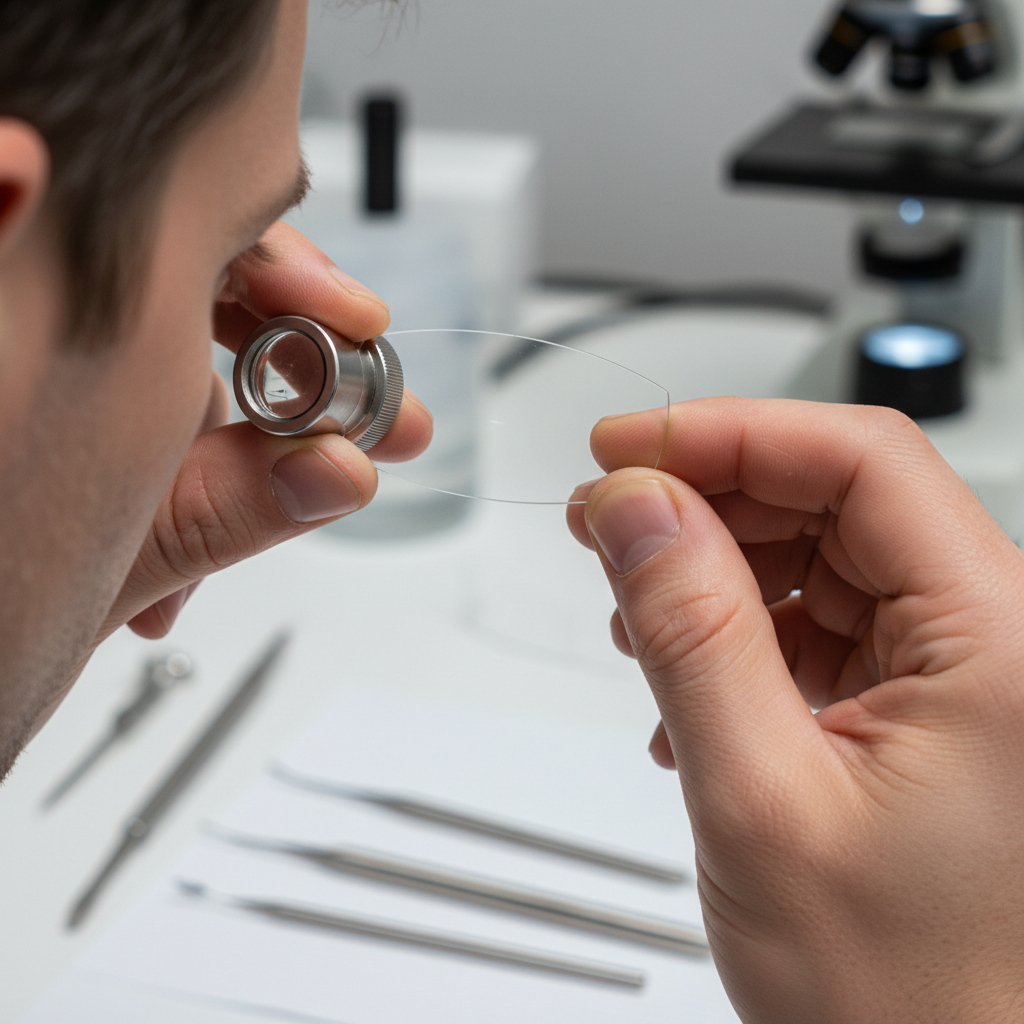
- Post-Assembly Inspection: The ultimate mark of quality is a final inspection. After the glasses are assembled, applying gentle pressure to the frame and viewing the drill-mount area under polarized light can reveal hidden stress patterns. This simple step allows a technician to identify and correct a potential failure point before it ever reaches you.
Balancing Aesthetics and Durability
We understand that the primary reason for choosing rimless frames is aesthetics. The goal is to minimize the presence of your eyewear. How do you achieve that with a strong prescription?
- Prioritize Material First: Accept that Polycarbonate or Trivex is the necessary foundation for durability. A cracked lens is never aesthetically pleasing.
- Optimize with Aspheric Design: Aspheric lenses are designed with flatter curves than traditional spherical lenses. This significantly reduces the magnification ("bug-eye") effect of high farsighted prescriptions and the minification ("small-eye") effect of high nearsighted prescriptions.
- Request Edge Polishing: The thick edges of a high-minus lens can be polished to a clear, glass-like finish. This allows light to pass through the edge, making it far less noticeable than a standard matte finish.
- Invest in Anti-Reflective Coating: A high-quality AR coating is essential. It eliminates reflections from the front and back surfaces of the lens, making them appear clearer, thinner, and more "invisible" on your face.
By combining the strength of Polycarbonate or Trivex with these aesthetic enhancements, you can achieve a durable, reliable, and beautifully minimalist pair of glasses.
Frequently Asked Questions
-
Can I put my old high-index lenses into a new rimless frame? It is strongly advised not to. The process of removing and re-drilling lenses carries an extremely high risk of causing cracks, especially with brittle high-index material.
-
Why did my last pair of rimless glasses crack at the screws? This is the classic sign of an inappropriate material choice, most likely standard CR-39 plastic. It can also be caused by improper drilling techniques that create invisible stress fractures during manufacturing.
-
Are Trivex lenses worth the extra cost over Polycarbonate? For many people, yes. If you are sensitive to chromatic aberration (color fringes) or want the absolute lightest and clearest option without compromising on safety, Trivex is a worthwhile upgrade for rimless frames.
-
Does this advice also apply to semi-rimless frames? Yes. Semi-rimless frames, which hold the lens in place with a thin nylon cord in a groove, also place significant stress on the lens. The groove itself can be a weak point, making impact-resistant Polycarbonate or Trivex the only safe choices.
Disclaimer: This article is for informational purposes only and does not constitute medical advice. Consult with a qualified eye care professional for any personal vision needs or before making decisions about your eyewear.


