

















Saffron for Seniors: Science-Backed Support for Macular Health
The Search for Vision Support Beyond the Basics
For many seniors and individuals with high-prescription lenses, maintaining visual clarity is a primary concern. As we age, the intricate structures of the eye, particularly the macula, face cumulative stress. This can lead to a gradual decline in function, making tasks like reading or recognizing faces more challenging. While standard multivitamins and the well-known AREDS2 formula provide a foundational layer of nutritional support, emerging research is highlighting a powerful, ancient spice for its remarkable potential in protecting our precious photoreceptor cells: saffron.
This article examines the compelling clinical evidence for saffron as a next-generation nutritional strategy for supporting macular health. We will explore how its unique compounds work at a cellular level, what the science says about its efficacy, and how it can be a valuable addition for those seeking to preserve their vision, especially individuals managing the visual complexities of high-refractive error lenses.

How Saffron Works: A Cellular-Level Shield for Your Eyes
Saffron contains potent antioxidant and anti-inflammatory compounds, primarily crocin and safranal. Unlike general antioxidants, these molecules appear to have a specific affinity for retinal tissue, offering a multi-faceted approach to eye protection.
Methodology Note: The insights presented here are derived from a review of published clinical and preclinical studies, primarily from the National Center for Biotechnology Information (NCBI) and other medical journals. The findings, while promising, should be interpreted as evidence of a therapeutic trend, not a guaranteed outcome for every individual.
Three primary mechanisms explain saffron's protective effects:
-
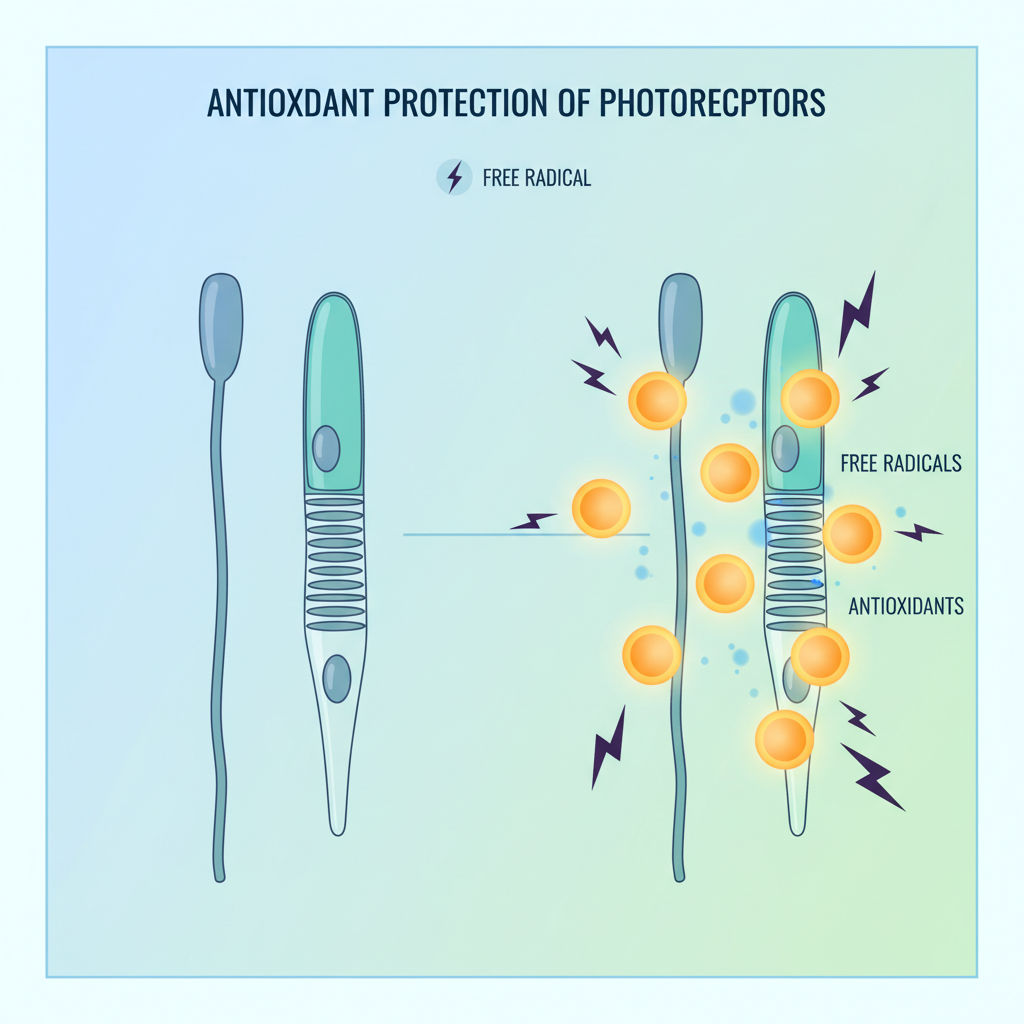
Neuroprotection of Photoreceptors: Your retina's photoreceptor cells (rods and cones) are metabolically active and highly susceptible to oxidative stress from light exposure. Research, including a 12-month study on its long-term effects, shows that saffron helps shield these delicate cells from damage. A study published in PMC (PMC6747458) found that saffron extract helps prevent the death of retinal ganglion cells under stress by modulating the inflammatory response at a cellular level.
-
Enhanced Retinal Function: Beyond just protection, saffron has been shown to actively improve the performance of the retina. A landmark human trial published in PMC (PMC3407634) on patients with early age-related macular degeneration (AMD) produced stunning results. After just 90 days of supplementation, participants demonstrated a significant improvement in retinal sensitivity. Incredibly, their average visual acuity improved by two lines on a Snellen eye chart (e.g., from 20/40 to 20/25). Another long-term study (PMC10941132) confirmed these functional gains, measuring an 8.7% increase in multifocal electroretinography (mfERG) response density, a direct measure of retinal function.
-
Reduced Inflammation and Improved Blood Flow: Chronic, low-grade inflammation is a key driver of many age-related diseases, including those affecting the eye. Saffron demonstrates powerful anti-inflammatory properties. In a study on uveitis, a severe inflammatory eye condition, saffron extract was found to be comparable to prednisolone (a steroid) in its ability to reduce inflammatory markers (PMC7281326). While not a direct treatment, this indicates its potential to calm the inflammatory processes that contribute to retinal aging.
Saffron vs. AREDS2: A Necessary Upgrade?
The Age-Related Eye Disease Study 2 (AREDS2) established a "gold standard" formula of vitamins C, E, lutein, zeaxanthin, and zinc for slowing the progression of intermediate-to-advanced AMD. This formula works primarily by providing antioxidant defense. However, research suggests saffron works through different and potentially complementary pathways.
A comparative review in PMC (PMC7059587) noted that while AREDS primarily helps slow the worsening of the condition, saffron has shown the ability to stabilize or even improve visual function in some patients. This suggests saffron's value extends beyond simple antioxidation, offering neuroprotective and anti-inflammatory benefits that the AREDS2 formula may not provide. It can be seen not as a replacement, but as a powerful ally, working alongside the foundational support of AREDS2 to offer a more comprehensive defense for the aging macula.
A Practical Guide to Saffron Supplementation
For seniors considering saffron, it's crucial to approach it as a clinical nutrient, not just a spice. Quality, dosage, and medical guidance are paramount.
-
Clinically-Studied Dosage: Most successful human trials have used a daily dose of 20mg to 30mg of a standardized saffron extract. A pilot study on glaucoma patients, for instance, used 30mg daily and observed a statistically significant drop in intraocular pressure of nearly 2.0 mmHg (p=0.013), a clinically meaningful reduction (PMC4213480).
-
The Importance of Standardization: As noted by practitioners, the consistency of saffron supplements can vary. For more reliable outcomes, look for products standardized to a minimum of 2% safranal, one of the key bioactive compounds. This ensures you are getting a therapeutic dose.
-
Set Realistic Expectations: Photoreceptor metabolism is a slow process. A common clinical heuristic is to recommend a 3-month trial period before assessing efficacy. Benefits, such as improved contrast sensitivity or reduced glare, are often gradual.
-
Safety First (A Critical Warning): Saffron may have mild antiplatelet (blood-thinning) effects. It is absolutely essential to consult your doctor before starting supplementation, especially if you are taking medications like warfarin or other anticoagulants. Professional monitoring is required to ensure safety.
Synergy with High-Performance Lenses
For users of high-index or progressive lenses, who are often more sensitive to visual disturbances, saffron's benefits can be particularly relevant. Many individuals with strong prescriptions report issues with nighttime glare and halos. While advanced lens coatings are the primary solution, supporting the underlying health of the retina can play a synergistic role. By enhancing the health and function of the retinal pigment epithelium, consistent nutritional support from saffron may help improve the eye's ability to process light, potentially leading to a subjective reduction in perceived glare and a more comfortable visual experience. This highlights a holistic approach where lens technology and targeted nutrition work together. If you've ever wondered will strong prescription lenses distort my eyes?, supporting the health of the retina itself is a key part of the answer.
A New Horizon for Macular Health
While saffron is not a cure for eye disease, the weight of scientific evidence positions it as one of the most promising and specific nutritional interventions for the aging eye to emerge in decades. Its demonstrated ability to protect photoreceptors, enhance retinal function, and improve visual acuity in clinical trials provides a new level of evidence-based hope.
For seniors, especially those managing the demands of high-prescription eyewear, saffron represents a proactive, science-backed strategy to support long-term macular health. As always, a conversation with your optometrist or ophthalmologist is the essential first step to determine if this powerful nutrient is a suitable addition to your vision care regimen.
This article is for informational purposes only and does not constitute professional medical advice. The information contained herein is not intended to diagnose, treat, cure, or prevent any disease. Always seek the advice of a qualified health provider with any questions you may have regarding a medical condition. Never disregard professional medical advice or delay in seeking it because of something you have read in this article.
References
- Falsini, B., et al. (2010). "Influence of Saffron Supplementation on Retinal Flicker Sensitivity in Early Age-Related Macular Degeneration." Investigative Ophthalmology & Visual Science, 51(12), 6759–6765. Available at: https://pmc.ncbi.nlm.nih.gov/articles/PMC3407634/
- Jabbarpoor Bonyadi, M. H., et al. (2014). "The Ocular Hypotensive Effect of Saffron Extract in Primary Open-Angle Glaucoma: A Pilot Study." BMC Complementary and Alternative Medicine, 14, 399. Available at: https://pmc.ncbi.nlm.nih.gov/articles/PMC4213480/
- López-García, J. S., et al. (2022). "Long-Term Effects of Saffron (Crocus sativus L.) on Retinal Function in Age-Related Macular Degeneration." Nutrients, 14(21), 4615. Available at: https://pmc.ncbi.nlm.nih.gov/articles/PMC10941132/
- Heitmar, R., et al. (2019). "Saffron (Crocus sativus L.) in Ocular Diseases: A Narrative Review of the Existing Evidence from Clinical Studies." Nutrients, 11(3), 649. Available at: https://pmc.ncbi.nlm.nih.gov/articles/PMC7059587/
- National Eye Institute. (2013). "AREDS2 Study Results." Available at: https://www.nei.nih.gov/eye-health-information/clinical-trials/age-related-eye-disease-studies-aredsareds2


