











Segment Height: Mapping the Sweet Spot for Multi-Focal Lenses
TL;DR: The Sweet Spot for Your Vision
- What It Is: Segment Height, or "Seg Height," is the vertical measurement in millimeters from the bottom of your lens to the starting point of the reading power in your bifocal or progressive glasses.
- Why It Matters: This measurement determines where the reading zone sits in your field of view. An error of just 2-3 millimeters can force you to constantly tilt your head up or down to find clear vision, leading to neck pain, headaches, and visual frustration.
- It's Personal: Seg Height is not part of your standard prescription from the doctor. It's a fitting measurement that is unique to you, the specific frame you choose, and how that frame sits on your face.
- The Fix: Understanding Seg Height empowers you to have better conversations with your optician and ensures your multi-focal glasses are a tool for comfort, not a source of strain.
Decoding Your Prescription: The Measurement That Isn't on the Slip
When you look at your prescription, you see a grid of numbers: Sphere (SPH), Cylinder (CYL), Axis, and ADD. These values define the optical power needed to correct your vision. But there’s a critical measurement that isn't on that slip, one that can make or break your experience with multi-focal lenses: the Segment Height.
Think of it this way: your prescription is the "what" (the power of the engine), but the Seg Height is the "where" (the precise placement of the steering wheel). Without correct placement, the engine's power is useless. This is especially true for bifocal and progressive lenses, which contain multiple vision zones in a single lens.
The Technical Definition of Seg Height
Segment Height is the vertical distance, measured in millimeters (mm), from the lowest point of the lens within your frame up to the center of your pupil.
- For Bifocal Lenses: The Seg Height determines the position of the visible line that separates the distance and reading portions of the lens.
- For Progressive Lenses: The Seg Height determines the starting point of the invisible "progressive corridor," the channel of clear vision that gradually shifts from your distance prescription at the top to your reading prescription at the bottom.

The High Cost of a Small Error: The 2mm Rule
In the world of optical fitting, precision is everything. A Seg Height measurement that is off by as little as 2-3mm can render an otherwise perfect prescription uncomfortable and difficult to use. This small error forces you to compensate by adopting an unnatural posture.
- Seg Height Too High: You have to tilt your chin down and look through the top of your lenses to see clearly in the distance.
- Seg Height Too Low: You have to lift your chin up to access the reading zone, leading to significant neck and shoulder strain.
This isn't just a matter of comfort; it's a physiological issue. Studies using electromyography (EMG) have shown that maintaining a "chin-up" posture to find the reading zone leads to significantly higher muscle activity and strain in the neck. The frustration and physical discomfort are primary reasons why some people struggle to adapt to new progressive lenses.
How Seg Height is Mapped for Your Lenses, Frames, and Life
The ideal Seg Height isn't a universal number; it’s a custom-fit parameter that depends on the type of lens you wear, the frame you choose, and your daily visual demands.
It's Not One-Size-Fits-All: Bifocals vs. Progressives
The target for the Seg Height measurement changes slightly depending on the lens technology.
For Bifocal Lenses: The Visible Line
With traditional bifocals, the goal is to place the top line of the reading segment right at the level of your lower eyelid. This creates a distinct, predictable boundary. When you look straight ahead, you’re using the distance portion. When you drop your eyes to read, they naturally pass into the near-vision segment.
For Progressive Lenses: The Invisible Corridor
Progressive lenses offer a seamless, no-line transition, but this requires a more precise measurement. The Seg Height is set to the dead center of your pupil. This ensures that when you look straight ahead, your eye is perfectly aligned with the clearest part of the distance zone. As your eye moves down, it enters the progressive corridor at the optimal point, allowing for a smooth transition through intermediate and near distances.
New wearers often notice some blur in their peripheral vision. This is a normal and unavoidable aspect of progressive lens design. As optical science confirms, you can move aberrations around the lens, but you can't eliminate them entirely—it's like pressing down on a waterbed. A correct Seg Height, however, ensures the "sweet spot" of the lens is perfectly aligned with your natural line of sight, making adaptation much easier. Many first-time users quickly learn to "point their nose" at what they want to see, a strategy that keeps their vision directed through the clearest part of the corridor.
The Frame Factor: How Your Choice of Glasses Changes Everything
The shape and fit of your frames are arguably the biggest variables in determining Seg Height.

Deep vs. Shallow Frames
The vertical depth of your frame dictates the length of your progressive corridor.
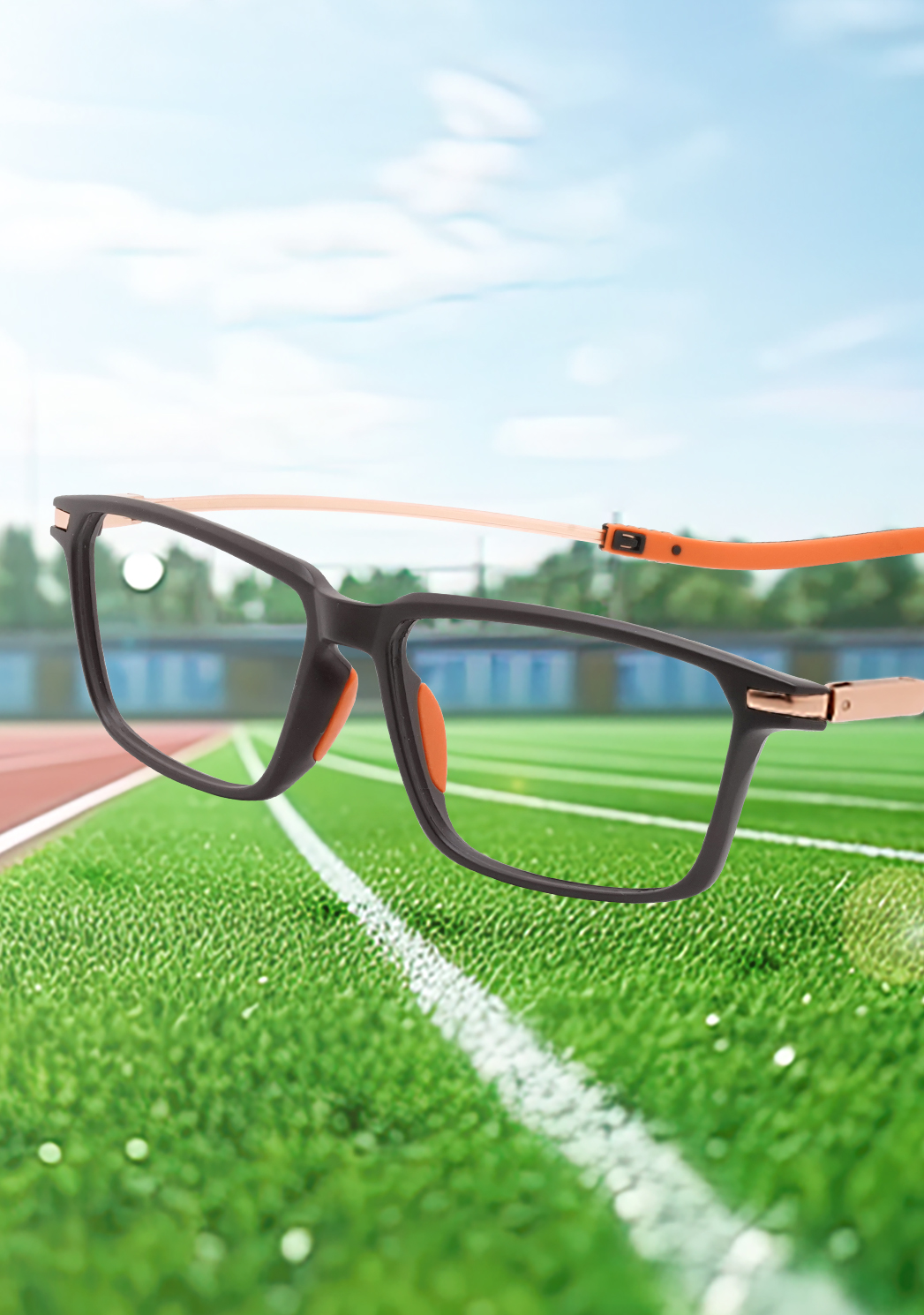
- Deep, Rectangular Frames: A taller lens provides more real estate for a longer, more gradual progressive corridor. This often creates a wider field of view for reading and intermediate tasks. An optician may even set the seg height 1-2mm higher than the pupil to give you a more generous reading zone without compromising distance vision.
- Shallow, Narrow Frames: A shorter lens requires a "short corridor" progressive design, which compresses the power transition into a smaller space. This can make the reading and intermediate zones feel narrower and the peripheral distortion more pronounced. In these frames, there is virtually no room for measurement error.
The Low Bridge Fit
Facial anatomy plays a crucial role. Research on facial anthropometry shows that individuals with a lower or wider nose bridge often require frames with specific adjustments, such as taller nose pads or a different pantoscopic tilt (the angle of the lens to the face). These adjustments are critical for positioning the lens corridor correctly in front of the eye. Without them, the Seg Height could be misaligned, even if measured accurately to the pupil.
The Lifestyle Factor: Optimizing for Your Daily Tasks
A skilled optician will also consider your primary activities when determining the perfect Seg Height.
The Desk Jockey: Optimizing for Intermediate Vision
If you spend more than four hours a day working on a computer, you are a heavy user of your intermediate vision. Studies have found that over 74% of VDT (Video Display Terminal) workers who wear general-purpose progressives suffer from Computer Vision Syndrome (CVS). This is because a standard progressive lens prioritizes distance and near vision, leaving only a small sliver for the computer screen distance.
For these users, a pair of "office" or "computer" progressive lenses may be a better solution. These task-specific lenses are designed with a much wider intermediate zone and may be fitted with a slightly different Seg Height to prioritize screen-level viewing, dramatically reducing neck strain.
The Driver or Outdoor Enthusiast: Prioritizing Distance Vision
Conversely, if your daily life involves lots of driving, sports, or outdoor activities, your priority is a wide, unobstructed distance view. For you, the Seg Height might be set right at the pupil or even a millimeter lower. This maximizes your distance vision and minimizes any interference from the reading power at the bottom of the lens.
This is also a critical safety consideration for older adults. Studies have shown that multi-focal wearers can have a higher risk of falls, partly due to the blur in the lower portion of the lens obscuring steps and curbs. Prioritizing distance clarity for outdoor and mobility-focused activities is essential.
How to Get an Accurate Segment Height Measurement
Given its importance, how do you ensure your Seg Height is measured correctly?
The Gold Standard: Professional In-Person Measurement
The most reliable way to measure Seg Height is to have it done by a qualified optician with the actual frames you will be wearing.
The process is simple but precise:
- Frame Fitting: You put on your chosen frames, and the optician adjusts them so they sit on your face exactly as you will wear them.
- Eye-Level Alignment: You stand or sit naturally, looking straight ahead at the optician's eyes, who is at the same height as you. This is crucial to avoid parallax error.
- Pupil Marking: The optician uses a special felt-tipped pen and a pupillometer ruler to place a tiny dot on the demo lenses of the frame, directly over the center of each of your pupils.
- Measurement: They then remove the frames and use a millimeter ruler to measure the distance from each dot to the bottom of the lens.
A common mistake is measuring from the lowest tip of a stylized frame instead of from the horizontal "datum line" of the lens. A professional knows how to find the correct reference point to ensure the measurement is vertically true.
Can You Measure Seg Height at Home? A Word of Caution
With the rise of online eyewear retailers, many people wonder if they can measure their own Seg Height. While it is technically possible, it should be approached with extreme caution, especially for first-time progressive wearers. A small mistake can lead to a pair of glasses that is difficult or impossible to wear.
If you must take a self-measurement, treat it as a double-check and follow these steps as precisely as possible:
- Put on the exact frames you plan to order. Adjust them to a comfortable, final resting position.
- Stand approximately 8-12 inches away from a mirror.
- It is best to have a friend help you. They should sit directly in front of you so their eyes are at the same level as yours.
- Stare straight ahead into the distance (or at your friend's nose). Do not look down at your eyes or at the marker.
- Your friend should use a non-permanent, fine-tipped marker to place a small dot on the outside of each lens, directly in front of the center of your pupil.
- Carefully remove the glasses without smudging the dots.
- Using a ruler with millimeter markings, measure the distance from the center of the dot to the bottom edge of the lens (the visible part inside the frame). This is your Seg Height for that lens. Measure both eyes, as they may differ slightly.
Your Key to Multi-Focal Success
The numbers on your prescription are only half the story. Segment Height is the crucial, personalized measurement that unlocks the full potential of your bifocal or progressive lenses. It is the bridge between the science of optics and the reality of your daily life.
By understanding what Seg Height is and why it matters, you can avoid the common pitfalls of multi-focal wear. You can ask smarter questions, make more informed choices about frames, and work with your optician to map a pair of glasses that delivers truly effortless and comfortable vision at every distance.
Frequently Asked Questions (FAQ)
Q1: Why does my neck hurt with my new progressive lenses? A: This is a common sign of an incorrect Seg Height. If the measurement is too low, you're likely tilting your chin up to find the reading zone. If it's too high, you're tilting your chin down to see in the distance. Both postures cause significant neck and shoulder strain.
Q2: Is Seg Height the same as Pupillary Distance (PD)? A: No. Pupillary Distance (PD) is the horizontal distance between your pupils and ensures the optical center of the lens is aligned side-to-side. Seg Height is the vertical measurement that aligns the reading power up-and-down. Both are essential for crafting custom multi-focal lenses.
Q3: Does my Seg Height change when I get new glasses? A: Yes, almost always. Seg Height is completely dependent on the frame you choose. A deeper frame, a shallower frame, or one that simply sits higher or lower on your nose bridge will all result in a different Seg Height measurement. It must be re-measured for every new pair of glasses.
Q4: I have to lift my glasses up to read. What's wrong? A: This is a classic symptom of a Seg Height that was measured too low. The reading portion of the lens is positioned too far down in the frame, forcing you to manually lift the entire lens to bring it into your line of sight.
Q5: What is the "datum line" and why is it important? A: The datum line is the horizontal line that runs exactly through the geometric center of the lens, halfway between the highest and lowest vertical points. For accurate optical fitting, measurements should be taken in reference to this line, not just the bottom edge of a frame, which can be angled or curved and give a false reading.
Disclaimer: This article is for informational purposes only and does not constitute medical advice. Please consult with a qualified optometrist or certified optician for a comprehensive eye exam and professional fitting services.


