





Signs Your Sunglasses' UV Defense Is Fading Away
TL;DR: Is It Time for a New Pair?
Your sunglasses' UV protection isn't foolproof and weakens over time. The most obvious warning signs are visible scratches, peeling coatings, or lens discoloration. Less obviously, the UV-blocking capability degrades with age and exposure, a process called photobleaching. As a general guideline, if you use your sunglasses heavily, consider replacing them every two years. The only way to be certain of their effectiveness is to have them tested by an optician with a UV photometer.
The Invisible Shield: Understanding How UV Protection Works
To know when your sunglasses are failing, it first helps to understand how they protect you. Quality sunglasses serve as a shield against ultraviolet (UV) radiation, a component of sunlight that is invisible to the naked eye but can cause significant damage to your eyes. This damage is cumulative and linked to conditions like cataracts, pterygium ("surfer's eye"), and even cancers of the eyelid.
The Gold Standard: What "UV400" Really Means
When you see a "UV400" or "100% UV Protection" label, it signifies that the lenses are designed to block nearly all light rays with wavelengths up to 400 nanometers. This covers the entire spectrum of UVA and UVB rays. As a technical report on solar UV protection standards highlights, the 380–400 nm band contains significant energy, making the UV400 standard a medical necessity, not just a marketing term. Lenses that only meet older standards (blocking up to 380 nm) can leave your eyes exposed to 45% more UV energy.
Myth Debunked: Lens Darkness Is Not UV Protection
A pervasive and dangerous myth is that darker lenses offer better UV protection. This is incorrect. The darkness of the tint only reduces the amount of visible light that passes through, making your eyes more comfortable in bright conditions. It has no bearing on UV protection. In fact, wearing dark lenses without certified UV blocking can be more harmful than wearing no sunglasses at all. As experts at the MD Anderson Cancer Center warn, the dark tint causes your pupils to dilate, opening them up to allow even more damaging UV radiation to enter the eye. True protection comes from a chemical coating or inherent properties of the lens material itself. For more on this, see our guide on dark tints vs. UV coatings.
Embedded vs. Coated Protection
UV protection is applied in one of two ways: it can be a coating applied to the lens surface, or it can be built directly into the lens material. Modern polycarbonate and Trivex lenses—the standard for most quality eyewear—have UV protection embedded within the material. This is a significant advantage because the protection cannot scratch off or wear away. According to health experts at the University of Utah, this embedded protection is far more durable. Cheaper plastic lenses, however, often rely on a thin surface coating that is vulnerable to damage.
Physical Signs of a Failing UV Defense
While the UV shield itself is invisible, its decay often leaves physical clues. Regular inspection is key to spotting trouble before it leads to eye damage. Here is a checklist for what to look for.
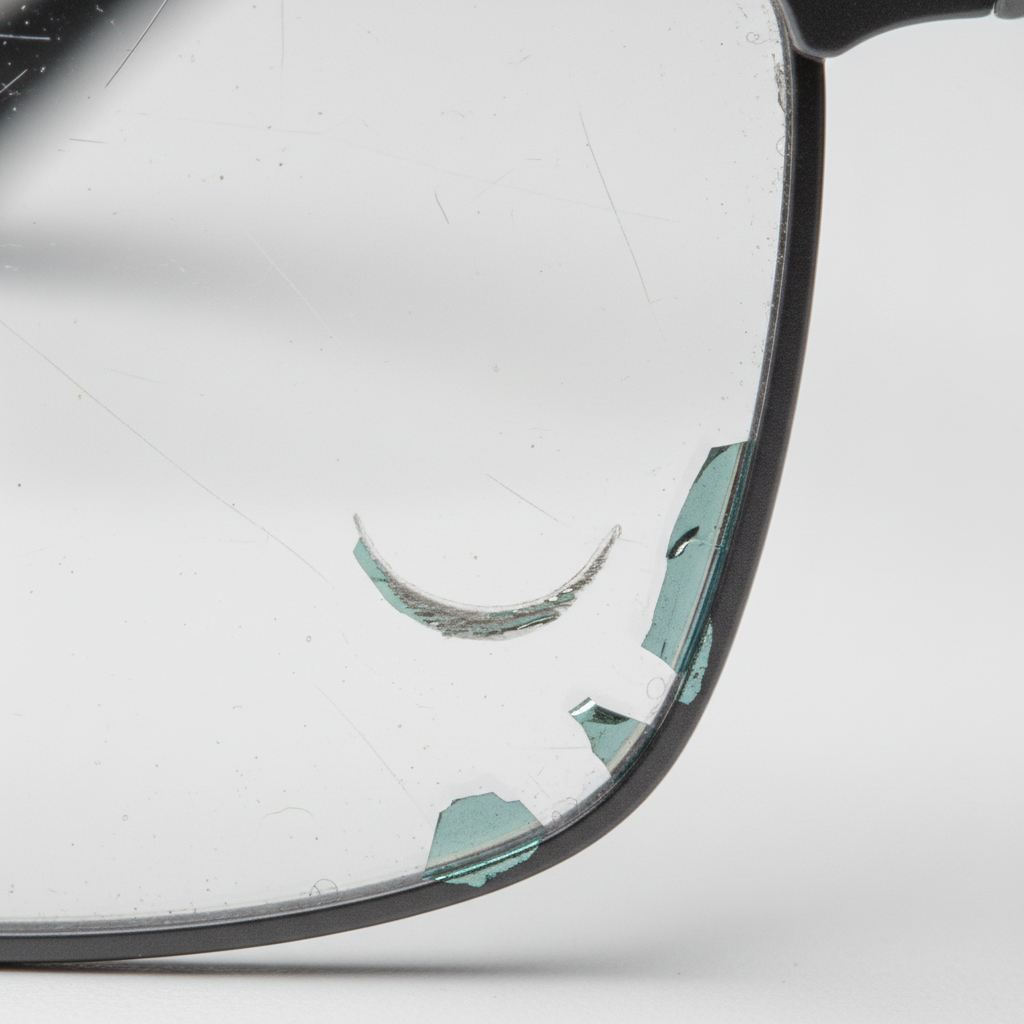
Damage Inspection Checklist
| Defect | What It Looks Like | Why It Matters |
|---|---|---|
| Deep Scratches | Visible lines, grooves, or scuffs, especially in your direct line of sight. | Scratches on a coated lens can physically remove the UV-protective layer, creating "micro-channels" that allow UV radiation to pass through directly to your eye. |
| Coating Delamination | Flaking, bubbling, or a "peeling" look, often starting at the edges of the lens. | This is a critical failure. It indicates the UV coating (and other coatings like anti-reflective or mirror finishes) is separating from the lens, rendering it ineffective. |
| Discoloration | A yellowish or cloudy tint that wasn't there originally. | This suggests the lens material itself is breaking down due to long-term UV exposure and heat. This not only compromises structural integrity but can also affect the efficacy of embedded UV blockers. |
| Warping or Distortion | Straight lines (like floor tiles) appear wavy or bent when looking through the lenses. | This indicates poor optical quality, which can be inherent or a result of heat damage. It causes eye strain and headaches and suggests the lens is not stable. |
Expert Warning: The Danger of Scratches
A common mistake is to ignore minor scratches. While a small scuff outside your field of vision might not seem like a big deal, on a coated lens, it represents a breach in your eye protection. Lab technicians know that these scratches create unpredictable pathways for UV light to scatter and penetrate the lens. It's not just about clear vision; it's a direct failure of the protective shield.
Invisible Degradation: When Age Is the Only Symptom
Perhaps the most deceptive issue is that sunglasses can lose their UV-blocking ability without any visible signs of wear. The chemical compounds responsible for absorbing UV radiation can break down over time due to constant exposure.
This process, known as photobleaching, was demonstrated in a study on UV protection standards, which found that some lenses could lose their protective efficacy after just 50 hours of intense simulator exposure. While this is an accelerated test, it proves that the protective chemistry has a finite lifespan.
As a practical rule of thumb based on material science, I recommend replacing your sunglasses every two years if you are an everyday wearer or spend significant time outdoors. For occasional wearers, the lifespan can be longer, but you should still inspect them regularly for the physical signs mentioned above. This is a key reason why it pays to understand if affordable sunglasses can still offer full UV safety; durability is a major factor.
How to Maximize the Lifespan of Your Sunglasses
Proper care is the single most effective way to preserve the integrity of your sunglasses' UV protection for as long as possible. Heat and improper cleaning are the primary culprits in accelerating the degradation of lens coatings.

Step-by-Step Cleaning Guide
- Rinse First: Run your sunglasses under lukewarm water to wash away any dust or grit that could scratch the lenses.
- Use Mild Soap: Apply a small drop of lotion-free dish soap to each lens.
- Lather Gently: Using your fingers, gently rub the soap over the entire surface of the lenses, the frame, and the nose pads.
- Rinse Thoroughly: Rinse all the soap away. Any residue can cause streaks.
- Dry with Microfiber: Gently dry your glasses with a clean, soft microfiber cloth. Never use paper towels, napkins, or the corner of your shirt, as their wood fibers are abrasive and will damage lens coatings.
Storage Best Practices
- Avoid the Dashboard: Never leave your sunglasses on the dashboard of your car. The intense heat, which can easily exceed 60°C (140°F), will warp plastic frames and accelerate the delamination and breakdown of lens coatings.
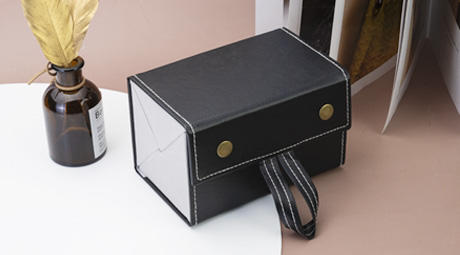
- Use a Hard Case: When you’re not wearing them, store your sunglasses in a protective hard case. This prevents them from being crushed or scratched in a bag or pocket.
When to See a Professional: The Definitive Test
While visual inspection is a good first step, the only way to be 100% certain of your sunglasses' UV protection level is to have them professionally tested. Most optical shops have a device called a UV transmissometer or spectrophotometer that can measure the exact percentage of UV light passing through a lens.
As the University of Utah Health advises, this test is quick, and many opticians will perform it for free. If you have an old favorite pair or are unsure about a recent purchase, this simple test provides immediate peace of mind. If a lens shows more than 1-2% UV transmission, it has failed the test and should be replaced immediately to avoid the risks of hidden eye damage from uncertified sunglasses.
Key Takeaways
Protecting your vision from UV damage is a lifelong endeavor, and your sunglasses are your primary line of defense. Remember that this defense can weaken.
- Inspect Regularly: Check for deep scratches and any signs of peeling or flaking coatings. Use the tile floor test to check for optical distortion.
- Respect Their Age: Understand that UV protection fades with exposure. Plan on replacing heavily used pairs every two years.
- Care Properly: Clean your lenses with mild soap and a microfiber cloth, and always store them in a case away from high heat.
- When in Doubt, Test It Out: For ultimate certainty, visit an optical shop for a free UV transmission test. It’s the best way to verify if your sunglasses are UV-protected.
Your eyes are irreplaceable. Taking a moment to check the condition of your sunglasses is a small investment that pays huge dividends for your long-term vision health.
Frequently Asked Questions (FAQ)
1. Can a UV coating be reapplied or repaired? No, once a UV coating is scratched or starts to delaminate, it cannot be effectively repaired. The lens itself must be replaced.
2. Do polarized lenses automatically have UV400 protection? Not necessarily. Polarization and UV protection are two separate technologies. Polarization is a filter that reduces glare from horizontal surfaces like water and roads. While most quality polarized sunglasses also include UV protection, the presence of one does not guarantee the other. Always look for the UV400 or "100% UV Protection" label specifically.
3. Is it worth investing in sunglasses with embedded UV protection? Absolutely. Lenses made from materials like polycarbonate or Trivex, which have UV protection inherent to the material, are far more durable. The protection won't scratch off, making them a superior choice for long-term eye safety, especially for children or those with active lifestyles.
Disclaimer: This article is for informational purposes only and does not constitute professional medical advice. Always consult with a qualified eye care professional for any concerns about your vision or eye health. Regular eye exams are crucial for detecting and addressing potential issues early.
References
- Masili, M., & Schor, R. (2014). "Study of the ultraviolet protection of sunglasses sold in the city of Sao Carlos, Brazil." Proceedings of SPIE, 8930. https://ui.adsabs.harvard.edu/abs/2014SPIE.8930E..1EM/abstract
- MD Anderson Cancer Center. (2023). "9 things to know about sunglasses, eye protection and cancer." https://www.mdanderson.org/cancerwise/9-things-to-know-about-sunglasses--eye-protection-and-cancer.h00-159699123.html
- University of Utah Health. (2023). "How to Tell if Your Sunglasses Are Really Protecting Your Eyes." https://healthcare.utah.edu/healthfeed/2023/06/how-tell-if-your-sunglasses-are-really-protecting-your-eyes
- American Academy of Ophthalmology. (2023). "How to Choose the Best Sunglasses." https://www.aao.org/eye-health/glasses-contacts/sunglasses-3


