







Solving Headaches from Tight Sports Sunglasses
TL;DR: Your Quick Fix Guide
- Headache Cause: The most common cause of sunglass-related headaches is frames that are 2–6 mm too narrow for your head, creating constant pressure on your temples.
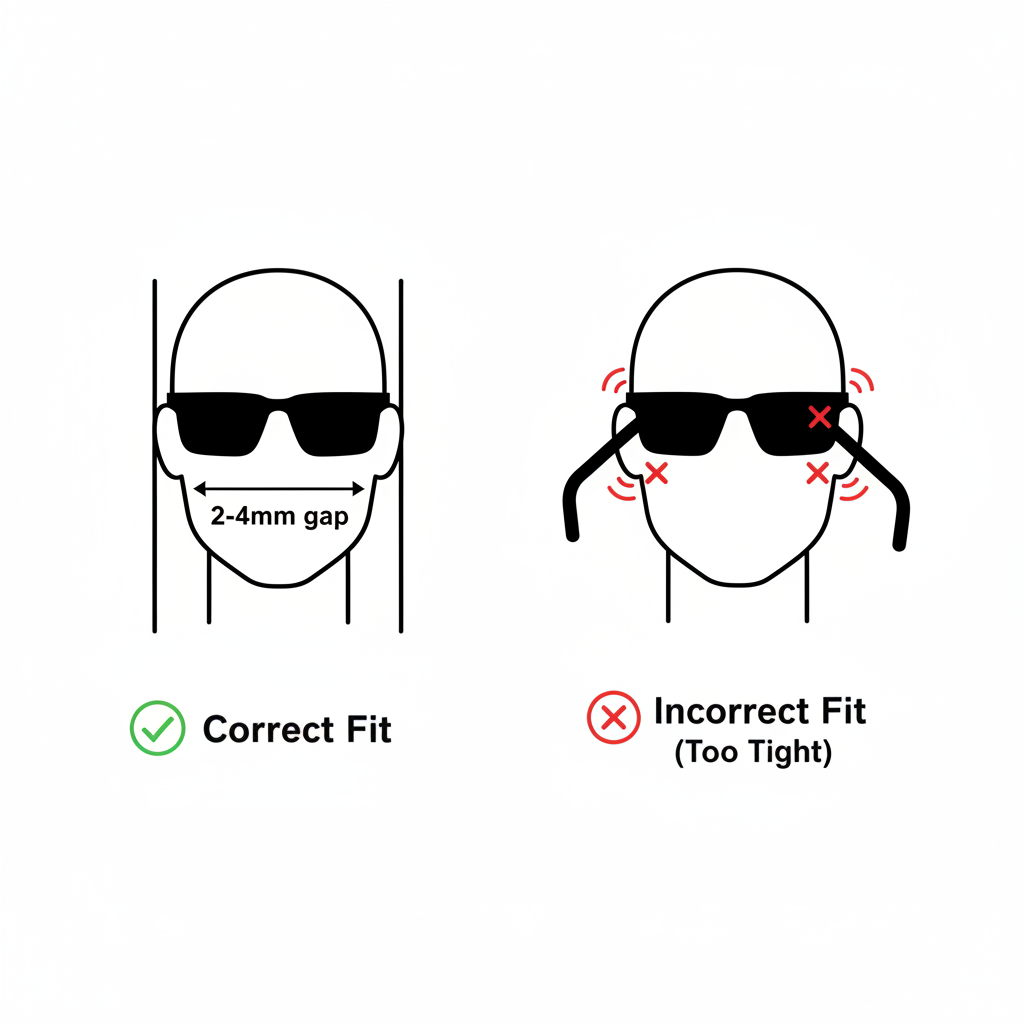
- The Temple Fit Test: Your frame arms should run parallel to your head with a 2–4 mm gap, touching lightly without pinching. If they splay outwards, the frame is too small.
- The Nose Pad Check: After 15 minutes of wear, you should see only faint, even marks on your nose. Deep red grooves mean the nose pads are too narrow or poorly positioned, concentrating all the weight in one spot.
- The Right Features: Look for frames with adjustable nose pads, flexible temple arms, and anti-slip materials (like TPE), which can reduce the need for painful tightness by 30–50%.
- Safe Adjustments Only: Minor adjustments to temple flare on wrap-style frames are sometimes possible with gentle heat. Never bend frames at the hinge or attempt adjustments that could compromise their structural integrity.
Nothing ruins a good run, ride, or day on the water faster than a nagging headache. You invested in high-performance sports sunglasses to protect your eyes and improve your vision, but now the very equipment meant to help is causing pain. If you're constantly feeling pressure points above your ears, on the bridge of your nose, or at your temples, you're facing a problem I see all the time: your sunglasses don't fit correctly.
A common myth is that sports eyewear needs to be clamped to your head to stay put. In reality, a secure fit comes from smart design and precise ergonomics, not brute force. An ill-fitting frame doesn't just cause discomfort; it can compromise your safety and performance. This guide will walk you through the same diagnostic checks and solutions I use to achieve a perfect, pain-free fit.
Why Your "Performance" Sunglasses Are Causing Pain
Understanding the source of the pressure is the first step to fixing it. Headaches from eyewear are typically a form of compression headache, caused by sustained external pressure on the scalp or forehead. Let's break down the primary culprits.
Pressure Point 1: The Temples
This is the number one cause. When a frame is too narrow for your intertemporal width (the distance between your temples), the arms splay outward and dig into the sides of your head. Even slight pressure on the temporal artery, which runs along this area, can trigger a tension headache over time.
In my experience, a frame that is just 2–6 millimeters too narrow is enough to cause significant discomfort. The goal isn't to have the arms hover far away from your head, but to have them make light, even contact without applying inward force.
Pressure Point 2: The Nose Bridge
The entire weight of your sunglasses rests on two small points on either side of your nose. If the nose pads are too narrow, too hard, or angled incorrectly, they create concentrated pressure spots. After wearing your glasses, you can diagnose this easily. Take them off and look in the mirror.
- A Good Fit: You see faint, slightly pink, symmetrical marks that disappear within a few minutes. This shows the weight is distributed evenly.
- A Bad Fit: You see deep, red grooves or indentations. This indicates excessive localized pressure that can lead to soreness, sinus pain, and headaches.
Pressure Point 3: Behind the Ears & Strap Tension
Less common but still a factor is pressure from temple arms that are too short or curve too aggressively behind the ear. For wraparound styles or goggles with a retaining strap, the "one-finger test" is a reliable guide. You should be able to comfortably slip one finger between the strap and the back of your head. If you can't, the strap is too tight, creating a band of pressure that can easily lead to a headache.
The Expert's Checklist for a Perfect, Pain-Free Fit
Follow these steps to diagnose exactly what is wrong with your current frames or to assess a new pair before you buy.
1. The Temple Width Test
Put the sunglasses on and look in a mirror. The arms of the frame should run straight back, parallel to the sides of your head. There should be a tiny gap, about 2–4 mm, between the arm and your temple. If the arms are visibly bending outward to accommodate your head, the frame is too narrow.
Pro Tip: High-quality sports frames often use anti-slip TPE (thermoplastic elastomer) pads on the temple arms. In practice, these materials can reduce the required mechanical tightness by 30–50% because the grip prevents slipping, meaning the frame can be worn looser without sacrificing stability.
2. The 15-Minute Nose Pad Assessment
Wear the glasses for 10–15 minutes. Remove them and examine the marks on your nose. If you see the deep red grooves mentioned earlier, the nose bridge is a problem. Look for frames with adjustable nose pads that can be widened or narrowed to match your specific anatomy. This is one of the most critical features for all-day comfort.

3. The Temple Arm Curve Check
The curve of the arm should begin just past the top of your ear and follow the natural contour of your head. It should rest lightly, not dig into the bone behind your ear. If the arms are too short and start curving on top of your ear, the frame is the wrong size.
Expert Adjustments and What to Avoid
While some minor tweaks are possible, it's crucial to know the limits. Over-adjusting a frame can weaken it or void the warranty. According to a review in the Journal of Athletic Training, sports injuries account for up to 20% of all serious ocular injuries, making frame integrity a critical safety issue.
Safe Adjustments vs. Damaging Mistakes
| Do: Safe & Effective Tweaks | Don't: Actions That Cause Damage |
|---|---|
| Gently heat-bend the temple arms on wrap-style frames in 3–5° increments to relieve pressure. | Never bend a frame at the hinge; this can weaken the metal and damage the finish. |
| Swap out nose pads for a different size, ensuring they match the pad post geometry. | Never drill into a frame or lens, as this creates a critical weak point. |
| Tighten screws to fingertip torque plus a final 1/8 turn. | Do not heat polycarbonate lenses while they are in the frame; this can ruin the lens. |
| Use a retaining strap and apply the "one-finger test" for tension. | Avoid overtightening screws, which can strip the threads or crack the frame. |
Expert Warning: Any adjustment that alters the fundamental shape or integrity of the frame, especially for high-impact rated eyewear, should be performed by a qualified optician. As guidance from the Texas Department of Insurance (TDI) clarifies, there is a significant difference between "dress eyewear" and ANSI Z87.1-rated "safety eyewear." The latter is designed to withstand impact, and improper modifications can cause it to fail.
Choosing Frames Designed for Comfort
When shopping for your next pair, prioritize features that promote a custom fit:
- Adjustable Components: Look for adjustable wire-core temple tips and multi-position nose pads.
- Lightweight Materials: Modern materials like Trivex or proprietary polymers reduce the overall weight resting on your nose and ears.
- Smart Geometry: For high-wrap frames, look for designs that incorporate a subtle 8–15° of temple flare. This angle allows the frame front to curve for maximum eye coverage without requiring the arms to pinch your head. Research using 3D head-forms published in Photochemical & Photobiological Sciences shows that frame geometry is critical for preventing peripheral light leakage, and a comfortable fit ensures the frame is worn correctly to achieve that protection.
- Lens Quality: While not a fit issue, poor optical quality with distortions can cause eye strain and headaches. If your frames seem to fit well but you still experience discomfort, the lenses might be the issue. You can learn more about how to minimize distortion in prescription sunglasses.
Wrapping Up: From Painful to Performance-Ready
Your sports sunglasses should be a tool that enhances your focus, not a source of distraction and pain. By moving past the "tighter is better" myth and adopting a more precise approach to fit, you can eliminate compression headaches for good.
Remember the key checkpoints: ensure the frame is wide enough for your temples, distributes weight evenly on your nose, and uses gentle tension, not force, to stay in place. Armed with this knowledge, you can confidently select and adjust your eyewear to feel like it’s barely there, allowing you to focus on your performance.
Frequently Asked Questions (FAQ)
Q: Can I stretch my plastic sunglasses if they are too tight? A: Forcing plastic frames can create weak spots or cause them to snap. An optician can sometimes use a professional frame warmer to make minor, safe adjustments. Attempting this at home with a hairdryer can easily damage the frame material and lens coatings.
Q: Do more expensive sunglasses have a better fit? A: Not always, as fit is highly personal. However, premium sports sunglasses often invest more in adjustable features, advanced lightweight materials, and more sophisticated ergonomic designs, which significantly increases the probability of achieving a perfect fit.
Q: My headaches only start after an hour of wear. Is it still a fit issue? A: Yes. This is a classic sign of a compression headache. A minor pressure point that is barely noticeable at first can build into significant pain over time as blood flow is restricted. If this is happening, re-run the temple width and nose pad checks immediately.
Q: What is the main difference between sports sunglasses and regular fashion sunglasses? A: The primary differences are impact resistance and stability. True sports eyewear is typically rated to ANSI Z87.1 or similar standards for impact protection, a crucial safety feature. They also incorporate design elements like rubberized contact points, deeper lens grooves, and wraparound shapes to ensure they stay in place during intense activity.
Disclaimer: This article is for informational purposes only and does not constitute professional medical advice. If you experience persistent or severe headaches, consult a qualified medical professional to rule out other underlying conditions. Always consult an optician for major frame adjustments.
References
- Asgari, S., & Asgari, S. (2016). A Review on Sports Related Eye Injuries. Journal of athletic training, 51(5), 427–433.
- Texas Department of Insurance. (n.d.). Sunglasses in the Workplace. Retrieved from https://www.tdi.texas.gov/pubs/videoresource/fssunglasses.pdf
- Alfadhel, M., O'Hagan, J., & Khazova, M. (2019). Ocular UV dosimetry on a head-form. Photochemical & photobiological sciences, 18(10), 2576–2584. https://doi.org/10.1039/c9pp00139e


