




How to Spot Fake Designer Sunglasses: 5 Red Flags to Watch For
The Ultimate Checklist for Authenticating Designer Sunglasses
The allure of designer sunglasses is undeniable, but the market is saturated with convincing counterfeits. These fakes not only cheat you out of your money but can also pose a serious risk to your eye health. Knowing how to distinguish a genuine pair from a forgery is an essential skill for any savvy shopper.
This guide moves beyond the obvious and teaches you to inspect the subtle-yet-critical details that counterfeiters almost always get wrong. By focusing on craftsmanship and material quality, you can develop the expert eye needed to invest in authentic, protective eyewear confidently.
TL;DR: 5 Red Flags of Fake Sunglasses
- Gritty or Loose Hinges: Authentic hinges feel solid, smooth, and often have a weighted tension. Fakes use cheap pin hinges that feel flimsy, squeak, or show glue.
- Sloppy Interior Markings: Genuine brands use clean, sharp engravings for model numbers and sizing inside the temple arms. Fakes have fuzzy, burned-looking laser etching or peel-off stickers.
- Imperfect Logos & Branding: Check for misspellings, incorrect fonts, or slightly off-kilter logo placement on the frame and lenses. These are tell-tale signs of a counterfeit.
- Failing the UV Blacklight Test: Genuine UV400 lenses will appear uniformly dark and opaque under a blacklight. Fakes often let light through, revealing inconsistent or non-existent UV protection.
- Distorted Lens Clarity: When looking at a straight-line pattern (like floor tiles), authentic lenses will show no warping or distortion. Fakes often use low-quality plastic that warps your vision.
Red Flag #1: The Hinge and Overall Craftsmanship
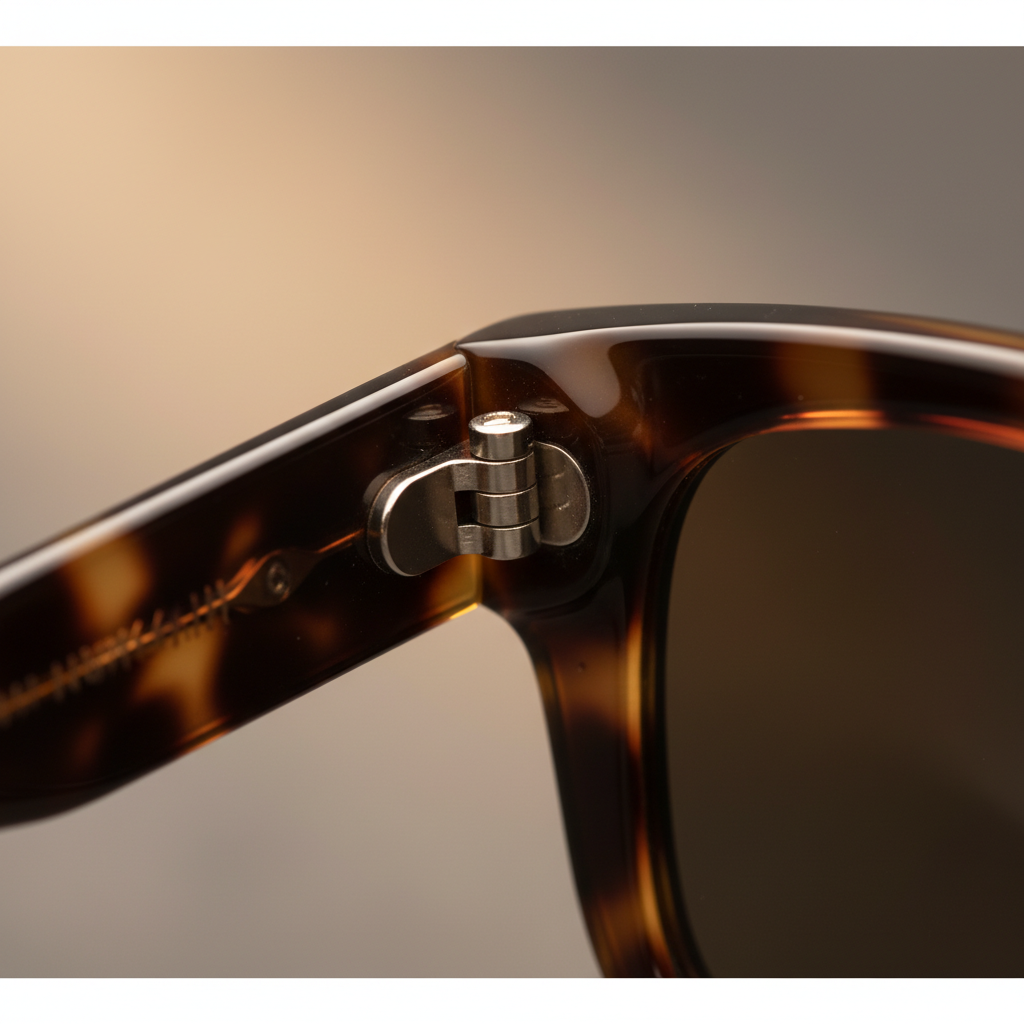
Forget the logo for a moment. The first place a seasoned expert looks is the hinge. This tiny mechanical component is a major indicator of cost-cutting and is where most fakes immediately fail.
Open and close the temple arms (the "legs" of the sunglasses). A genuine pair from a reputable brand will have a hinge that operates with a smooth, satisfying resistance. It feels engineered. You might feel the tension of a small spring or the fluid motion of a friction-fit mechanism. There is a certain "weighted" quality to the movement—it doesn’t flop around, nor does it feel stiff or gritty.
On our repair bench, we consistently see fakes with cheap, simple pin hinges. They often feel loose, rattle, or even squeak. You might see visible glue residue or tooling marks around the hinge area. In contrast, authentic hinges are cleanly integrated into the frame material, be it acetate or metal.
The Feel Test: Don’t just look at the glasses; handle them. The overall weight, balance, and finish are key. Authentic acetate is polished to a deep luster, while fake plastic often feels light, cheap, and may have rough seams from the molding process.
Red Flag #2: The Fine Print on the Frame
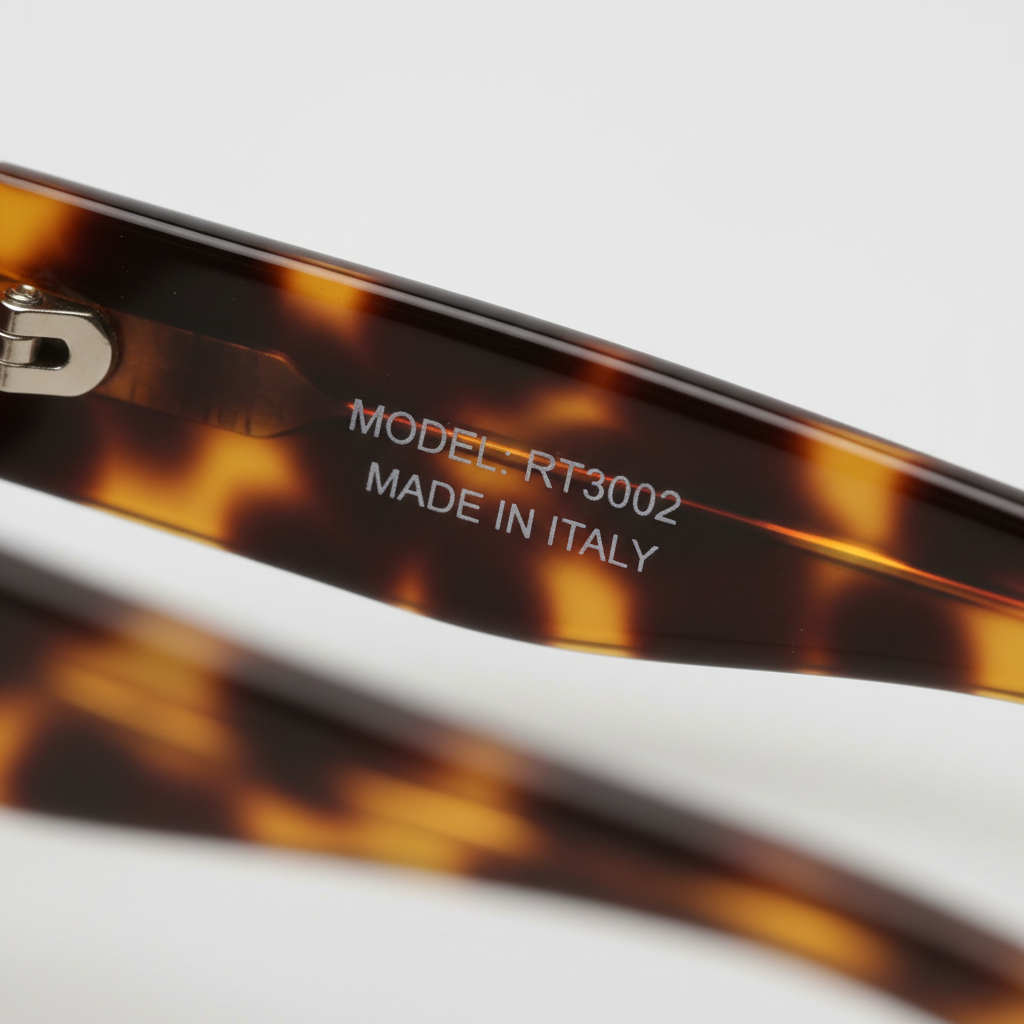
Next, examine the interior of the temple arms. Here, authentic brands consistently provide information like the model number, color code, frame dimensions, and country of origin. The key is not just that the information is there, but how it’s applied.
On a genuine pair, this text is typically engraved or etched with extreme precision. The lines are sharp, the font is consistent with the brand’s identity, and the lettering is perfectly clean. It looks like it belongs.
Counterfeiters, on the other hand, often use cheap laser etching that looks "burned" into the plastic. The text may appear fuzzy, slightly blurry, or have a brownish tint around the edges. In the worst cases, this information is printed on a cheap sticker that can be peeled off with a fingernail—an immediate deal-breaker.
What to look for:
- Crispness: Are the letters and numbers perfectly sharp?
- Consistency: Does the font match the brand’s official logo and marketing materials?
- Permanence: Is it cleanly engraved into the frame, or is it a sticker or cheap surface print?
Red Flag #3: Logo and Branding Details
While the hinge and engravings are more reliable indicators, you should still scrutinize the logos and branding. Counterfeiters have gotten better at replicating logos, but errors are still common. Hold the sunglasses up and carefully inspect any branding on the outer temples and the lens itself.
Look for the slightest imperfection. Common mistakes include:
- Misspellings or incorrect font usage.
- Logo placement that is slightly off-center or crooked.
- A logo that is a sticker instead of being inlaid or etched.
- An etched logo on the lens that looks cloudy or is easily scratched off.
Pay attention to the packaging as well. The box, carrying case, and cleaning cloth should all feature the same high-quality branding. Typos on the box or a flimsy, cheap-feeling case are major red flags.
Red Flag #4: UV Protection That Isn't Protective
The single most important function of sunglasses is to protect your eyes from harmful ultraviolet (UV) radiation. This is a matter of health and safety, not just style. Reputable manufacturers adhere to strict standards, ensuring their lenses block harmful rays. According to the U.S. Food and Drug Administration (FDA), all sunglasses sold in the United States must meet specific impact resistance standards, and proper UV protection labeling is crucial.
Unfortunately, many fakes that claim "100% UV protection" offer virtually none. As a study highlighted by the MD Anderson Cancer Center warns, wearing dark lenses without proper UV blocking is actually more dangerous than wearing no sunglasses at all. The dark tint causes your pupils to dilate, allowing even more damaging UV radiation to enter your eye.
The Blacklight Test:
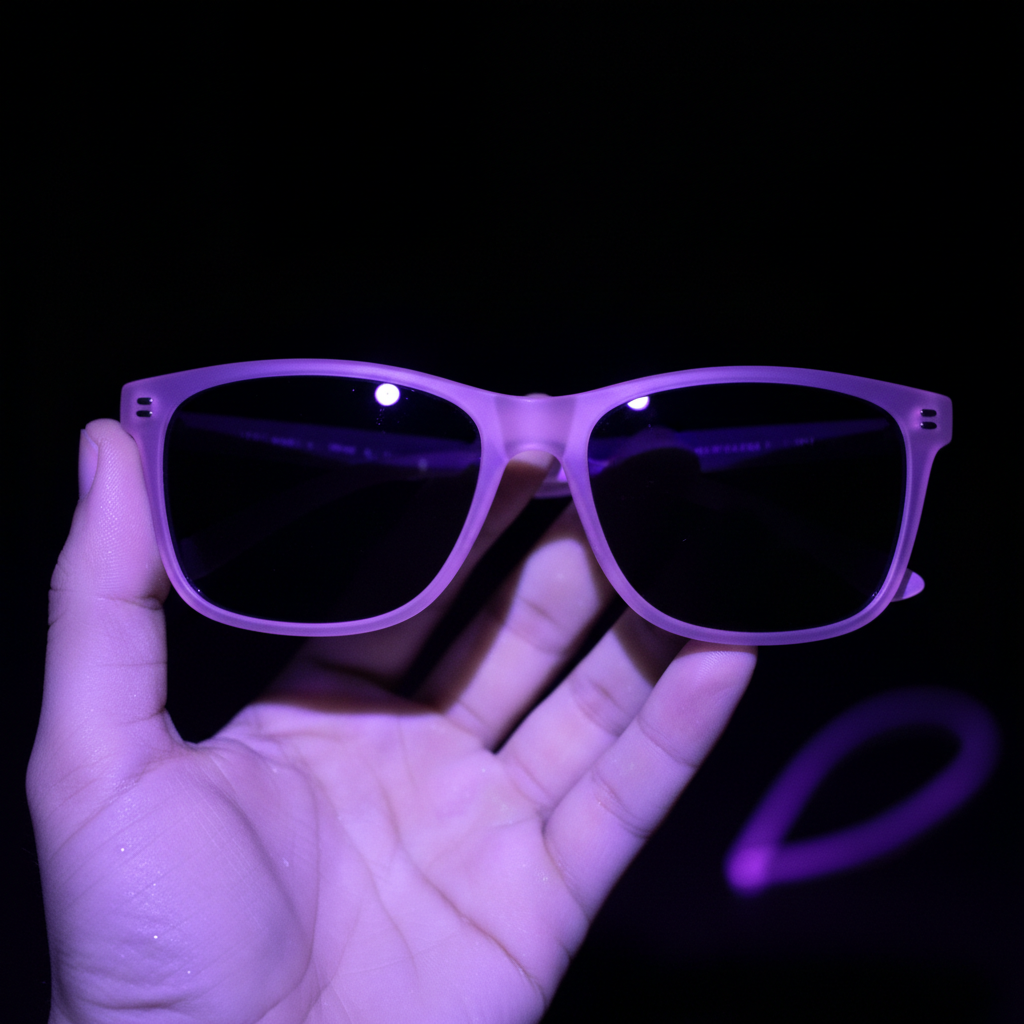
You can perform a quick and effective field test with a UV blacklight. Authentic lenses labeled "UV400" are designed to block all UVA and UVB rays up to 400 nanometers.
- In a dark room, shine a UV blacklight onto a surface.
- Place the sunglasses in front of the light.
- Result: A genuine pair of UV400 lenses will appear completely opaque, absorbing all the light. If you see the UV light passing through the lens, even in patches, it means the coating is inconsistent or, more likely, completely fake.
This test is critical because, as research on sunglasses standards points out, purchasing from unregulated sources dramatically increases the risk of getting non-compliant UV filters.
Red Flag #5: Lens Quality and Distortion
High-quality lenses provide crisp, clear, and undistorted vision. Manufacturers of genuine designer sunglasses invest heavily in optical-grade materials and precision grinding. Counterfeiters use cheap, molded plastic that can cause visual distortions, leading to eye strain and headaches.
The American Academy of Ophthalmology (AAO) suggests a simple way to check for optical quality:
The Tile Floor Test:
- Find a surface with a distinct rectangular pattern, like a tiled floor or a brick wall.
- Hold the sunglasses at a comfortable distance and cover one eye.
- Look through one lens at the pattern, moving the glasses slowly from side to side and up and down.
- Result: With high-quality lenses, the lines should remain straight and unwavering. If the lines bend, wiggle, or warp as you move the glasses, the lenses are optically inferior and likely fake.
Furthermore, all prescription and non-prescription sunglasses sold in the U.S. must comply with the FDA's impact resistance regulations (21 CFR 801.410). While you can't test this at home, it's a standard that authentic brands certify. A fake pair is highly unlikely to meet this safety requirement, meaning the lenses could shatter dangerously upon impact.
Frequently Asked Questions (FAQ)
Q: Is there a difference between polarized and UV-protective lenses?
A: Yes, a huge difference. As Harvard Health explains, polarization is a special filter that only blocks horizontal light waves, which cause glare from surfaces like water or roads. UV protection, on the other hand, blocks the high-energy ultraviolet radiation that is invisible to the naked eye but harmful to your ocular health. A lens can be polarized without offering UV protection, and a UV-protective lens is not automatically polarized. They are separate features.
Q: Does a higher price mean better UV protection?
A: Not necessarily. A study published in PubMed found that price doesn't always correlate perfectly with UV protection. However, the study does emphasize that buying from unregulated, "informal" markets significantly increases your risk of getting non-compliant lenses. Buying from a trusted vendor ensures the "UV400" label is backed by lab testing and certification.
Q: What does UV400 mean?
A: "UV400" means the lenses block light rays with wavelengths up to 400 nanometers. This covers all UVA and UVB rays. Some older or lower-quality standards only protect up to 380 nm, but as technical reports have shown, the 380-400 nm band contains significant UV energy. UV400 is the comprehensive standard you should always look for.
Q: Why do I feel dizzy or get a headache from cheap sunglasses?
A: This is almost certainly due to poor optical quality. As described in the "Tile Floor Test," low-grade lenses can have distortions, waves, or "hot spots" that force your eyes to constantly re-focus, leading directly to eye strain, fatigue, and headaches.
Disclaimer: This article is for informational purposes only and does not constitute professional advice. The tests described are for authenticating consumer goods and do not replace a comprehensive eye exam by a qualified optometrist. Always consult with an eye care professional for matters concerning your vision and health.
References
- U.S. Food and Drug Administration (FDA). (n.d.). Impact-Resistant Lenses: Questions and Answers. https://www.fda.gov/regulatory-information/search-fda-guidance-documents/impact-resistant-lenses-questions-and-answers
- MD Anderson Cancer Center. (2023). 9 things to know about sunglasses, eye protection and cancer. https://www.mdanderson.org/cancerwise/9-things-to-know-about-sunglasses--eye-protection-and-cancer.h00-159699123.html
- American Academy of Ophthalmology (AAO). (2023). How to Choose the Best Sunglasses. https://www.aao.org/eye-health/glasses-contacts/sunglasses-3
- Harvard Health Publishing. (2021). Polarized sunglasses: Protecting your eyes from harmful glare. https://www.health.harvard.edu/staying-healthy/polarized-sunglasses-protecting-your-eyes-from-harmful-glare
- Cole, B. L., & Morris, R. (2003). Compliance with standards for sunglasses and sunglasses. PubMed. https://pubmed.ncbi.nlm.nih.gov/12643804/
- Cole, B. L. (2019). Solar UV protection by sunglasses. PubMed. https://pubmed.ncbi.nlm.nih.gov/31274741/


