














Standing Desk Vision: How Posture Changes Your Eyewear Fit
The Posture-Vision Problem: Why Your Standing Desk is Causing Eye Strain
You invested in a standing desk for your back and energy levels, a move supported by research showing sit-stand workstations can reduce lower back pain by over 50%. But in the process, you may have traded one ache for another: a persistent, nagging eye strain. This isn't a coincidence. The simple act of changing your posture from sitting to standing fundamentally alters the geometry between your eyes and your glasses, potentially rendering a perfectly good prescription uncomfortable.
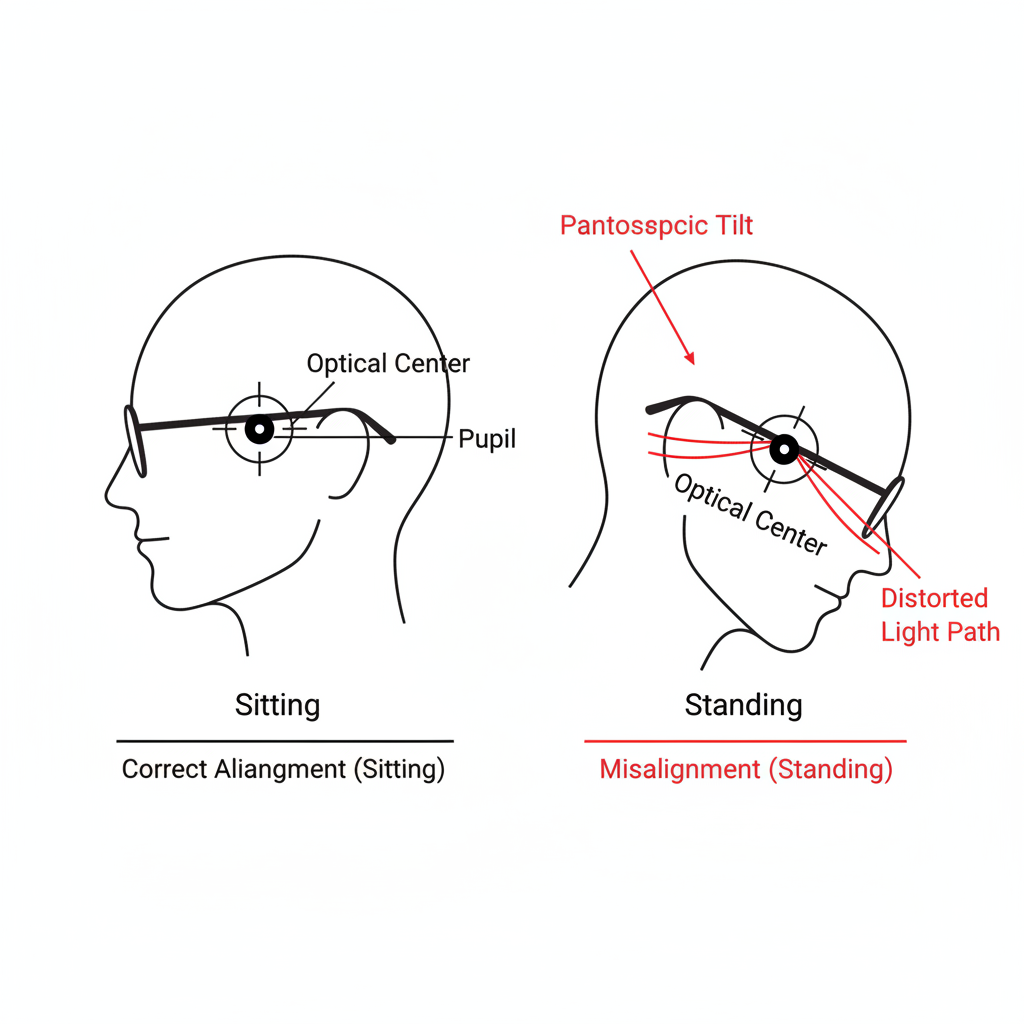
When you stand, your head naturally tilts downward more to view your monitor. This increases what opticians call the "pantoscopic tilt" of your frames. As we've observed in fittings, this shift can be subtle, around 5-10 degrees, but it's enough to misalign your pupil from the lens's optical center by 1-2 millimeters. For your eyes, this is a significant deviation. It forces you to look through a part of the lens not designed for sharp, primary vision, leading to blur, headaches, and the very eye strain you're trying to avoid.
The Adjuster's Guide: Fine-Tuning Your Frames for Dynamic Work
Before you assume your prescription is wrong, the solution might be sitting right on your nose. With a few careful tweaks, you can often adapt a single pair of glasses to serve you comfortably in both sitting and standing postures. The key is choosing the right type of frame and knowing how to adjust it.
Frame Material is Your Foundation
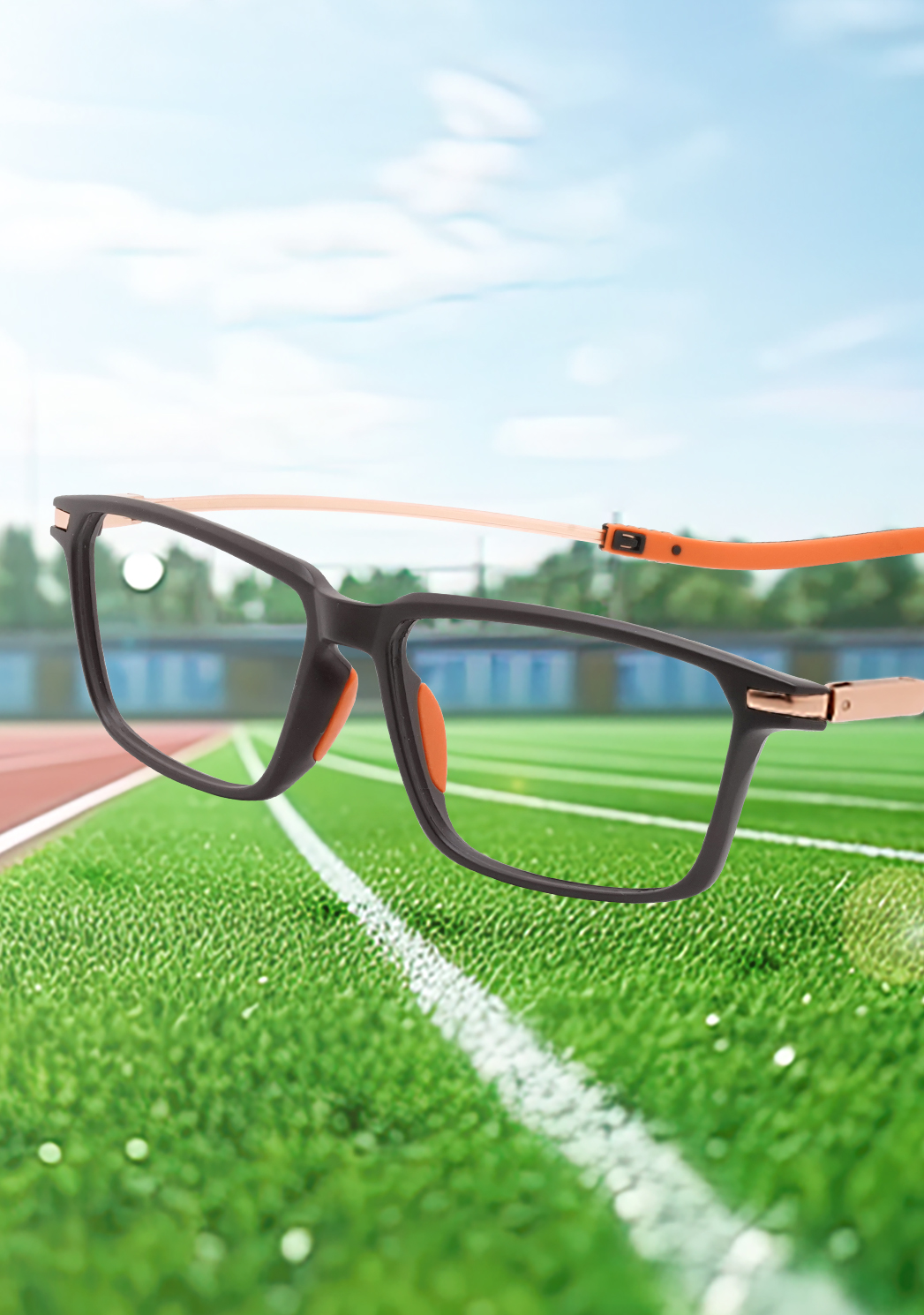
Your ability to fine-tune your eyewear starts with the frame itself. Rigid acetate frames with fixed nose pieces offer little to no room for modification. For a dynamic sit-stand workstation, your best allies are frames made from lightweight, flexible materials.
- Recommended: Titanium or memory metal frames are ideal. They are durable, lightweight, and can be carefully adjusted without being damaged.
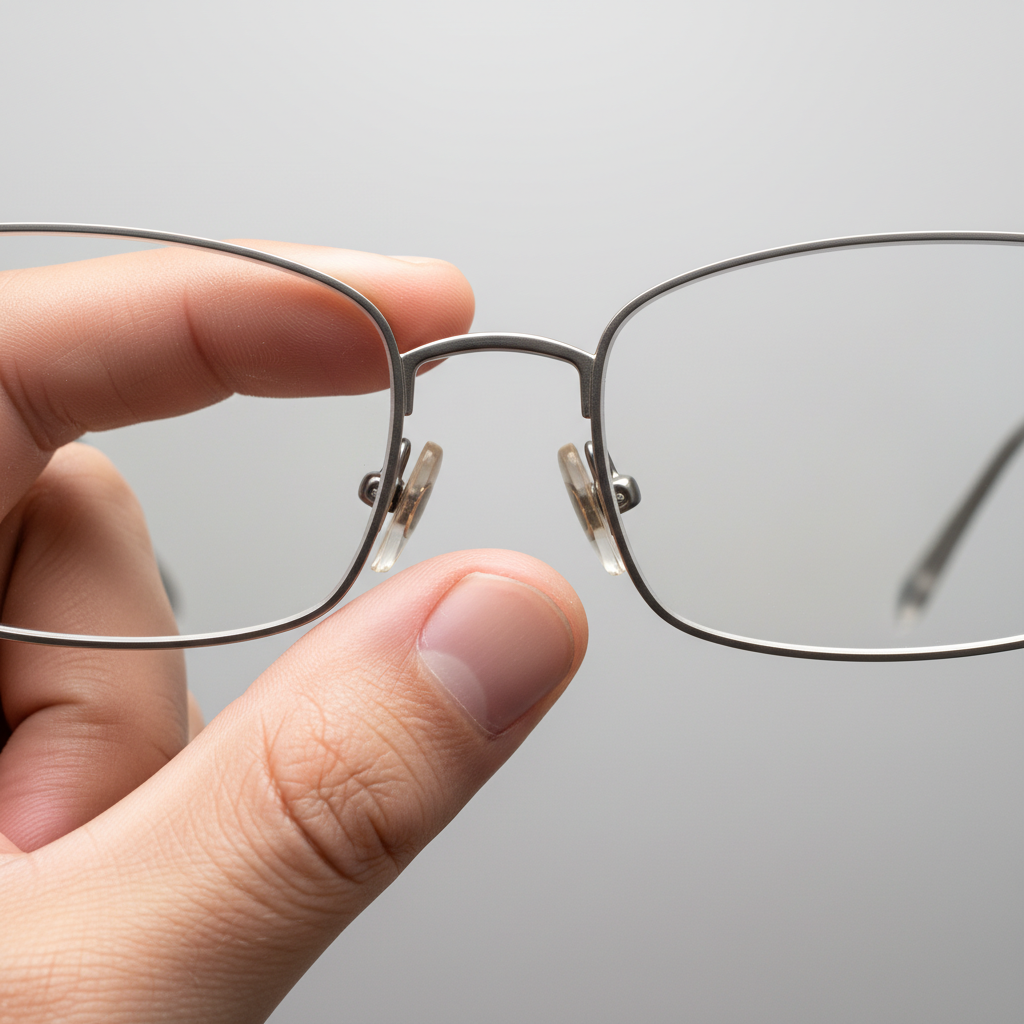
- Key Feature: Look for adjustable silicone nose pads. These small components are the primary tool for changing how your glasses sit on your face.
Mastering the Nose Pad Adjustment
This is the most critical adjustment for compensating for postural changes. The goal is to lift the glasses slightly when you stand to counteract your downward head tilt.
Practical Heuristic: Based on common fitting practices, you should aim to adjust the nose pads so the frame sits 1-2mm higher on your nose when standing compared to when you are sitting. This simple change can be enough to realign your pupils with the optical centers of your lenses.
To do this, gently use your thumbs to push the small wire arms holding the silicone pads closer together. This narrows the gap, forcing the frames to sit higher on your nasal bridge. Make small, incremental changes and test the result in your standing position. If you go too far, you can gently widen them again.
Taming the Temples for a Secure Fit
As you move between sitting and standing, you might find your glasses slipping. The common instinct is to tighten the hinge screws, but this rarely solves the problem and can create pressure points. A better approach is to adjust the temple arms.
For a more secure grip, an optician's trick is to create a gentle "library curve"—a slightly more pronounced outward and then inward bend just before and around the ear. This distributes pressure evenly and uses the shape of your ear for support, providing a much more stable fit than simple pressure from a tight temple arm.
When DIY Isn't Enough: Signs You Need Professional Help
While self-adjustments are effective for many, they have their limits. Certain symptoms are red flags indicating that a more fundamental issue with your prescription or lens type needs to be addressed by an optician.
The High-Prescription Challenge
Individuals with stronger prescriptions (generally +/-4.00 diopters and above) are far more sensitive to changes in fit. For these users, even a millimeter of misalignment in vertex distance (the space between the lens and the eye) can cause significant distortion and strain. If you have a high prescription and experience discomfort, self-adjustments may not be enough.
The Case for a Dedicated "Standing Desk" Prescription
If you spend over 50% of your workday standing, it may be worth investing in a dedicated pair of glasses prescribed specifically for that posture. An optician can take measurements while you are standing at your desk, ensuring the optical center, pantoscopic tilt, and vertex distance are all perfectly calibrated for your primary working position.
If you experience any of the following, it's time to schedule an appointment:
- Persistent headaches that coincide with standing work.
- Noticeable blur or "swim" when you transition from sitting to standing.
- Dizziness or a feeling of imbalance.
- Needing to constantly tilt your head to find a "sweet spot" of clear vision.
Holistic Ergonomics: Your Glasses Are Part of a System
Perfectly adjusted glasses can still be undermined by a poorly configured workstation. Achieving visual comfort requires a holistic approach that aligns your eyewear, your posture, and your environment. According to the ANSI/HFES 100-2007 standard, proper workstation design is crucial for user health and safety.
- Monitor Height: Position your primary monitor so the top of the screen is at or just below eye level. You should be able to look at the center of the screen with a slight downward gaze of 15-20 degrees.
- The 20-20-20 Rule: Digital eye strain isn't just about fit; it's about focus fatigue. As recommended by ophthalmologists at the Cleveland Clinic, you should look at something 20 feet away for 20 seconds every 20 minutes. This simple habit relaxes your eye's focusing muscles.
- Blink More: When we stare at screens, our blink rate can drop by more than half, from a normal 15 times per minute to just 5-7, according to the American Academy of Ophthalmology. This leads to dry, irritated eyes. Make a conscious effort to blink fully and frequently.
- Control Lighting: To reduce glare and washout, your office lighting should be appropriate for screen use. OSHA guidelines suggest that lighting for computer monitors should often be lower than what's needed for paper documents, typically in the 300-500 lux range.
Frequently Asked Questions (FAQ)
Can I use one pair of glasses for both sitting and standing? For most people with low-to-moderate prescriptions, yes. The key is having an adjustable frame (like titanium with silicone nose pads) and performing the micro-adjustments detailed in this guide to maintain alignment in both postures.
Why do my eyes feel more strained at my standing desk even if my screen is at the right height? It's likely due to optical misalignment. Even with perfect ergonomics, if your head is tilted differently, your pupils may no longer align with the optical center of your lenses. This forces your eyes to work harder to maintain focus, causing strain.
Are progressive lenses a good choice for a sit-stand desk? Progressive lenses can be an excellent solution, as they offer different zones for different distances. However, they require an extremely precise fitting by a qualified optician. You must discuss your sit-stand habits with them, as the height of the "corridor" for intermediate (computer) vision needs to be perfectly placed to be effective in both postures.
Your Vision, Your Workstation
Embracing a standing desk is a positive step for your overall health, but it requires a small update to how you think about your eyewear. By understanding the relationship between posture and optical alignment, you can make the necessary adjustments to ensure your eyes are as comfortable as your back. Pay attention to your body's signals. If you experience persistent strain, don't just push through it—fine-tune your fit or consult a professional. Your vision is too important to be a compromise.
Disclaimer: This article is for informational purposes only and does not constitute professional medical advice. Consult with a qualified optometrist or ophthalmologist for any personal vision concerns, especially if you have a high prescription or pre-existing eye conditions.
References
- Callaghan, J. P., et al. (2014). The Impact of a Sit-Stand Workstation on Lower Back Discomfort and Sedentary Time. Texas A&M University.
- American Academy of Ophthalmology (AAO). (n.d.). Computers, Digital Devices and Eye Strain.
- U.S. Occupational Safety and Health Administration (OSHA). Computer Workstation eTool: Workstation Environment.
- Human Factors and Ergonomics Society. (2007). ANSI/HFES 100-2007 Human Factors Engineering of Computer Workstations.
- Cleveland Clinic. (2022). Do Blue Light Glasses Work?.


