








Can I Use a Strong Prescription with Rimless Frames?
Can You Use a Strong Prescription with Rimless Frames?
Rimless frames offer a sophisticated, barely-there aesthetic that appeals to those who prefer a minimalist look. They are lightweight and place no visual boundaries around your field of view. However, a common question arises for those with significant vision correction needs: are these delicate-looking frames a viable option for strong prescriptions?
Many people believe that a high-power prescription automatically disqualifies them from wearing this elegant style. The concern is that the lenses will be too thick, too heavy, and too fragile for a frame that relies on mounting hardware drilled directly into the lens.
This article provides an in-depth, practical guide for anyone with a high prescription considering rimless eyeglasses. We will explore the specific challenges, the crucial role of modern lens technology, and the exact steps you need to take to achieve a successful, durable, and aesthetically pleasing result. While it requires more careful planning than a standard order, the answer is often a resounding yes—you can absolutely wear rimless frames with a strong prescription.
The Short Answer
Yes, you can wear rimless glasses with a strong prescription, but success hinges on making informed choices. The key is to combine advanced lens materials (like high-index plastics or Trivex) with specific lens designs (aspheric) and to choose a conservative lens shape and size. Simply putting a strong prescription into a standard lens on a rimless frame is not a recipe for success; it requires a deliberate, technically-sound approach.
Understanding the Challenges of High Prescriptions in Rimless Frames
To appreciate the solution, it's important to first understand the problem. A "strong" or "high" prescription—generally referring to a spherical (SPH) power greater than +/− 4.00 or a cylinder (CYL) power over +/− 2.00—creates several engineering and optical challenges, which are amplified by the structure of a rimless frame.
Lens Thickness and Weight: For nearsightedness (a minus prescription), lenses are thickest at the edges. For farsightedness (a plus prescription), they are thickest in the center. In either case, as the power increases, so do thickness and weight. On a rimless frame, a thick edge is not only visually apparent but also adds considerable weight, which can lead to discomfort and the glasses sliding down your nose.
Structural Stress Points: Unlike full-rim or semi-rimless frames that support the lens within a groove, rimless frames attach the temples and bridge directly to the lens itself using screws and bushings. These drill-mount points become areas of concentrated stress. A heavier lens exerts more torque and pressure on these small points, increasing the risk of the hardware loosening or, worse, the lens chipping or cracking around the drill holes.
Material Fragility: Standard plastic (CR-39) lenses, while optically clear, are relatively brittle. Subjecting them to the drilling process and the constant micro-stresses of daily wear in a rimless mount makes them prone to stress fractures. This is a primary reason why standard lenses are ill-suited for this frame style, especially with the added weight of a high prescription.
The Key to Success: High-Index and High-Performance Lens Materials
The single most important factor in making rimless frames work with a high prescription is the choice of lens material. Modern optical technology offers several advanced plastics that are specifically designed to solve the problems of thickness, weight, and fragility. According to the U.S. Food and Drug Administration (FDA), all prescription lenses sold in the United States must be impact-resistant, but some materials offer far greater durability than the minimum standard.
Here’s a breakdown of the most common materials and their suitability for a high-prescription rimless setup.
| Material | Refractive Index | Key Characteristics & Best Use Case for Rimless | UV Protection |
|---|---|---|---|
| CR-39 (Standard Plastic) | 1.50 | Not Recommended. Too thick, heavy, and brittle for high-power rimless applications. Prone to cracking at drill mounts. | Partial (Requires Coating) |
| Polycarbonate | 1.59 | Good Choice. Excellent impact resistance and tensile strength, making it very durable for drilling. Thinner and lighter than CR-39. A workhorse for safety and active use. | 100% Built-In |
| Trivex | 1.53 | Excellent Choice. The most durable, impact-resistant material available. Superior optical clarity (higher Abbe value) to polycarbonate. Lightweight and strong, ideal for rimless. | 100% Built-In |
| High-Index 1.67 | 1.67 | Very Good Choice. Significantly thinner and lighter. A great option for prescriptions above ±4.00D. Durable enough for rimless styles with proper handling. | 100% Built-In |
| High-Index 1.74 | 1.74 | Best for Extreme Prescriptions. The thinnest and lightest plastic lens material available. Ideal for minimizing thickness in very high prescriptions (>±6.00D). Can be more brittle than 1.67. | 100% Built-In |
Why Refractive Index Matters
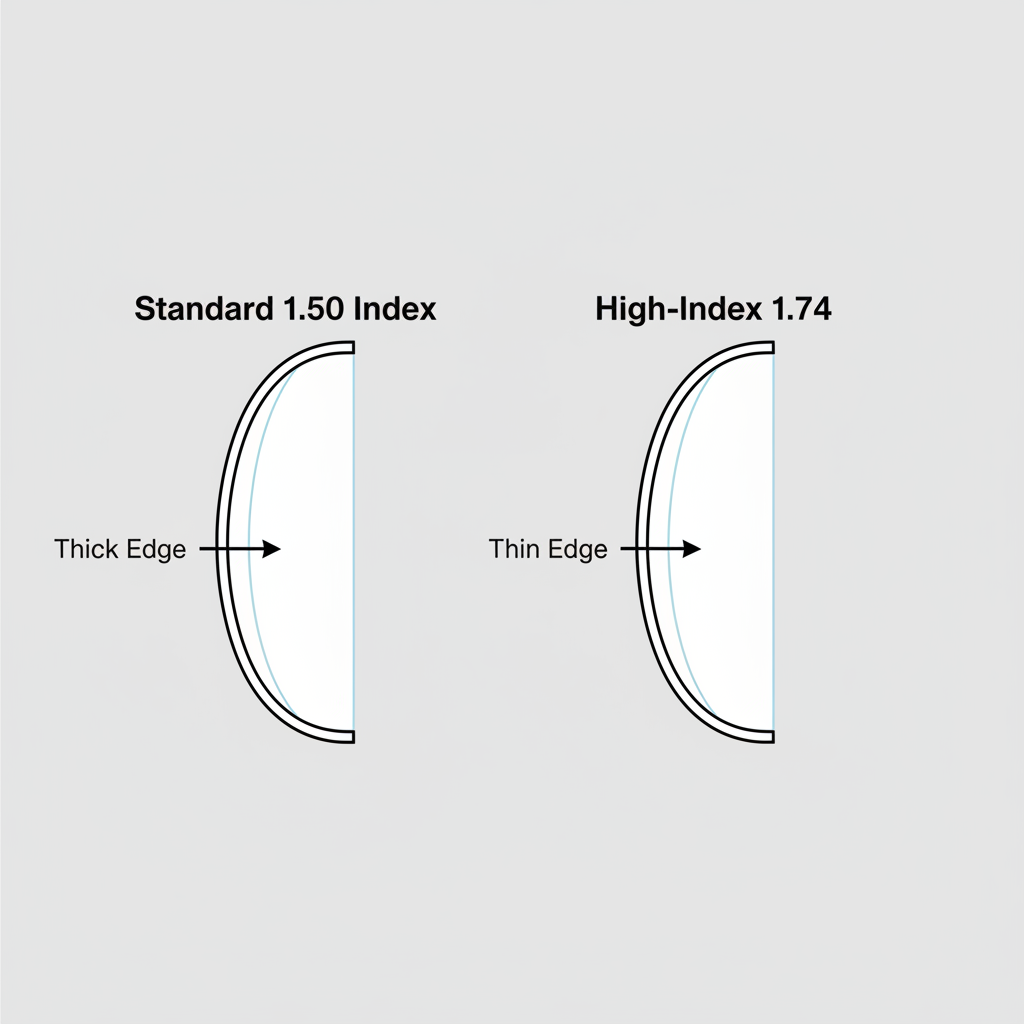
As explained by optical programs like the one at Ferris State University, the refractive index is a number that indicates how efficiently a material bends light. The higher the index, the less material is needed to achieve the same prescriptive power. For you, the wearer, this translates directly into a thinner and lighter lens—the two most important aesthetic and comfort factors for a high prescription.
For a -6.00D prescription, a 1.74 high-index lens can be up to 50% thinner than a standard 1.50 CR-39 lens. This dramatic reduction in edge thickness is what makes a strong prescription virtually disappear in a rimless frame.
Expert Warning: Thinnest Isn't Always the Only Goal
A common misconception is that you should simply choose the absolute highest index possible. While 1.74 is the thinnest, materials like Trivex and polycarbonate have far superior tensile strength and impact resistance. This makes them exceptionally resistant to cracking or chipping around the drill mounts.
For moderate-to-high prescriptions (e.g., up to ±6.00D), Trivex is often a superior choice for rimless frames because it offers an unparalleled combination of safety, durability, and optical clarity, even if it isn't quite as thin as a 1.67 or 1.74 lens. For active users or those concerned about durability, the trade-off of a millimeter of thickness for a dramatic increase in toughness is a worthwhile investment.
Essential Considerations Beyond Lens Material
Choosing the right material is half the battle. To ensure a great outcome, you also need to pay attention to the lens design, the shape of the lens, and the accuracy of your fitting measurements.
Aspheric Lens Design: Fighting Distortion
Strong prescriptions, especially for farsightedness, can create a "bug-eye" effect where your eyes appear magnified and distorted to others. High-minus lenses can have the opposite effect, making your eyes look smaller. Aspheric lens designs help solve this. They are created with flatter curves than traditional spherical lenses, which reduces magnification and improves peripheral vision. For anyone with a sphere power over ±2.00D or a cylinder over ±2.00D, an aspheric design is crucial for better aesthetics and clearer sight.

Lens Shape and Size
This is a critical, often overlooked, factor. The larger the lens, the more pronounced the edge thickness will be for a minus prescription. To keep your lenses as thin and light as possible, you should opt for smaller, more conservative lens shapes. Avoid wide, rectangular shapes and instead favor oval or soft, rounded square shapes. Keeping the overall diameter of the lens to a minimum is a professional strategy to manage thickness and weight.
The Critical Role of Pupillary Distance (PD)
The optical center of your lenses should be directly in front of your pupils. The measurement of the distance between your pupils is called the Pupillary Distance (PD). With high-power lenses, an inaccurate PD can cause induced prism, leading to eye strain, headaches, and a feeling that your vision is "off." This effect is magnified in stronger prescriptions, making PD accuracy non-negotiable. As discussed in our guide on whether small PD errors matter, precision is key. You can learn how to measure your PD at home to ensure a perfect fit.
A Practical Checklist for Success
Ordering rimless glasses with a high prescription online is entirely possible if you are methodical. Follow this checklist to ensure you cover all the critical variables.
Start with Your Full Prescription. Under the FTC's Eyeglass Rule, your eye doctor is required to give you a copy of your prescription immediately following an exam. Ensure it includes your sphere, cylinder, axis, and PD. If you have a complex prescription, you can learn more about it in our guide to reading your prescription.
Choose the Right Lens Material. Use this heuristic based on experience:
For sphere power between ±2.00 and ±4.00: Polycarbonate or Trivex are excellent choices.
For sphere power between ±4.00 and ±6.00: A 1.67 high-index lens offers a great balance of thinness and durability.
For sphere power above ±6.00: A 1.74 high-index lens is recommended to achieve the thinnest possible profile.
Insist on an Aspheric Design. This will provide better visual clarity and a more flattering appearance, minimizing eye distortion.
Select a Smaller Lens Shape. Avoid wide, oversized styles. Stick to smaller oval, round, or soft rectangular shapes to minimize edge thickness and overall weight.
Double-Check Your Pupillary Distance (PD). This measurement is crucial for high-power lenses. Measure it multiple times or have a friend assist to ensure accuracy.
Add an Anti-Reflective (AR) Coating. High-index lenses reflect more light than standard lenses. An AR coating is essential to allow more light to pass through the lens for clearer vision, and it reduces distracting glare from the lens surfaces.
Wrapping Up: A Clear Path to a Minimalist Style
The idea that rimless frames are off-limits for those with strong prescriptions is outdated. Thanks to major advancements in lens technology, it is now entirely feasible to pair a high-power prescription with a minimalist, drill-mount frame.
Success is not automatic; it is a result of deliberate choices. By prioritizing a high-index, impact-resistant material like Trivex or a 1.67+ index plastic, insisting on an aspheric lens design, and selecting a smaller, more conservative lens shape, you can build a pair of glasses that are not only stylish and lightweight but also optically superior and durable enough for daily wear. Don’t let a high prescription number dictate your style—empower yourself with the right knowledge to achieve the look you want.
Frequently Asked Questions (FAQ)
What is the absolute strongest prescription you can use with rimless glasses?
There is no strict official limit, but practicality is key. Most labs can comfortably handle up to +/− 8.00D, and some can go higher. Beyond this, lens thickness and curvature become very difficult to manage in a rimless mount, even with 1.74 index material. The final result depends on the combination of your sphere, cylinder, PD, and chosen lens shape.
Are rimless glasses less durable than full-rim frames?
Yes, inherently they are. The structural integrity relies on just two or three mounting points on each lens. This makes them more susceptible to damage from being dropped or twisted. However, choosing a highly durable material like Trivex or polycarbonate significantly mitigates this risk, making them tough enough for normal daily use.
Why do I see color fringes (rainbows) around objects with my high-index lenses?
This is called chromatic aberration. It happens because the lens material splits white light into its component colors, much like a prism. Materials with a lower "Abbe value" (common in higher-index plastics) exhibit more chromatic aberration. While most wearers don't notice it or adapt quickly, it can be apparent when looking at high-contrast objects through the periphery of the lens.
Can I put new, stronger prescription lenses in my old rimless frames?
Possibly, but it requires evaluation by an optical lab. The lab needs to ensure that the new lens thickness and curvature will work with the existing frame hardware and mounting angles. If the prescription change is significant, the lens shape or edge thickness may change enough to make re-using the frame impossible.
Disclaimer: This article is for informational purposes only and does not constitute professional medical advice. Always consult with a qualified optometrist or ophthalmologist for any health-related concerns, to receive a comprehensive eye exam, and to discuss your specific eyewear needs.


