










The Small Frame Myth for Strong Prescriptions
TL;DR: The Small Frame Rule is Outdated
For years, the conventional wisdom for anyone with a strong prescription was simple: stick to small, conservative frames to hide thick lenses. This guide is here to challenge that outdated rule. Thanks to major advances in lens technology—specifically high-index materials and aspheric designs—you can now wear a much wider variety of fashionable, larger frames without the "bug-eye" look or cumbersome weight. We'll show you how to combine the right lenses with smart frame choices to achieve clear vision without sacrificing your personal style.
The Physics Behind the Myth: Why Lenses Get Thick
Before we can break the rule, it helps to understand why it existed in the first place. A prescription eyeglass lens is essentially a tool for bending light to correct a refractive error. The stronger your prescription—whether for nearsightedness (myopia) or farsightedness (hyperopia)—the more light-bending power is required.
For Myopia (Negative Power, e.g., -6.00): The lens is thinnest in the center and thickest at the outer edges.
For Hyperopia (Positive Power, e.g., +6.00): The lens is thickest in the center and thinnest at the edges.
In either case, as the lens gets larger to fit a bigger frame, the thickness somewhere on that lens increases dramatically. This leads to two main problems: aesthetics (the visible edge thickness or center bulge) and comfort (heavier glasses that slide down your nose). The old solution was logical: keep the frame small to use the smallest, thinnest possible portion of the lens blank. But today, we can attack the problem at its source: the lens material itself.
Game Changer: High-Index and Aspheric Lens Technology
Modern optical technology offers a powerful two-part solution that minimizes thickness and distortion, freeing you to explore more frame styles.
1. High-Index Materials: Thinner, Lighter, and More Efficient
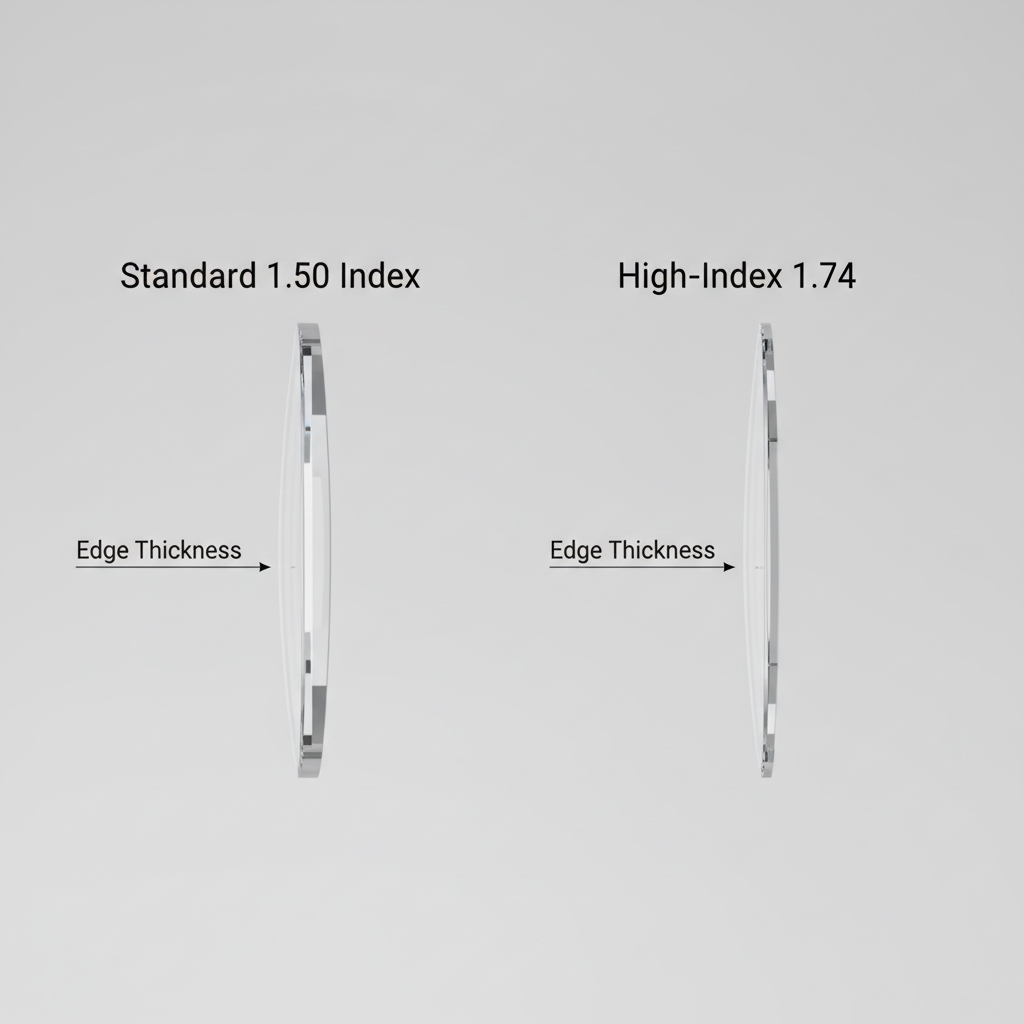
Standard plastic lenses have a refractive index of 1.50. High-index lenses are made from advanced materials with a higher refractive index (from 1.60 up to 1.74). As explained by optical experts at Ferris State University, a higher index means the material can bend light more efficiently. This allows the lens to be made significantly thinner and lighter while providing the exact same corrective power.
Here’s a practical guide for choosing the right index based on your prescription strength:
Up to ±3.00 D: Standard 1.50 index is often sufficient.
From ±3.00 D to ±6.00 D: A 1.60 or 1.67 high-index lens offers a great balance of a noticeably thinner profile and reasonable cost.
Above ±6.00 D: The difference with a 1.74 high-index lens becomes dramatic, offering the thinnest and most cosmetically appealing option.
Furthermore, these materials provide excellent protection from the sun. A study published in PubMed found that plastic lenses offer superior protection against UV radiation compared to glass, and high-index plastics inherently block 100% of UV rays.
2. Aspheric Lens Design: Better Vision, Better Appearance
Lens technology isn't just about the material; it's also about the shape. Traditional lenses have a spherical curve, like a slice taken from a ball. An aspheric lens has a more complex, flatter curve that changes from the center to the edge. This sophisticated design, as highlighted by the Optometrists Network, accomplishes two crucial things for strong prescriptions:
Reduces Magnification/Minification: It dramatically lessens the "bug-eye" look of strong farsighted prescriptions and the "tiny-eye" effect of strong nearsighted prescriptions.
Improves Peripheral Vision: It provides sharper, less distorted vision when you look away from the center of the lens.
Expert Warning: For anyone with a prescription over ±3.00 D, an aspheric design should be considered standard practice. When combined with a high-index material, it delivers the best possible visual and cosmetic result.
| Lens Material | Typical Prescription Range | Key Benefit | Key Trade-Off |
|---|---|---|---|
| Standard Plastic (1.50) | Up to ±3.00 D | Most affordable | Thickest and heaviest option for high Rx |
| Polycarbonate (1.59) | Up to ±4.00 D | Highest impact resistance | Poorer optical clarity (Abbe value) |
| High-Index 1.67 | ±3.00 D to ±8.00 D | Significantly thinner & lighter | Requires Anti-Reflective coating |
| High-Index 1.74 | Above ±6.00 D | Thinnest & lightest plastic lens available | Highest cost, requires AR coating |
Smart Frame Selection: How to Wear Larger Styles Successfully
Armed with the right lens technology, you can now approach frame selection with a new set of rules. The goal is to choose a frame that works synergistically with your high-tech lenses.
Debunking the Myth: Size Isn't Everything, Shape Is
The secret to making larger frames work is to understand that not all "large" frames are created equal. A huge, square frame will still require a massive lens that will be thick at the edges. However, you can achieve a bold, stylish look by focusing on other attributes.
Choose Rounder Shapes: For the same overall "width," a round or oval lens will have a smaller diagonal measurement than a sharp-cornered rectangle. This trims away the thickest parts of the lens blank, reducing both weight and edge profile.
Look for a Smaller "Eye Size": A mistake I often see is customers choosing a frame that is wide overall but also has a very wide lens opening. A better strategy is to find a frame with a smaller A/B measurement (the lens window itself) but that achieves its stylish width through other design elements, like a thicker rim or decorative end pieces.
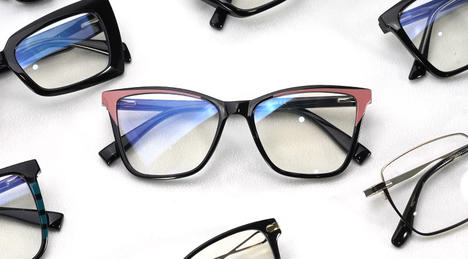
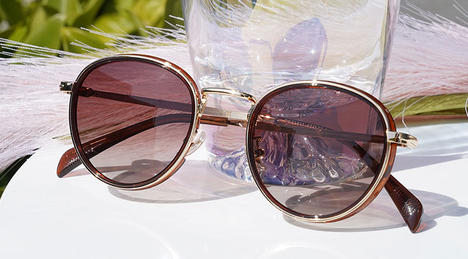
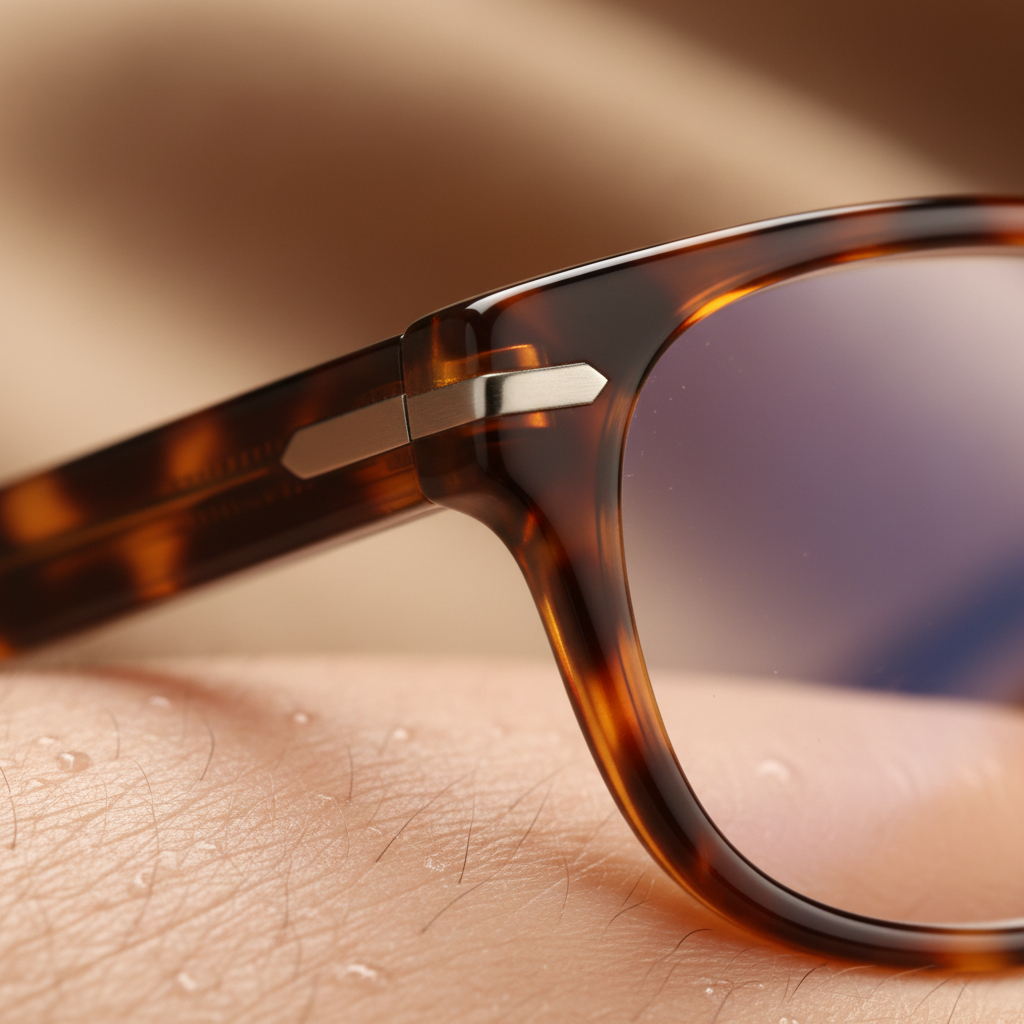
Use Frame Design to Your Advantage: Fuller acetate rims are brilliant at masking the edge of a lens. A thicker frame, a flared temple arm, or a darker color can make even a moderate lens edge seem to disappear entirely. This is a classic optical styling trick. For more on this, you can explore if you can wear thin, stylish frames with a high Rx.
The Critical Importance of Fit
With strong prescriptions, precision is everything. Small variations in how the glasses sit on your face can impact how well you see.
Pupillary Distance (PD): This is the distance between your pupils, and it determines the optical center of your lenses. An error in PD can induce prism and cause eye strain. While getting a PD measurement at home is possible, precision is key. If you're unsure, it's always best to have it professionally measured. Even a small PD error can matter with high powers.
Vertex Distance: This is the distance from the back of the lens to the front of your eye. As noted by practitioners, for prescriptions beyond ±4.00 D, even a 2-3 mm change in vertex distance can alter the effective power of the lens. A frame that slides down your nose isn't just annoying—it can actually change your vision.
Your Checklist for a Perfect Pair
Navigating the world of online eyewear can be complex, but knowledge is power. The U.S. Federal Trade Commission's Eyeglass Rule guarantees you the right to a copy of your prescription, allowing you to shop around for the best combination of technology and style. For help understanding the details, check our simple guide to reading your prescription.
Follow this checklist to ensure you get the best results:
Start with a Current Prescription: Your vision needs can change. Always use an up-to-date prescription from a qualified eye care professional.
Choose the Right High-Index Material: Match the index (1.60, 1.67, 1.74) to your prescription strength to ensure a thin, lightweight result.
Insist on an Aspheric Lens Design: This is non-negotiable for minimizing distortion and improving the cosmetic appearance of your eyes.
Select Your Frame Wisely: Prioritize rounder shapes and look for designs that strategically hide the lens edge. Don't just focus on the overall frame width.
Provide a Precise PD: Double-check your pupillary distance measurement. For strong or progressive prescriptions, a monocular PD (measured for each eye individually) is best.
Always Add an Anti-Reflective (AR) Coating: High-index lenses reflect more light than standard plastic. An AR coating is essential for clear vision, reduced glare (especially at night), and making your lenses appear nearly invisible.
Ensure Impact Resistance: All lenses sold in the US must meet the FDA's impact-resistance standards. For children or those with active lifestyles, polycarbonate or Trivex lenses offer superior shatter resistance.
Frequently Asked Questions (FAQ)
Q: Will high-index lenses make my glasses heavy?
A: No, quite the opposite. High-index materials are denser but require significantly less material to achieve the same power, making the final lens noticeably lighter than a standard 1.50 index lens.
Q: Are high-index lenses worth the extra cost?
A: For prescriptions stronger than ±3.00 D, the benefits are undeniable. The improvement in comfort (less weight), appearance (thinner profile, less eye distortion), and visual quality (when paired with an aspheric design and AR coating) provides significant daily value.
Q: Why do my eyes still look small with my new high-index glasses?
A: This is likely because the lens design is spherical, not aspheric. While the high-index material makes the lens thinner, only the aspheric design corrects the optical distortion that causes the minification or magnification effect. Ensure you select both features for the best result.
Disclaimer: This article is for informational purposes only and does not constitute professional medical advice. The information provided is intended to help you make informed decisions in consultation with a qualified optometrist or ophthalmologist who can properly assess your vision needs and eye health.


