











Can You Get a Strong Rx in Any Sunglass Frame?
Can You Get a Strong Rx in Any Sunglass Frame?
You’ve found the perfect pair of sunglasses—bold, stylish, and exactly what you’re looking for. But a familiar concern creeps in for those of us with strong prescriptions: can these frames actually handle my lenses without them looking like "coke bottles"? It’s a common frustration that often leads to sacrificing style for function.
The good news is that modern optical technology has largely made this a problem of the past. You no longer have to choose between clear vision and the frames you love. The key is understanding the interplay between your prescription, lens material, and the geometry of the sunglass frame. This guide will walk you through the technical details and practical choices that make it possible to fit a strong prescription into almost any style of sunglasses.
TL;DR: Your Quick Guide to high-Rx Sunglasses
- Yes, it's possible: With the right lens technology and smart frame choices, you can wear most sunglass styles.
- high-Index Lenses are Key: These materials are denser and bend light more efficiently, allowing lenses to be significantly thinner and lighter. We recommend a 1.67 index for prescriptions over ±4.00 and a 1.74 index for those over ±6.00.
- Frame Size and Shape Matter: While you have more options than ever, extremely large or aggressively wrapped frames can still pose challenges. Smaller, rounder shapes centered on your eyes yield the thinnest lenses.
- Thicker Rims are Your Friend: Acetate or other thick-rimmed frames are excellent for concealing the edge of a strong lens.
- Accurate Measurements are Non-Negotiable: A precise Pupillary Distance (PD) is crucial for high prescriptions to ensure your lenses are optically centered, preventing distortion and eye strain.
Understanding the Core Challenge: Lens Thickness and Frame Size
Before diving into the solutions, it’s important to understand why strong prescriptions create thick lenses in the first place. The power of your prescription, measured in diopters (D), dictates the curvature of your lenses.
- Nearsightedness (Myopia): If you have a minus (-) prescription, your lenses are thinner in the center and thicker at the edges. The stronger the prescription, the thicker the outer edge becomes.
- Farsightedness (Hyperopia): If you have a plus (+) prescription, your lenses are thickest in the center and thinner at the edges.
The size and shape of your sunglass frame directly impact the final thickness of your lenses. A larger, wider frame requires a larger lens blank to be cut from. For a nearsighted person, this means the thicker, outer part of the lens blank is used, resulting in more prominent edge thickness.
This is where a technical term used by opticians becomes relevant: Effective Diameter (ED). The ED is the longest diagonal measurement of the frame's lens opening. For strong prescriptions, keeping the ED under 70mm is a good rule of thumb to avoid excessively thick and heavy lenses.
The Modern Solution: Advanced Lenses and Smart Selections
Fortunately, you are not limited by old technology. A combination of advanced materials and careful frame selection can solve nearly any challenge posed by a strong prescription.
high-Index Lenses: The Secret to a Slimmer Profile
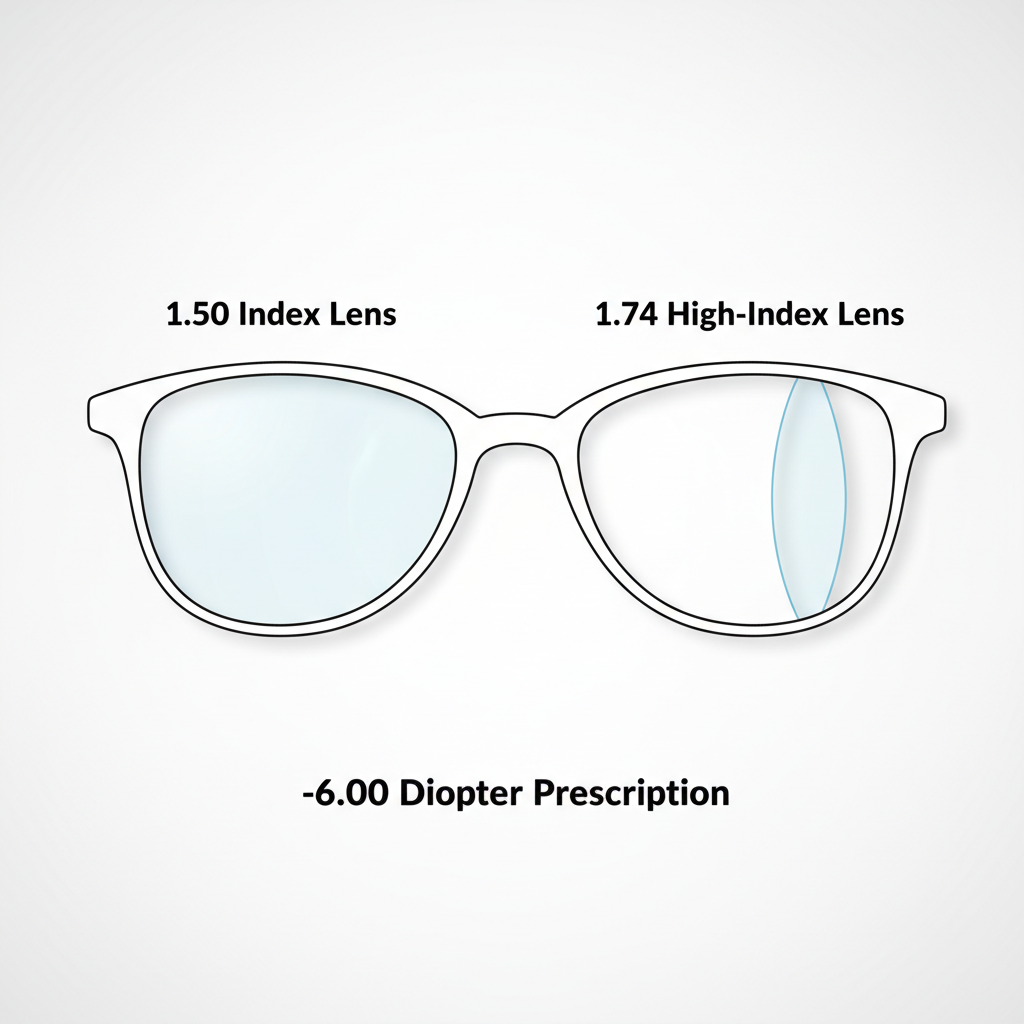
The single most effective tool for reducing lens thickness is the use of high-index lens materials. The "index of refraction" refers to how efficiently a material bends light. Standard plastic lenses have an index of 1.50. high-index materials, however, have higher values, meaning they can achieve the same prescription power with less curvature and therefore, less material.
According to optical science programs like the one at Ferris State University, these advanced materials are denser and bend light more effectively. This results in lenses that are both thinner and lighter, which is a huge benefit for comfort, especially in a heavier sunglass frame.
Here’s a practical guide for choosing the right index based on your prescription power:
| Prescription Strength (Diopters) | Recommended Lens Index | Primary Benefit |
|---|---|---|
| Up to ±3.75 D | 1.50 Standard Plastic | Cost-effective for mild prescriptions. |
| ±4.00 D to ±5.75 D | 1.67 high-Index | A significant reduction in thickness and weight. |
| ±6.00 D and higher | 1.74 high-Index | The thinnest and lightest plastic lens material available. |
Aspheric Lenses: Better Vision and Appearance
Beyond the material itself, the design of the lens surface plays a huge role. Aspheric lenses have a more complex, flatter curvature than traditional spherical lenses. This design helps to reduce the magnification or minification effect that strong prescriptions can have on your eyes. If you've ever worried about your glasses making your eyes look unnaturally small or large, aspheric lenses are the solution. This flatter profile also helps to reduce distortion at the periphery of the lens, giving you a wider field of clear vision.
Expert Warning: Be Cautious with Wraparound Frames
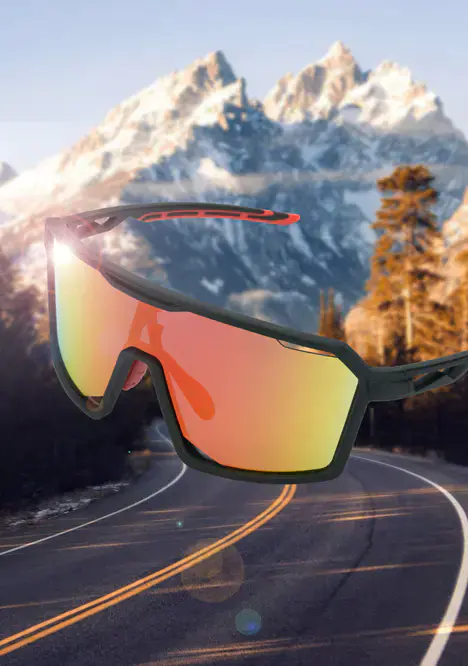
High-wrap or "8-base" sport sunglasses are very popular, but they present significant challenges for strong prescriptions. The extreme curvature can induce what's known as oblique astigmatism, creating blurriness and distortion when you look away from the center of the lens. While some labs can compensate for this, there are limits. For prescriptions above ±4.00 D, it is generally best to avoid aggressive wrap styles to ensure visual clarity and comfort.
Choosing the Right Sunglass Frame for Your Prescription
While lens technology does the heavy lifting, your frame choice is the final piece of the puzzle. Making a smart choice here can enhance the cosmetic appearance and comfort of your finished sunglasses.
Frame Material and Style
- Thicker is Better: Full-rim frames made from acetate or nylon are ideal. The thickness of the frame material does a fantastic job of hiding the edge of the lens. This is a simple but effective strategy explored in our guide to why thicker frames are a stylish high-rx solution.
- Avoid Rimless and Thin Metal: While not impossible, fitting a strong prescription into rimless or very thin wire frames is challenging. The exposed, thick edge is often cosmetically unappealing, and the mounting process can compromise the integrity of a very thin lens.

The Importance of Centering
The best frame for a strong prescription is one that places your eye directly in the center of the lens opening. When your eye is centered, the optical lab can use the thinnest part of the lens blank. If the frame is too wide, it forces the lab to "decenter" the optics, which can significantly increase the thickness on one side of the lens. This is why a proper Pupillary Distance (PD) measurement is so critical—it tells the lab exactly where the optical center of your lenses should be.
Your Checklist for Success
When ordering strong prescription sunglasses, follow these steps to ensure the best possible outcome:
- Start with a Current Prescription: Ensure your prescription is up-to-date. All prescription eyewear, including sunglasses, must meet federal impact resistance standards, as outlined in FDA 21 CFR 801.410, ensuring a baseline of safety for your eyes.
- Choose the Right Lens Index: Use the table above as a guide. Don't hesitate to invest in a higher index; the cosmetic and comfort benefits are well worth it.
- Prioritize an Anti-Reflective (AR) Coating: high-index lenses reflect more light than standard plastic. An AR coating is essential to eliminate distracting reflections off the back surface of the lens, which are especially noticeable in sunny conditions.
- Select a Suitable Frame: Opt for a well-fitting, full-rim acetate frame that centers your eyes in the lenses. Check the frame's measurements and compare them to a pair of glasses you already own.
- Provide an Accurate PD: A correct Pupillary Distance is the most important measurement for ensuring your vision is clear and comfortable. Use a reliable tool or have it measured by a professional.
Wrapping Up: Style and Substance are Both Possible
The idea that a strong prescription limits you to small, uninspired frames is a myth. Thanks to advancements in high-index materials and aspheric lens designs, you have access to a vast world of fashionable sunglasses. By understanding the core principles of lens thickness and making informed choices about your frames and lenses, you can confidently wear sunglasses that you love while enjoying the crisp, clear vision you need.
Frequently Asked Questions (FAQ)
Q: Will strong prescription sunglasses distort the look of my eyes? A: Strong prescriptions can cause magnification (farsightedness) or minification (nearsightedness). However, choosing aspheric lens designs and high-index materials significantly flattens the lens curvature, which dramatically reduces this effect for a more natural appearance.
Q: Can I get mirrored or polarized sunglasses with a high prescription? A: Absolutely. Mirror coatings and polarization are separate treatments that are applied to the lens surface. They are fully compatible with high-index materials and strong prescriptions. Polarization is especially useful for reducing glare from surfaces like water and pavement, as noted by sources like Harvard Health Publishing.
Q: Are oversized or aviator-style sunglasses completely out of the question? A: Not necessarily. While they are more challenging, it may be possible depending on the exact prescription, your PD, and the specific frame geometry. Choosing the highest index available (1.74) is a must. It's best to be prepared for the lenses to be thicker than they would be in a smaller frame, but a skilled optician can often produce a very wearable result.
Q: Do I need 100% UV protection in my prescription sunglasses? A: Yes. UV protection is crucial for long-term eye health, helping to prevent conditions like cataracts and macular degeneration. Reputable lens manufacturers, including those who make high-index materials like polycarbonate, have UV protection built directly into the lens material, blocking over 99% of harmful UVA and UVB rays, a standard recommended by the American Academy of Ophthalmology.
Disclaimer: This article is for informational purposes only and does not constitute medical advice. Please consult with a qualified eye care professional for any questions regarding your specific vision needs and to receive a comprehensive eye examination.
References
- Ferris State University. "high Index Lenses."
- U.S. Food and Drug Administration (FDA). "Impact-Resistant Lenses: Questions and Answers."
- Harvard Health Publishing. "Polarized sunglasses: Protecting your eyes from harmful glare."
- American Academy of Ophthalmology (AAO). "How to Choose the Best Sunglasses."


