












What Do the Numbers on My Sunglass Frames Mean?
TL;DR: What the Numbers on Your Sunglasses Mean
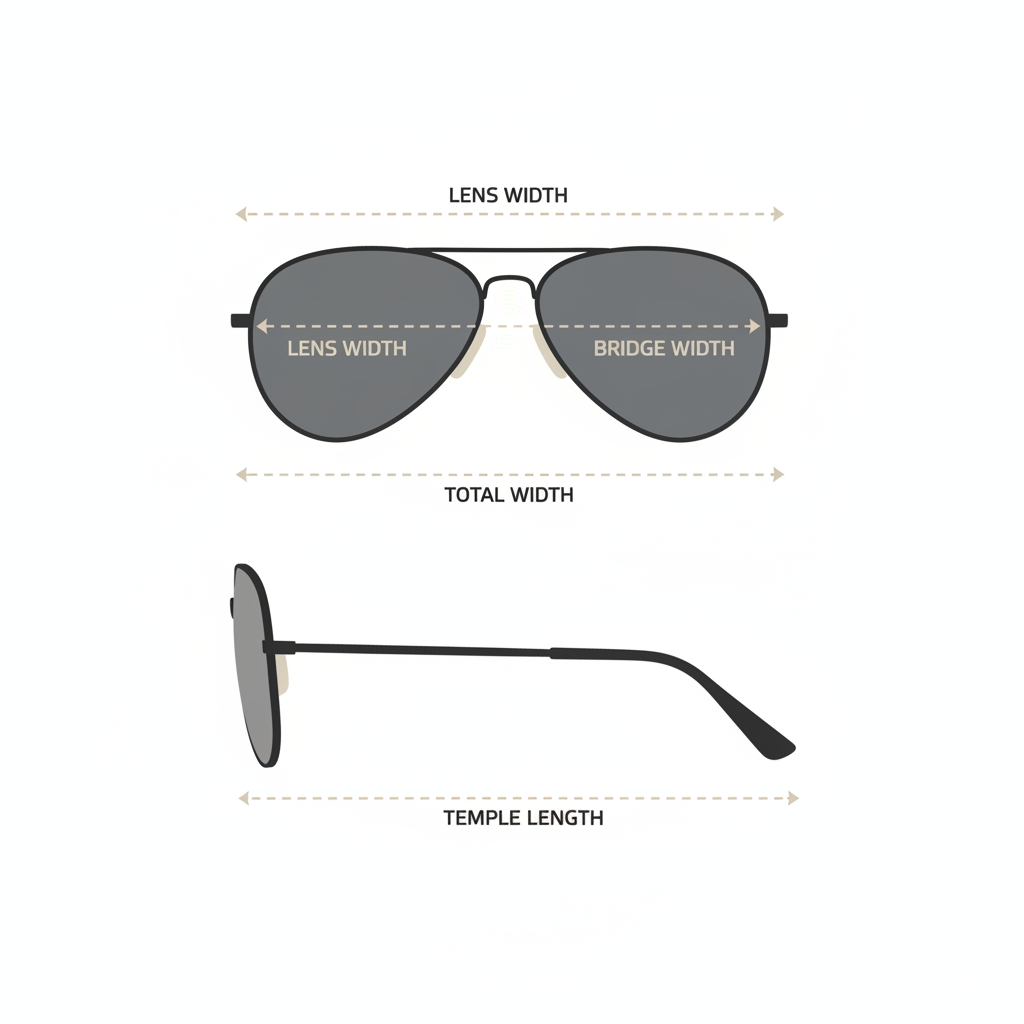
The three numbers inside your sunglass frame (e.g., 52-18-140) are your guide to a perfect fit. They represent:
- Lens Width (e.g., 52mm): The horizontal width of one lens.
- Bridge Width (e.g., 18mm): The distance between the lenses, which determines how they sit on your nose.
- Temple Length (e.g., 140mm): The length of the arm from hinge to tip.
While these numbers are a crucial starting point, the total frame width and your Pupillary Distance (PD) are the real keys to finding comfortable, optically precise eyewear online.
Decoding the Three Magic Numbers on Your Frames
Turn over your favorite pair of sunglasses and look at the inside of one of the arms, known as temples. You'll likely see a series of three numbers separated by a small dash or a square, such as 52-18-140. This isn't a model number; it's the frame's core dimensions in millimeters. Understanding this code is the first step to moving beyond guessing and toward precision when you shop for eyewear.
The First Number: Lens Width (e.g., 52mm)
The first number in the sequence represents the horizontal width of one of the lenses at its widest point. This is a primary factor in the overall size and scale of the glasses.
- Typical Range: For most men's styles, this number usually falls between 48mm and 58mm.
- Why It Matters: Lens width dictates how wide the frames will look on your face. Narrower lenses (e.g., 48-50mm) are often suited for smaller faces, while wider lenses (e.g., 54-58mm) complement larger facial structures. For those with stronger prescriptions (over ±4.00D), I always recommend prioritizing frames with a smaller lens width. This helps minimize the lens thickness at the edges, reducing weight and visual distortion—a crucial factor for both aesthetics and comfort. For more detail on this, our guide on high-prescription sunglass frames offers an in-depth look.
The Second Number: Bridge Width (e.g., 18mm)
The second number is the bridge width, measuring the shortest distance between the two lenses. This piece rests on your nose, making it one of the most critical measurements for comfort.
- Typical Range: This measurement typically ranges from 16mm to 20mm.
- Why It Matters: A well-fitting bridge ensures the glasses sit at the correct height and don't slide down your face. If the bridge is too narrow, the frames will sit too high and may pinch your nose. If it's too wide, the frames will constantly slip. A practical heuristic I use in the shop is simple: if you try on a pair and it feels tight on your nose, look for a model with a bridge width that is 1–2mm larger. Conversely, if a pair slides, try a smaller bridge measurement.
The Third Number: Temple Length (e.g., 140mm)
The final number is the temple length, which measures the entire "arm" from the frame hinge to the very tip that rests behind your ear.
- Typical Range: Standard temple lengths are often 135mm, 140mm, or 145mm.
- Why It Matters: The temple arm must be long enough to wrap comfortably and securely over your ear. If it’s too short, the frames will feel unstable and may slip forward. A common mistake is assuming the printed temple length is an absolute guarantee of comfort. In reality, the end of the temple arm can typically be heat-adjusted by a professional to curve more or less, effectively changing the fit by 5-10mm. So, while it’s a vital measurement, it also has a degree of built-in flexibility.
Beyond the Numbers: What Really Guarantees a Perfect Fit
A common myth I frequently encounter is that simply matching the three numbers from an old, comfortable pair of glasses will guarantee a perfect fit on a new pair. While it’s a great starting point, it’s not the whole story. Frame shape, material, and other dimensions play an equally important role.

Total Frame Width: A More Holistic Measurement
While not printed on the arm, the total width of the frame is arguably the most important factor for aesthetic balance. You can estimate it with a simple formula:
(2 x Lens Width) + Bridge Width + ~2-6mm for End Pieces/Hinges
For a truly great fit, the total width of your frames should be slightly wider than your face, but the lenses themselves should not extend past the sides of your face. You can easily measure your face width by looking in a mirror and holding a ruler straight across from temple to temple.
Pupillary Distance (PD): The Key to Optical Clarity
Your Pupillary Distance (PD) is the measurement in millimeters between the centers of your pupils. This is essential for prescription eyewear because it ensures the optical center of the lens aligns perfectly with your eye. A mismatch can cause eye strain, headaches, and visual distortion.
While a single PD number is common, for higher prescriptions or progressive lenses, I always work with a monocular PD—the individual measurement from your nose bridge to each pupil. This allows for far greater accuracy. While many online tools exist, it's important to ensure they are properly calibrated. You can learn more about this crucial step in our guide on how to measure your PD at home.
Lens Height and Frame Geometry
The vertical height of the lens is another unlisted measurement that impacts fit and function, especially for progressive lenses, which require a minimum vertical height of around 28-30mm to accommodate the different viewing zones.
Furthermore, the overall shape of the frame is critical for protection. As a study on ocular UV exposure published in the Proceedings of the National Academy of Sciences (PMC) found, frame geometry is a major factor in how much peripheral light reaches the eye. This is why "wraparound" styles offer significantly more protection during high-exposure activities than standard flat frames, as they block UV rays from the sides. For those interested in this style, especially with a prescription, our guide to wraparound sunglasses is a valuable resource.
Pro Tips from an Optician's Toolkit
After years of fitting eyewear, you learn to spot common issues quickly. Understanding these can save you the frustration of a poor online purchase.
Expert Warning: The Pitfalls of Uncalibrated Phone Apps
A mistake I often see is people relying entirely on a phone app to measure their PD without using a credit card or another object of a known size for scale. While convenient, these apps can have an error margin of ±1–2mm. According to our article on PD errors, this might be negligible for very weak prescriptions, but for anyone with a moderate-to-strong correction, this inaccuracy is enough to induce noticeable eye strain or headaches.
Common Fit Problems & Solutions Checklist
I’ve compiled a quick troubleshooting guide for the most frequent fit issues. Use this table to diagnose problems and find the right solution.
| Problem | Likely Cause | How to Fix It When Shopping |
|---|---|---|
| Glasses slide down your nose | The bridge is too wide, or temples are too short. | Look for a frame with a 1-2mm smaller bridge width. Ensure temple length is adequate. |
| Pinching or marks on the nose | The bridge is too narrow. | Select a frame with a 1-2mm wider bridge width. |
| Frames look too wide or too narrow | The total frame width doesn't match your face. | Measure your face width and choose a frame where the total width is a close match. |
| Pressure or pain behind the ears | The temples are too short or not adjusted correctly. | Choose a longer temple length and get the curve adjusted for a custom fit. |
Wrapping Up: From Numbers to Confidence
Those three numbers on your sunglass frames are more than just a technical specification; they are the foundation of a comfortable and effective fit. By understanding what lens width, bridge width, and temple length mean, you can move from a world of guesswork to one of informed choices.
However, remember that these numbers are just the starting point. For a truly superior fit, you must also consider the total frame width, your pupillary distance, and the practical realities of how a frame sits on your unique features. Armed with this knowledge, you are now fully equipped to navigate the world of online eyewear and find a pair of sunglasses that feels like it was made just for you.
Frequently Asked Questions (FAQ)
Can I just use the numbers from my old glasses to buy a new pair?
Yes, using the dimensions from a comfortable old pair is an excellent starting point and will likely get you a similar fit. However, be sure to also compare the overall frame shape and total width, as different styles can fit differently even with the same core numbers.
What if there are only two numbers on the frame?
This is uncommon in modern eyewear but can sometimes be found on older or minimalist frames. It typically indicates that the temple length is considered a "standard" size and has been omitted. In this case, focus on the lens and bridge width for fit.
How much can the numbers vary and still provide a good fit?
As a general rule of thumb, you can often go up or down by 1-2mm on the lens and bridge widths without a dramatic change in fit. Temple length is less flexible, but remember that the ear-bend can be adjusted. The most important factor is that the bridge is comfortable and the total width is appropriate for your face.
Disclaimer: This article is for informational purposes only and does not constitute professional medical advice. Please consult with a qualified optometrist or ophthalmologist for any vision-related health concerns, especially if you have pre-existing conditions. The accuracy of at-home measurements can vary, and a professional fitting is always recommended for optimal comfort and optical performance.
References
- American Academy of Ophthalmology (AAO). (n.d.). Choosing the Best Sunglasses. https://www.aao.org/eye-health/glasses-contacts/sunglasses-3
- Alfieri, R., et al. (2019). Ocular and periocular ultraviolet radiation exposure in a mannequin model. Proceedings of the National Academy of Sciences, 116(43). https://pmc.ncbi.nlm.nih.gov/articles/PMC6803516/
- U.S. Food and Drug Administration (FDA). (2023). Impact-Resistant Lenses: Questions and Answers. https://www.fda.gov/regulatory-information/search-fda-guidance-documents/impact-resistant-lenses-questions-and-answers


