






Do Scratches on Sunglass Lenses Affect UV Protection?
TL;DR: Do Scratches Affect UV Protection?
For most modern sunglasses, the answer is no. A typical surface scratch does not compromise UV protection. Here’s the quick breakdown:
- If your lenses are made of polycarbonate or high-index materials: The UV protection is built directly into the lens material itself. A scratch is just a surface defect and cannot remove the UV-blocking properties.
- If your lenses have a UV coating (common in older or very low-cost glasses): A deep scratch could potentially remove the coating in that specific area, creating a tiny, unprotected spot. However, the risk from this small exposure is minimal compared to the visual problems the scratch causes.
- The bigger concern: A significant scratch, especially in your line of sight, causes visual distortions, glare, and eye strain. This functional impairment is a more immediate reason to replace your lenses than the negligible loss of UV protection.
A scratch on a brand-new pair of sunglasses is a frustrating experience. Beyond the cosmetic annoyance, it’s natural to wonder if the damage has compromised their most important feature: protecting your eyes from harmful ultraviolet (UV) radiation. The answer isn't a simple yes or no; it depends entirely on the technology used to make your lenses.
This article will explore the science behind UV protection in sunglasses, help you assess the damage to your own pair, and provide clear, expert-backed guidance on when a scratch is just a scratch, and when it’s time for a replacement.
How Sunglasses Block UV Light: Two Core Technologies
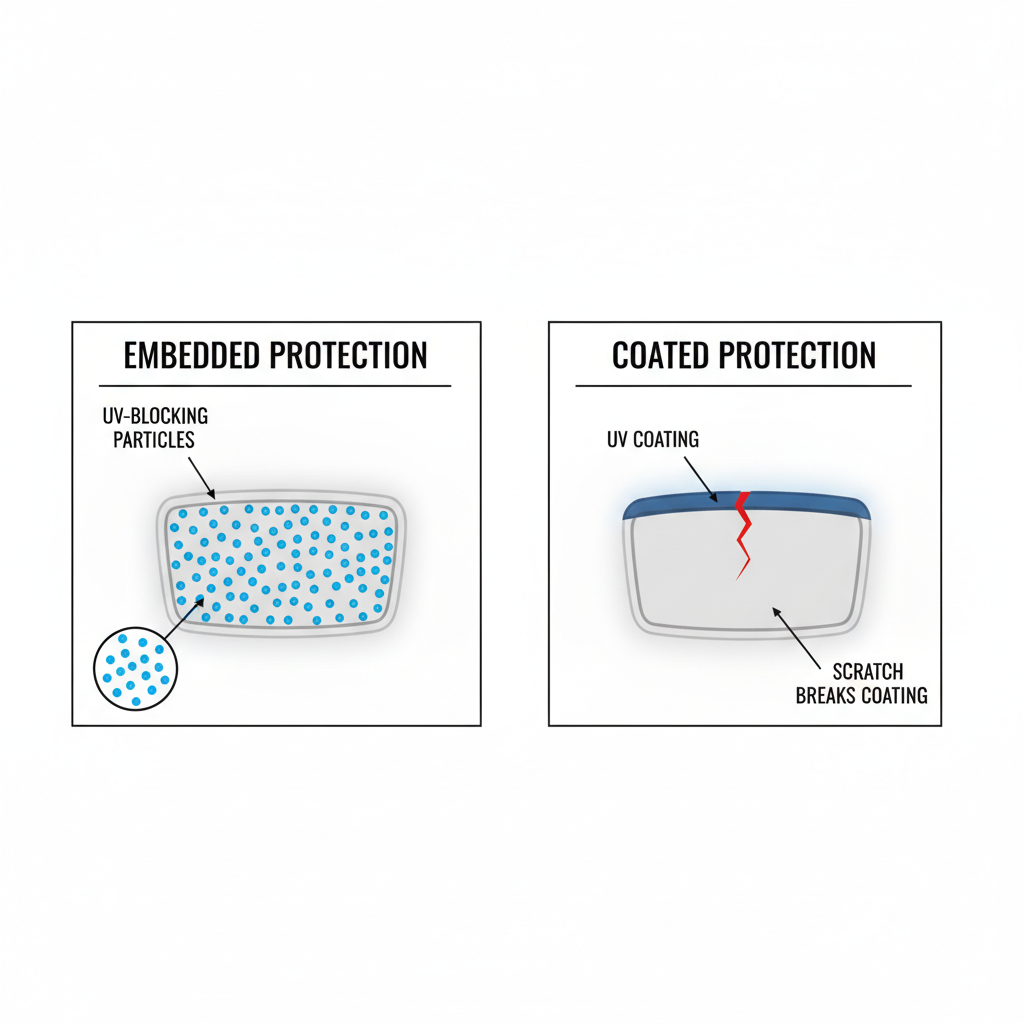
To understand if a scratch matters, you first need to know how your lenses are made. UV protection is integrated into lenses in one of two ways: it’s either mixed into the material itself or applied as a surface coating.
The Modern Standard: Embedded UV Protection
Virtually all quality sunglasses sold today, especially those with polycarbonate lenses, feature embedded UV protection. During manufacturing, UV-absorbing compounds are mixed directly into the liquid lens material (the monomer) before it is molded and hardened.
Think of it like mixing cocoa powder into cake batter rather than just spreading frosting on top. The UV protection is an inseparable part of the entire lens, from front to back. As a result, a surface scratch cannot remove the UV-blocking capability. The material beneath the scratch is just as protective as the surface.
According to health resources from the University of Utah, modern polycarbonate lenses have this UV protection built into the material itself, making it a durable and reliable solution.
The Older Method: UV-Protective Coatings
An older or less common method involves applying a clear, UV-blocking coating to the surface of a basic plastic lens that lacks inherent protection. While effective when new, this technology has a distinct vulnerability: the protection can be physically removed.
A deep scratch can scrape away a line of this coating, potentially exposing the non-protective lens material underneath. While this might create a microscopic entry point for UV rays, the area is so small that it poses a very low risk. The more significant issue with a scratched coating is that it can peel or flake, severely impacting visual clarity.
A Practical Guide to Assessing a Scratched Lens
Is your scratch a safety concern or just an aesthetic flaw? You can determine the risk by evaluating the lens material, scratch depth, and, most importantly, the impact on your vision.
Step 1: The Fingernail Test for Scratch Depth
First, assess how deep the scratch is. Gently run your fingernail across the lens surface.
- If your nail glides smoothly over the mark: It’s a minor, cosmetic scuff in the scratch-resistant hard coat. It has no impact on UV protection.
- If your nail catches in the groove: It’s a deep scratch. This is the only type of damage that could potentially compromise a UV coating (if your lenses have one). Even so, the primary concern is not UV but visual distortion.
Step 2: The Visual Distortion Test
This is the most critical test. The real danger of a scratched lens comes from its effect on optical clarity, which can lead to eye strain, fatigue, and headaches. Put your sunglasses on and look at a pattern of straight lines, like a tiled floor, a brick wall, or a door frame.
- Ask yourself: Do the lines appear to bend, wave, or distort when you look through the scratched area?
- Check for light scatter: In a well-lit room, look near a lamp. Does the scratch create a distracting halo, starburst, or glare?
If you answered yes to either of these questions, the scratch is functionally significant. It is interfering with the lens’s ability to deliver clear, accurate vision to your eye. This optical interference is a far greater problem than any potential UV leakage.
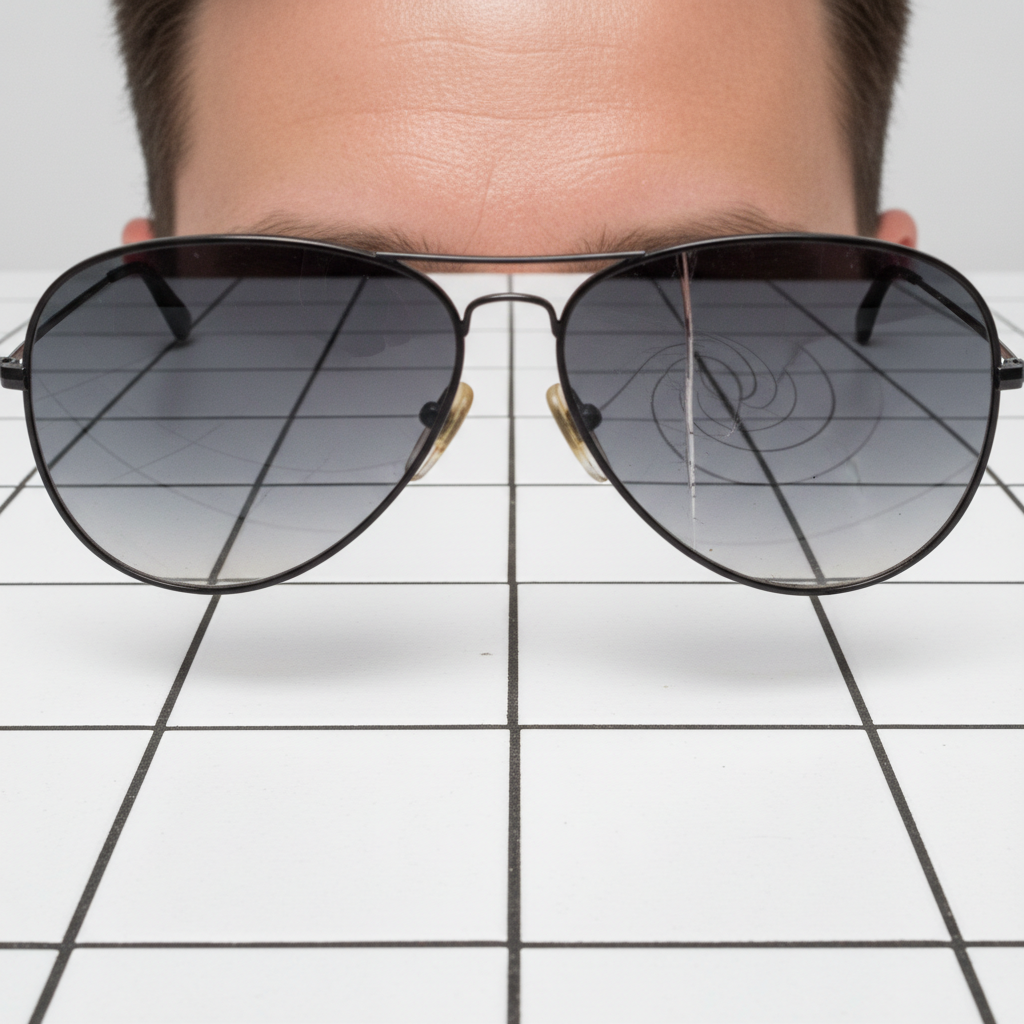
The Hidden Dangers of Scratched Lenses
Even if a scratch doesn’t affect UV protection, it can introduce other risks that warrant replacing your eyewear.
Myth Debunked: Darkness and Safety
A pervasive myth about sunglasses is that darker lenses offer better protection. This is dangerously false. Lens color and tint darkness are completely separate from UV protection. In fact, wearing dark sunglasses that lack a proper UV filter is more harmful than wearing none at all. As explained by experts at the MD Anderson Cancer Center, the dark tint causes your pupils to open wider. If the lens isn't blocking UV, this dilation allows even more damaging radiation to enter your eye.
True safety comes from a certification label stating "UV400" or "100% UV Protection," which means the lenses block all UVA and UVB rays up to 400 nanometers. This protection is independent of the lens color or how dark it is.
Compromised Impact Resistance
All sunglasses and prescription glasses sold in the United States must meet impact resistance standards set by the FDA. This is verified using the "Drop Ball Test," where a steel ball is dropped onto the lens to ensure it doesn’t shatter. A deep scratch creates a structural fault line, weakening the lens and potentially causing it to fail an impact test that it would have otherwise passed. For active individuals or in situations where eye safety is critical, this compromised integrity is a significant concern.
Lens Efficacy Over Time
Beyond scratches, do lenses lose their UV-blocking power with age? Research on this topic is ongoing, but some studies suggest it's possible. A report in the journal SPIE noted that some lens materials could experience "photobleaching," a degradation of UV-blocking efficacy after hundreds of hours of direct, intense sun exposure. For the average person, this is not a major concern. However, if you are an outdoor professional (e.g., a landscaper, pilot, or ski instructor) and have used the same pair for several years, it may be worth considering a replacement to ensure maximum protection.
Key Takeaways: When to Replace Your Sunglasses
Deciding whether to keep or replace your scratched sunglasses comes down to function and safety. Use this checklist as a guide.
You should replace your sunglasses if:
- The scratch is in your direct line of sight and causes any visual distortion, warping, or blurriness.
- The scratch creates distracting glare, halos, or starbursts around lights.
- A deep scratch has caused the lens coating to peel or flake away.
- The lens is cracked, which compromises both its optical quality and impact resistance.
You likely do not need to replace your sunglasses if:
- It is a minor surface scuff on a modern polycarbonate lens.
- The scratch is on the periphery of the lens and is not in your field of vision.
- The scratch does not cause any visual distortion or glare.
Frequently Asked Questions (FAQ)
Q1: Can scratches on polarized lenses affect the polarization? Yes. Polarization is a film applied to or laminated within the lens. A deep scratch can damage this film, creating a "dead spot" or line where glare reduction is lost. This often appears as a bright or distorted area when viewing reflected glare.
Q2: Can you repair a scratch on a sunglass lens? No. Products that claim to "repair" scratches are typically waxy substances that fill the groove. While they might make the scratch less visible temporarily, they create significant optical distortion and will smudge and wear off quickly. There is no way to permanently and safely repair a scratched lens.
Q3: Are more expensive sunglasses more scratch-resistant? Generally, yes. Premium eyewear often features more advanced and durable scratch-resistant "hard" coatings. These are multi-layer coatings that are baked onto the lens for superior hardness. However, no sunglass lens is completely scratch-proof, and even the best can be damaged by contact with sand, keys, or pavement.
Disclaimer: This article is for informational purposes only and does not constitute professional medical advice. If you have concerns about your eye health or vision, please consult a qualified optometrist or ophthalmologist.
References
- University of Utah Health: "How to Tell if Your Sunglasses Are Really Protecting Your Eyes" - https://healthcare.utah.edu/healthfeed/2023/06/how-tell-if-your-sunglasses-are-really-protecting-your-eyes
- MD Anderson Cancer Center: "9 things to know about sunglasses, eye protection and cancer" - https://www.mdanderson.org/cancerwise/9-things-to-know-about-sunglasses--eye-protection-and-cancer.h00-159699123.html
- SPIE: "Evaluation of the conformity of sunglasses to the Brazilian standard and to the most recent international standards for UV protection" - https://ui.adsabs.harvard.edu/abs/2014SPIE.8930E..1EM/abstract
- U.S. Food & Drug Administration (FDA): "Impact-Resistant Lenses: Questions and Answers" - https://www.fda.gov/regulatory-information/search-fda-guidance-documents/impact-resistant-lenses-questions-and-answers


