









Sunglasses That Won't Snag or Pull Your Hair
The Frustration of Tangled Hair: Finding Sunglasses That Don't Snag
It’s a familiar, frustrating moment: you slide your sunglasses up to rest on your head, and when you go to pull them back down, they bring a painful tangle of hair with them. This common annoyance can ruin a hairstyle and even lead to breakage. The good news is that hair-snagging sunglasses aren't a given. The problem lies in specific design flaws, not the concept of sunglasses themselves.
By understanding the key features that prevent snagging—like seamless hinge construction, integrated nose pads, and ultra-smooth finishes—you can choose a pair that glides through your hair effortlessly. This guide breaks down the science of snag-free design, giving you a practical checklist for your next purchase.
TL;DR: Your Quick Guide to Snag-Free Sunglasses
- Prioritize Hinge Design: Look for "integrated" or "hidden" hinges that are molded into the frame, eliminating the gaps and barrels that trap hair.
- Inspect the Nose Pads: Choose frames with smooth, molded nose pads that are part of the frame itself, rather than separate, adjustable silicone pieces with small crevices.
- Check the Temple Arms: The inner edges of the arms should be perfectly smooth and rounded. A slightly rounded edge of even 2-3 millimeters can make a significant difference.
- Examine the Finish: High-quality polishing is crucial. Run your fingers along the entire frame; any rough spots or burrs are guaranteed to catch hair.
The Anatomy of a Snag: Why Most Sunglasses Tangle Your Hair
The difference between a smooth experience and a painful pull comes down to microscopic details in the frame’s construction. According to manufacturing process guides from sources like The Vision Council, the journey from raw material to polished frame involves dozens of steps, and skipping or rushing any of them can lead to the imperfections that cause snagging.
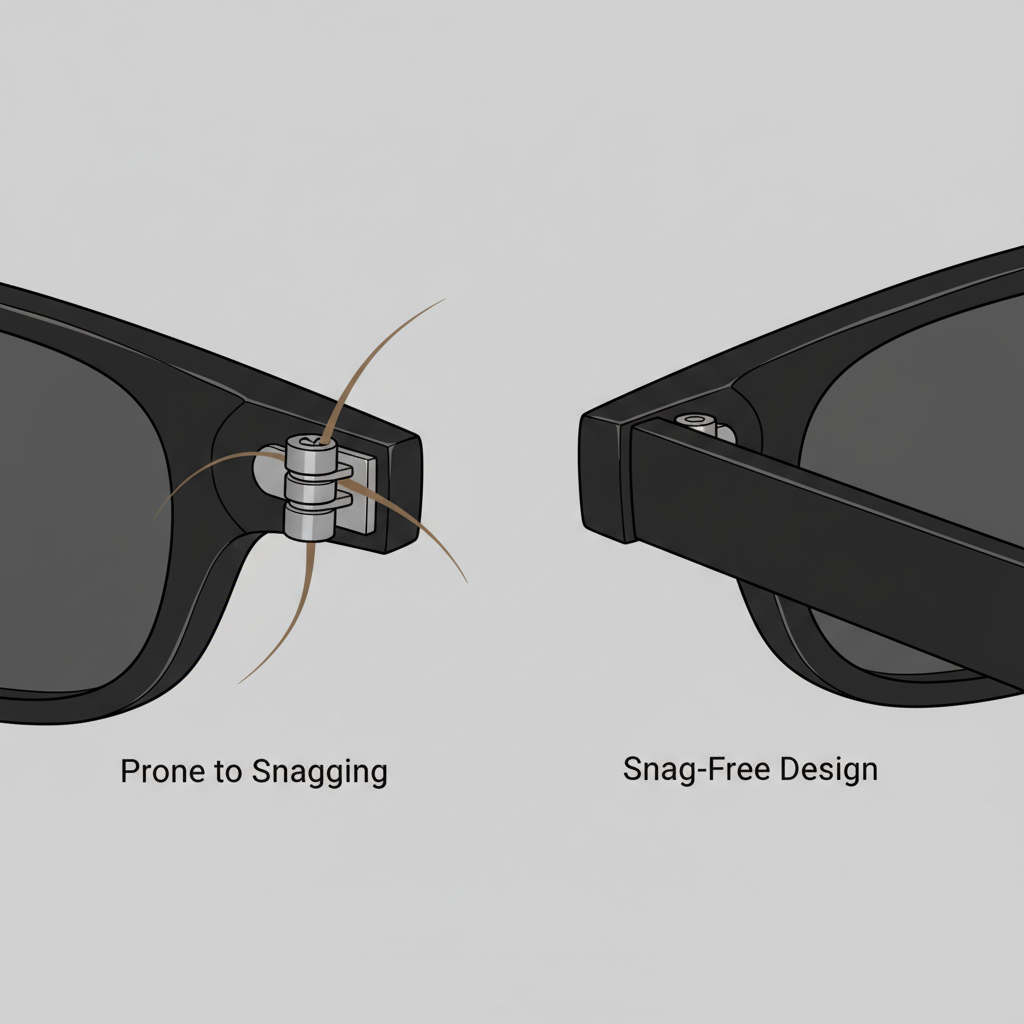
Culprit #1: Exposed Hinge Barrels
The most common offender is the traditional barrel hinge. This design involves interlocking metal loops that create a visible cylinder held together by a tiny screw. While effective, the small gaps between these loops are perfect traps for fine strands of hair.
- What to Look For Instead: Seek out frames with hidden or integrated hinges. These modern designs embed the hinge mechanism within the acetate or plastic of the frame itself, creating a completely smooth, continuous surface where the temple arm meets the frame front. There are no exposed parts for hair to get caught in.
Culprit #2: Sharp Edges and Rough Finishes
Even a premium material can become a snagging hazard if it isn't finished properly. During manufacturing, tiny burrs or sharp edges can be left along the temple arms or around the lenses. An inner-edge radius of less than half a millimeter is a common culprit for catching hair.
- The Expert Fix: From a technical perspective, a well-finished frame will have an inner-edge radius of 2–3 mm. This subtle rounding is enough to eliminate most snags. When shopping, run a finger along the inside of the temple arms. If you feel any sharpness or texture, it’s likely to pull your hair.
Culprit #3: Non-Integrated Nose Pads
Many metal frames and some plastic styles use adjustable nose pads made of silicone or PVC. These are mounted on small metal arms, creating multiple snag points where the pad meets the arm and where the arm meets the frame. Hair can easily get looped and trapped in these tiny crevices.
- The Seamless Solution: Look for acetate or nylon frames with integrated nose pads. These are molded as part of the frame's structure, offering a smooth, uninterrupted surface that hair can't get caught on. If you prefer the feel of soft nose pads, look for designs where the silicone is inset directly into the frame, leaving no gaps.
Your Checklist for Finding Snag-Free Sunglasses
Use this table as a quick reference guide when shopping. Focusing on these key construction details will dramatically increase your chances of finding a pair that is as comfortable on your head as it is over your eyes.
| Feature | Look For This (Snag-Free) | Avoid This (Snag-Prone) | Why It Matters |
|---|---|---|---|
| Hinges | Integrated, hidden, or seamless barrel-less designs. | Exposed multi-barrel hinges with visible gaps and screws. | Eliminates the primary trap where hair gets caught and twisted. |
| Nose Pads | Molded as part of the frame; smooth, inset silicone. | Adjustable pads on metal arms; separate pieces with crevices. | Creates a continuous surface with no small gaps for hair to loop into. |
| Temple Arms | Smooth, polished finish with rounded inner edges. | Sharp inner edges, rough textures, or decorative metal logos with raised edges. | Allows the arms to glide over hair without catching individual strands. |
| Temple Tips | Smooth, tapered design with a slight downward curve. | Abrupt, blocky tips or plastic sleeves with poorly sealed seams. | Ensures the glasses slide on and off the head easily without pulling. |
| Overall Quality | Feels smooth and solid when handled. No visible molding lines. | Feels flimsy; visible seams or burrs from the injection molding process. | A high-quality finish indicates the attention to detail needed to prevent snags. |
Debunking a Common Myth: Materials vs. Manufacturing
A frequent misconception is that one material, like plastic, is inherently less likely to snag hair than another, like metal. In reality, the quality of manufacturing is far more important than the material itself.
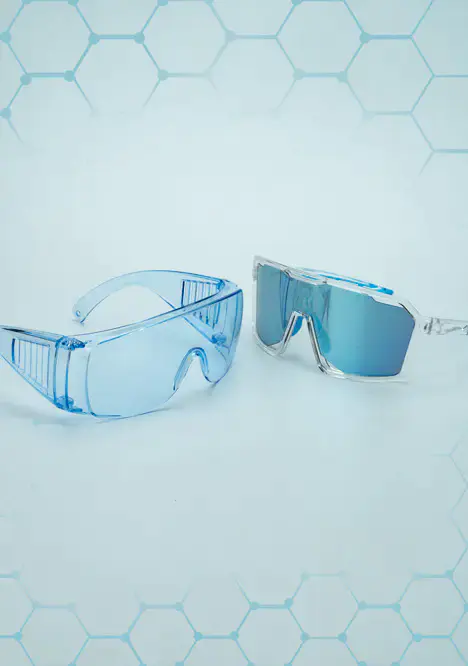
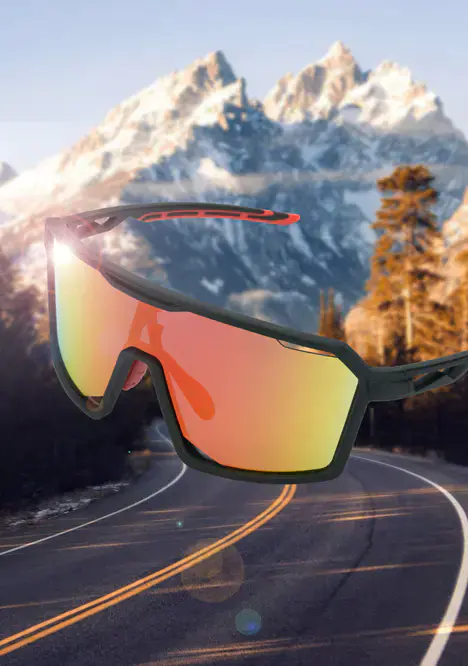
A cheaply made acetate frame with rough edges and an exposed barrel hinge will snag hair far more than a meticulously polished metal frame with a well-designed integrated hinge. The key is the precision in the finishing process. High-end frames undergo extensive hand-polishing and quality control checks to ensure every surface is perfectly smooth. This is a critical factor that organizations like the American Academy of Ophthalmology point to when discussing frame quality, even if their primary focus is on coverage for UV protection. The same design principles that create better coverage, such as those found in durable wraparound sunglasses, often lead to smoother, more integrated designs that are less likely to snag.
Quick Fixes and Proactive Care
What if you already own a pair of sunglasses that you love, but they constantly pull your hair? A few simple tricks can help.
- Micro-Sanding: For minor rough spots on a plastic frame, you can sometimes use a very fine-grit (600+) sandpaper or a nail polishing block to gently smooth the offending edge. Proceed with extreme caution and test on an inconspicuous area first.
- Apply a Sealant: A thin coat of clear nail polish over an exposed hinge screw can sometimes fill the gap just enough to prevent hair from getting caught.
- The "Slide Forward" Method: When moving sunglasses from your eyes to your head, don't just lift them straight up. Instead, slide them forward off your face first, then place them on your head from the front. This motion helps lay the hair down flat so the frames can glide over it.
- Consider Your Hair Type: Those with curly or coily hair benefit most from completely smooth surfaces and closed hinges. If you have fine, straight hair, you may tolerate some designs better, but soft silicone nose pads can provide extra grip to keep the frames from sliding without pulling.
Wrapping Up: The Path to Tangle-Free Style
Choosing sunglasses that won't pull your hair isn't about luck; it's about making an informed choice based on design and construction. By prioritizing frames with smooth, integrated hinges, molded nose pads, and impeccably polished finishes, you can eliminate the frustration of tangled hair for good. The next time you shop for a new pair, use the checklist to inspect the small details that make a big difference. Your hair will thank you for it.
Frequently Asked Questions (FAQ)
1. Are metal or plastic frames better for not pulling hair?
Neither material is inherently better. The manufacturing quality is the most important factor. A well-made metal frame with smooth, integrated hinges can be superior to a poorly-finished plastic frame with exposed hinges and rough edges. Look for smoothness and seamless construction, regardless of material.
2. Do spring hinges cause more snagging?
Spring hinges can be more prone to snagging because the mechanism creates a larger, more complex gap where the temple arm meets the frame. Hair can easily get trapped inside the spring housing. If you are sensitive to snagging, it's often best to choose frames with a standard, high-quality integrated hinge.
3. Can I fix a pair of sunglasses that already snags my hair?
For minor issues, you can try gently sanding a rough plastic edge with a very fine-grit buffer or applying a drop of clear nail polish to fill a gap in a hinge. However, for major design flaws like exposed barrel hinges, there is often no easy fix. The best solution is to choose a well-designed pair from the start.
4. Are more expensive sunglasses less likely to snag hair?
While not a guarantee, higher-priced sunglasses often undergo more rigorous finishing and polishing processes, which reduces the chance of rough edges that snag hair. However, you can find affordable sunglasses that are snag-free if you know what to look for. Focus on the design features—integrated hinges, molded nose pads, and a smooth finish—rather than the price tag alone. As sunglasses are considered Class I Medical Devices by the FDA, all reputable sellers must adhere to certain manufacturing standards, but the level of refinement can vary.


