














Decoding Temple Arm Length for a Secure Sunglass Fit
TL;DR: How to Find Your Sunglass Temple Length
Feeling pressure behind your ears or constantly pushing your shades back up your nose? The temple arms are likely the wrong length. For a secure fit, measure the temple arm of a pair of glasses that already fits you well, from the hinge to the very tip. This measurement, usually between 130 mm and 150 mm, is your key to all-day comfort. If you don't have a reference pair, measure from your temple to just behind your ear and add about 30-35 mm.
Why Temple Length is the Unsung Hero of Sunglass Fit
When choosing sunglasses, we focus on lens shape, frame color, and overall style. We might even check the lens width and bridge size. But the third number in that sequence, like the "140" in "52-18-140," is the temple arm length in millimeters, and it's arguably one of the most critical factors for long-term comfort and stability.
This measurement dictates how the frame balances on your face. It determines where the glasses make contact behind your ears and how securely they stay put during movement. An incorrect length is the primary culprit behind two of the most common fit complaints:
- The Pinch: A sharp, localized pressure behind your ears that grows from a minor annoyance to a real headache. This happens when the temple arms are too short, forcing the curve to dig into the sensitive area behind your ear instead of resting gently over it.
- The Slip: The frustrating tendency for your sunglasses to slide down your nose, forcing you to constantly push them back up. This occurs when the temple arms are too long, creating a gap behind your ear and failing to provide the necessary grip to hold the frames in place.
Debunking a Common Myth: Frame Width vs. Temple Length
A frequent mistake is assuming that a wide frame automatically requires long temples. This isn't always true. According to insights from professional opticians, the ideal temple length is more dependent on the distance from the front of your face to the spot where your ear begins. Two people with the same face width might need very different temple lengths if one has ears that are set further back than the other. The angle of the hinge and the shape of the temple tip's curve also play a significant role in how the frame sits, making the temple length measurement a far more reliable indicator of fit than frame width alone.
How to Find Your Ideal Temple Length
Determining your perfect temple length is a straightforward process that ensures your next pair of sunglasses fits as if it were custom-made. A proper fit is not just about comfort; it's a crucial safety component, especially in active situations. As highlighted in a review of sports eyewear standards, a frame that fits securely is less likely to become dislodged during an impact, ensuring the protective lenses stay where they need to be. You can find your ideal measurement in just a few minutes.
Step-by-Step Guide to Measuring Your Fit
The most reliable method is to use a pair of existing glasses or sunglasses that already feel comfortable and secure.
- Find a Ruler: Grab a small ruler with millimeter markings for the most accurate measurement.
- Position the Frame: Lay your glasses on a flat, stable surface.
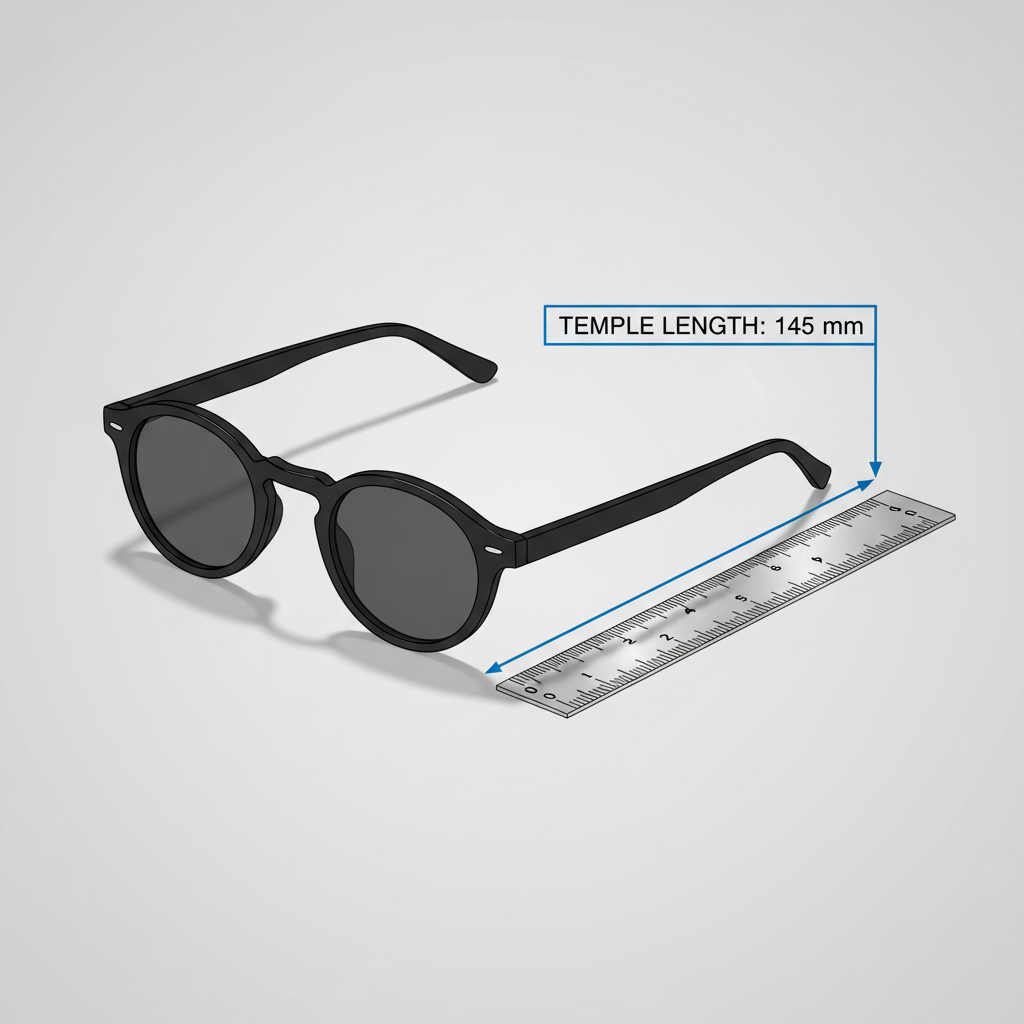
- Measure the Arm: Place the "0" mark of the ruler at the center of the hinge screw where the temple arm connects to the frame front.
- Extend to the Tip: Extend the ruler along the entire length of the temple arm, following its curve, all the way to the very end of the tip.
- Record the Measurement: The number in millimeters is your ideal temple length. Most will fall between 120 mm and 150 mm.
Expert Tip: If you don't have a pair of glasses to use as a reference, you can get a close estimate. Use a flexible measuring tape to measure the distance from your temple (the flat area next to your eye) straight back to the point just behind the top of your ear. Add 30-35 mm to this measurement to account for the portion of the arm that extends to the frame front. While not as precise, this gives you a strong starting point.
Understanding Temple Length Categories
Temple lengths are generally consistent across the industry. Knowing where you fall can help you quickly filter online selections.
| Temple Length Range | Classification | Best For |
|---|---|---|
| 120 mm – 129 mm | Short | Individuals with smaller heads or ears set closer to the face. |
| 130 mm – 139 mm | Medium | Fits the majority of adults; this is a very common size range. |
| 140 mm – 150 mm | Long | Individuals with larger heads or ears set further back. |
| 150 mm + | Extra-Long | Less common; typically for those who need a specialty fit. |
Solving Common Fit Problems
Even with the right measurements, you might encounter issues. Understanding the cause makes finding a solution much easier. Many issues boil down to the interplay between temple length and frame design.
Problem: Constant Pressure or Pain Behind the Ears
If you feel a digging or pinching sensation, your temple arms are too short. The curve of the arm isn't clearing your ear, causing it to press into cartilage and skin. When shopping, look for a temple length that is at least 5 mm longer than your current pair. If you have frames made of acetate, a skilled optician can often gently heat and reshape the arm to adjust the curve, but there is no way to lengthen a temple that is fundamentally too short.
Problem: Sunglasses Slipping Down Your Nose
This is the classic sign of temple arms that are too long. The curve behind the ear starts too far back, failing to "hook" on and provide grip. This is often made worse by heavy lenses or a wide bridge. Look for a temple length that is 5-10 mm shorter. Also, consider the temple tip material; a rubberized or textured tip can provide extra grip to counteract minor slipping.

The Role of Spring Hinges and Frame Materials
The type of hinge and frame material can offer some flexibility. Spring hinges can add about 5-8 mm of usable flex, which can forgive a slightly short temple length by reducing pressure. However, it won't solve the problem of a grossly incorrect size.
Frame material also matters for adjustments:
- Acetate: This plastic material can be gently heated and reshaped by a professional to alter the temple curve by a few millimeters. This is useful for customizing the fit behind the ear.
- Metal: Metal temples can be bent slightly, but repeated adjustments risk causing metal fatigue and breakage. Minor bends of 1-2 mm are possible but should be done with care.
Advanced Fit: Why It Affects More Than Just Comfort
A secure fit is about more than just avoiding annoyance; it impacts the performance and protective qualities of your eyewear. Research on ocular UV exposure using 3D head-forms, detailed in a study available through PMC, found that the geometry and fit of a frame are critical. Poorly fitting glasses allow more peripheral light to leak in from the sides and top, potentially reducing their UV-blocking effectiveness.
Furthermore, the temple length affects the vertex distance—the space between the back of the lens and the front of your eye. For prescription wearers, a stable vertex distance is essential for clear vision. If your frames are constantly slipping, you're changing that distance and potentially compromising your visual acuity. This is why starting with the right fit fundamentals, including temple length and measuring your pupillary distance (PD), is so important for online eyewear purchases.
Key Takeaways for a Perfect Fit
Finding the right sunglasses online can feel daunting, but ensuring a secure and comfortable fit is entirely achievable when you focus on the right details.
- Measure First: Don’t guess. Use a well-fitting pair of glasses as your guide to find your ideal temple length.
- Prioritize Length Over Width: Remember that the length of the temple arm is more critical for a secure fit than the overall width of the frame front.
- Diagnose Fit Issues: Understand that pressure behind the ears means temples are too short, while slipping means they are too long.
- Consider the Whole Frame: Pay attention to materials and hinge types, which can offer minor adjustability and forgiveness in fit.
A few minutes of measurement can save you from the daily annoyance of ill-fitting sunglasses, ensuring your new pair is one you'll love to wear.
Frequently Asked Questions (FAQ)
1. Can I adjust the temple length myself? It is not possible to shorten or lengthen a temple arm. However, you can make minor adjustments to the bend of the temple tip if the frame is made of acetate. We recommend taking it to a professional optician, as improper heating can damage the material. Metal frames should only be adjusted minimally to avoid breakage.
2. Does a difference of a few millimeters in temple length really matter? Yes, it can make a significant difference. A temple that is just 5 mm too short can cause painful pinching, while one that is 5 mm too long can lead to constant slipping. While there is some tolerance, especially with spring hinges, staying as close to your ideal measurement as possible is best for comfort.
3. Are spring hinges always better? Not necessarily. While spring hinges provide extra flexibility and can enhance comfort for some, a well-fitted standard barrel hinge on a frame with the correct temple length will be just as secure and comfortable. Spring hinges are a helpful feature but aren't a substitute for a proper initial fit.
Disclaimer: This article is for informational purposes only and does not constitute professional medical advice. The information provided is intended to help you make informed decisions about eyewear, but you should consult with a qualified eye care professional for any specific vision needs or health concerns.


