









How to Test the Quality of Blue Light Lenses at Home
Do Your Blue Light Glasses Really Work? Simple At-Home Tests to Find Out
You've bought a pair of blue light filtering glasses, hoping to ease digital eye strain or improve your sleep. But a nagging question remains: are they actually doing anything? In a market filled with bold claims, it's smart to be skeptical. The good news is you don't need a science lab to get a good idea of your lenses' effectiveness.
This guide will walk you through simple, reliable methods to test your blue light glasses at home. We'll cover what to look for, which tests work best, and which common "tricks" are actually myths. By the end, you'll be able to verify your lenses' quality with confidence.
Understanding What You're Testing For
Before you start testing, it’s crucial to know what you’re looking for. Not all blue light lenses are created equal. They generally fall into two categories:
- Clear "Filter" Lenses: These are designed for daytime use and have a subtle coating that aims to reduce a portion of the highest-energy blue-violet light (typically in the 400-455 nm spectrum). They are meant to reduce glare and sharpen contrast without significantly distorting color perception.
- Amber/Orange "Blocking" Lenses: These are much more powerful and are intended for evening use. Their visible tint is designed to block a large percentage of the entire blue light spectrum (up to 500 nm) to prevent the suppression of melatonin, your body's sleep hormone.
The goal of a good test is to see how well your lens attenuates or blocks blue light from passing through it.
Common Misconception: The Reflection Color Myth
A widespread myth is that the color of the reflection off the lens surface—usually purple or green—indicates blue light filtering. This is incorrect. That colorful glare is the anti-reflective (AR) coating, which is designed to reduce reflections from the front and back of the lenses to improve clarity and reduce distractions. While many high-quality blue light lenses also have an AR coating, the coating itself is not the filter. You cannot judge filtering performance by the reflection's color.

The Most Reliable At-Home Test: The Blue LED Method
This is the most effective and straightforward DIY test. It relies on a concentrated source of blue light to make the filtering effect obvious.
What You'll Need:
- A blue LED light source (a blue LED penlight is ideal, but a phone screen set to display a pure blue square also works).
- Your blue light glasses.
- A pair of regular prescription or non-prescription glasses with clear lenses (for comparison).
- A neutral white surface (like a wall or piece of paper).
Step-by-Step Instructions:
- Set the Scene: Go into a dimly lit or dark room to make the light source clear and avoid interference from ambient lighting.
- Establish a Baseline: Shine the blue LED light onto the white surface. Note its brightness and color.
- Test the Control Lens: Place a lens from your regular, non-filtering glasses in front of the light beam. You should see little to no change in the light's brightness or color on the wall. This is your control.
- Test the Blue Light Lens: Now, place your blue light filtering lens in the path of the beam.
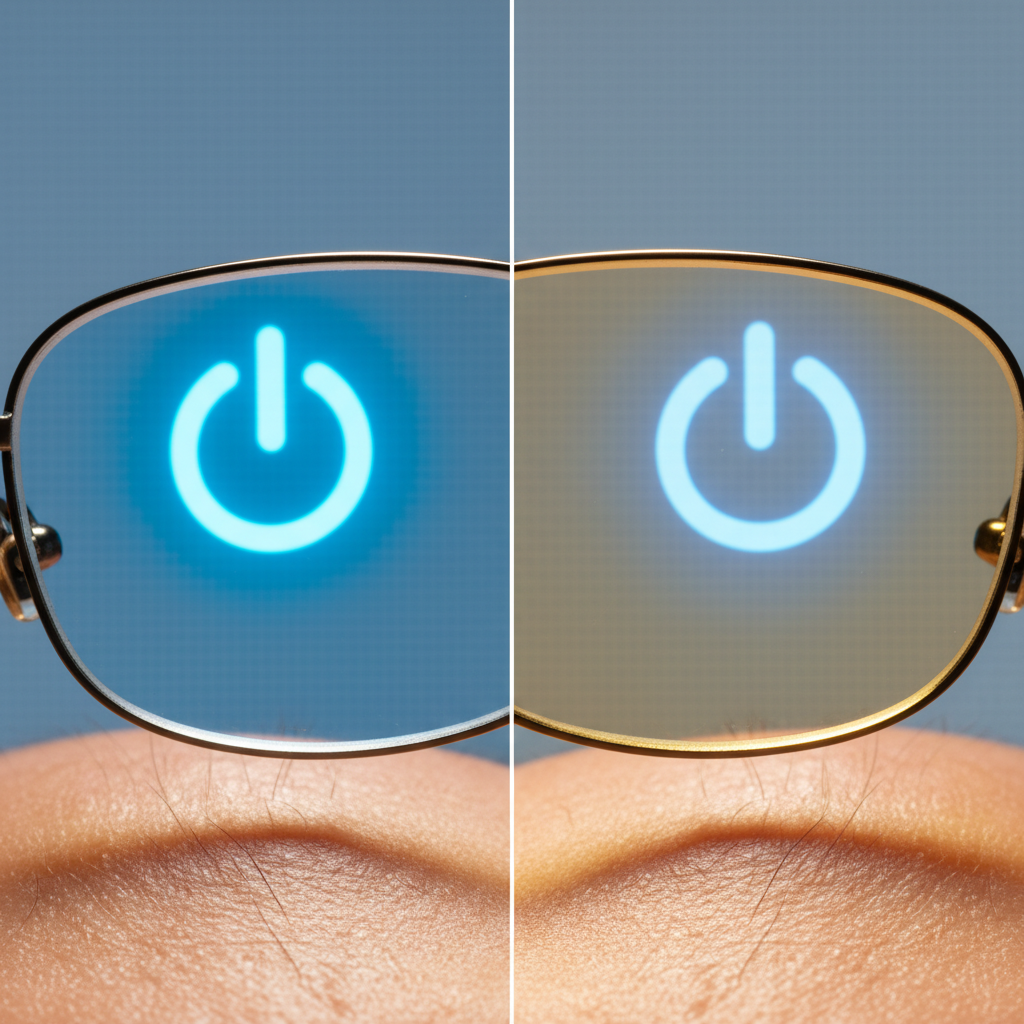
- Observe the Result: Look at the light projected onto the surface. A quality blue light filtering lens will noticeably dim the blue light. A clear, subtle filter might reduce it by 15-30%, while a heavier amber-tinted lens will block it almost entirely.
This direct comparison makes it easy to see the filtering effect in action.
A Quick Visual Check: The Screen Color Block Test
This test uses your computer or smartphone screen to check for color distortion, which indicates that certain light wavelengths are being filtered.
- Find a Color Spectrum Image: Search for an image that displays a full spectrum of colors, including a vibrant blue.
- View Without Glasses: Look at the image normally to establish your baseline. Pay close attention to the whites and blues.
-
View With Glasses: Put on your blue light glasses and look at the same image.
- With clear "filter" lenses: The whites should take on a very faint yellowish or warm tint. The vibrant blues may appear slightly muted or less intense.
- With amber/orange "blocking" lenses: The effect will be dramatic. The entire screen will shift to a warm, orange hue, and the blue sections of the image will appear very dark or nearly black.
This test confirms that the lenses are altering the light that reaches your eyes.
Interpreting Your Results and Common Pitfalls
How your lenses perform in these tests depends on their intended purpose. Don't be concerned if your clear daytime lenses only have a subtle effect; that's by design.
| Lens Type | Blue LED Test Result | Screen Color Test Result | Primary Use |
|---|---|---|---|
| Clear/Subtle Filter | Noticeable dimming of blue light (e.g., 15-30% reduction) | Whites appear slightly warm/yellow; blues are subtly muted. | All-day use to reduce glare and high-energy violet light. |
| Amber/Orange Blocker | Significant dimming or complete blocking of blue light. | Entire screen appears orange; blues look black or very dark. | Evening/night use to support sleep cycle. |
Expert Warning: Why Smartphone Camera Tests Are Unreliable
You may have seen videos of people placing lenses over their smartphone camera to test them. This is not a reliable method. Smartphone cameras have automatic white balance and exposure correction. The software will try to "fix" the color shift introduced by the lens, hiding the filtering effect and misleading you. Always trust what your own eyes see directly, not what a camera shows you.
Other common mistakes to avoid:
- Testing in bright, mixed lighting: This can contaminate your results. Always test in a dark environment with a single light source.
- Ignoring other factors: Remember that perceived clarity also depends on having the correct prescription and an accurate pupillary distance (PD). Even the best filter won't work well if the glasses aren't made for your eyes. For more on this, see our guide on why a small PD error can matter.
Beyond DIY: How Professionals Verify Lens Quality
While at-home tests are great for confirmation, professional optical labs use a device called a spectrophotometer. This instrument measures the exact percentage of light transmitted at every specific wavelength. Reputable eyewear manufacturers use this data to create spectral graphs for their lenses.
According to a detailed analysis in a study published by the National Center for Biotechnology Information, high-quality filters are selective. They are engineered to reduce the transmission of potentially hazardous blue-violet light (around 400–455nm) while allowing more of the "good" blue-turquoise light (455–500nm), which is essential for regulating your sleep-wake cycle, to pass through.
Key Takeaways
Testing your blue light glasses at home is a simple and empowering way to ensure you're getting the protection you paid for.
- Trust the Blue LED Test: It's the most reliable DIY method for visualizing the filtering effect.
- Forget the Reflection Myth: The purple or green glare is from an anti-reflective coating, not the blue light filter.
- Match the Lens to the Purpose: Clear lenses are for subtle, all-day filtering, while amber lenses are for significant blocking before bed.
- Trust Your Eyes, Not Your Camera: Avoid using your smartphone camera for testing, as its auto-correction features can hide the filtering effect.
By performing these simple checks, you can be a more informed consumer and feel confident in the quality and function of your eyewear.
Frequently Asked Questions (FAQ)
Q: Do blue light glasses actually reduce digital eye strain? A: The current medical consensus is that blue light from screens is not the direct cause of digital eye strain. As experts from the Cleveland Clinic explain, symptoms like tired eyes and headaches are primarily caused by a reduced blink rate and focus fatigue. A rigorous double-blind study found no significant difference in eye strain symptoms between participants wearing blue-blocking lenses and those wearing placebos. The best remedy for eye strain is taking regular breaks using the "20-20-20" rule.
Q: So, when should I wear blue light glasses? A: The most significant evidence for blue light glasses is related to sleep regulation. Research from Harvard Health Publishing suggests that wearing them in the evening can help prevent the suppression of melatonin, potentially making it easier to fall asleep. Chronobiology experts recommend against daytime use, as blue light during the day is crucial for alertness, but strongly encourage use after dusk.
Q: Can I use one pair for both day and night? A: It's not ideal. A lens strong enough to protect your sleep cycle at night (amber/orange) will distort color too much for comfortable all-day use. A subtle daytime lens won't be powerful enough to offer significant melatonin protection in the evening. It's best to use them for their intended purposes.
Disclaimer: This article is for informational purposes only and does not constitute professional medical advice. Consult with a qualified eye care professional for any health concerns or before making decisions about your vision care.
References
- Cleveland Clinic. "Do Blue Light Blocking Glasses Actually Work?" https://health.clevelandclinic.org/do-blue-light-blocking-glasses-actually-work
- Harvard Health Publishing. "Can blue-light blocking glasses improve your sleep?" https://www.health.harvard.edu/blog/can-blue-light-blocking-glasses-improve-your-sleep-202110262625
- Rahmani, E., et al. "Blue Light Transmission and Brightness of Clear and Blue-Blocking Lenses." Optometry and Vision Science, vol. 97, no. 2, 2020, pp. 127-134. https://pmc.ncbi.nlm.nih.gov/articles/PMC7431718/
- Rosenfield, M., et al. "Do Blue-blocking Lenses Reduce Symptoms of Digital Eye Strain?" Optometry and Vision Science, vol. 97, no. 2, 2020, pp. 98-105. https://pubmed.ncbi.nlm.nih.gov/32007978/
- Tosini, G., et al. "The role of blue light in the retina: a narrative review of the literature." Journal of Ophthalmology, vol. 2022, 2022. https://pmc.ncbi.nlm.nih.gov/articles/PMC8897255/


