












Can You Wear Thin, Stylish Frames with a High Rx?
Don't Let a Strong Prescription Limit Your Style
For years, I saw clients walk in with a strong prescription and a familiar sense of resignation. They'd point to a stylish, thin-rimmed frame on the wall and ask, "Can I even wear something like that?" The fear of "coke-bottle" lenses—thick, heavy, and distorting—often forced them to choose bulky, conservative frames they didn't love.
The great news is that optical technology has come a long way. You no longer have to sacrifice style for sight. With the right combination of advanced lens materials, specific frame choices, and a precise prescription, you can absolutely wear thin, fashionable frames, even with a high Rx.
This guide will walk you through everything you need to know to make it happen. We'll break down the science, demystify the jargon, and give you the practical steps to confidently shop for glasses you'll be excited to wear.
TL;DR: How to Get Thin Lenses in Stylish Frames
Choose High-Index Lenses: Select a lens material with a high index of refraction (1.67 or 1.74) to significantly reduce lens thickness and weight.
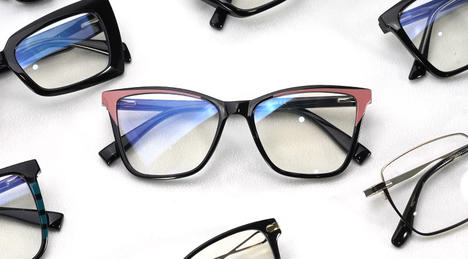
Pick the Right Frame Shape: Opt for smaller, rounder, or more oval-shaped frames. These shapes minimize the thickest parts of the lens, especially for nearsighted prescriptions.
Select a Full-Rim Frame: Materials like acetate or thicker metal rims do a much better job of concealing the edge of the lens compared to rimless or semi-rimless styles.
Insist on an Anti-Reflective Coating: High-index lenses reflect more light. A good AR coating is essential for clearer vision and better aesthetics.
Ensure Your Pupillary Distance (PD) is Accurate: A precise PD is critical for high prescriptions to ensure the optical center of the lens aligns perfectly with your pupil.
Understanding Your Prescription's Impact on Lenses
Before we dive into the solutions, it's helpful to understand the "why." Your prescription contains the blueprint for correcting your vision, and its numbers directly influence the physical shape of your lenses.
According to the Cleveland Clinic's guide on reading prescriptions, the key numbers are:
Sphere (SPH): This indicates the main lens power for correcting nearsightedness (a minus sign, ‘-’) or farsightedness (a plus sign, ‘+’). A "high" prescription is typically one where the SPH value is beyond -4.00 or +4.00.
Cylinder (CYL) & Axis: These values correct for astigmatism, an imperfection in the eye's curvature.
The SPH value is the biggest factor in lens thickness.
For Nearsightedness (- SPH): The lens is concave—thinnest in the center and thickest at the edges. The higher the number, the thicker the outer edge becomes.
For Farsightedness (+ SPH): The lens is convex—thickest in the center and thinnest at the edges. The higher the number, the more the center bulges.
A common mistake I see is people choosing a very wide, rectangular frame for a high minus prescription. This forces the lab to use a much larger lens blank, resulting in a finished lens that exposes the thickest possible edge.
The Game-Changer: High-Index Lenses and Aspheric Designs
The single most important innovation for high-prescription wearers is the high-index lens. This is the core technology that makes thin, lightweight glasses possible.
What is a High-Index Lens?
Think of the "index" (or index of refraction) as a measure of how efficiently a material bends light. Standard plastic lenses have an index of around 1.50. High-index materials have indices of 1.61, 1.67, and 1.74.
Because a high-index material bends light more efficiently, it requires less curvature and less material to achieve the same corrective power. The result? A noticeably thinner and lighter lens. For me, the real "aha!" moment in my career was seeing a -8.00 prescription in a 1.74 high-index lens for the first time. It looked as thin as a standard -3.00 lens.

To make this clearer, here’s a breakdown of how these materials stack up.
| Lens Index | Recommended SPH Range | Key Benefit | Trade-Off |
|---|---|---|---|
| 1.50 (Standard Plastic) | ±0.25 to ±2.00 | Most affordable | Thick and heavy for higher Rx |
| 1.59 (Polycarbonate) | ±2.00 to ±4.00 | Impact-resistant, built-in UV | Less clear optics than other materials |
| 1.61 (High-Index) | ±3.00 to ±6.00 | Good balance of thinness and cost | Reflects more light (needs AR coating) |
| 1.67 (High-Index) | ±5.00 to ±9.00 | Significantly thinner and lighter | Higher cost, can be more brittle |
| 1.74 (High-Index) | Beyond ±9.00 | The thinnest and lightest plastic lens | Highest cost, requires careful handling |
Aspheric Designs: The Finishing Touch
In addition to the material itself, the lens design plays a huge role. Traditional lenses have a spherical curve, like a slice of a ball. Aspheric lenses use a more complex, flatter curve that reduces the magnification effect (for + powers) and the minification effect (for - powers). This not only creates a thinner profile but also reduces the "bug-eye" or "tiny-eye" distortion that can happen with strong prescriptions.
How to Choose the Perfect Frame for Your High-Rx Lenses
With high-index lenses doing the heavy lifting, your next step is to choose a frame that complements the technology. The right frame acts as a strategic partner, helping to conceal any remaining thickness and ensuring a comfortable fit.
1. Material and Rim Style are Key
My number one piece of advice for anyone with a prescription stronger than -6.00 is to favor full-rim frames.
Acetate Frames: This plastic material is often the best choice. It’s available in various thicknesses and can fully hide the edge of the lens.
Metal Frames: Thicker metal rims can also work well.
Avoid Rimless and Semi-Rimless: These styles leave the lens edge completely exposed, defeating the purpose of choosing a thin lens.
2. Shape and Size Matter More Than You Think
The goal is to keep the lens diameter as small as possible.
Go for Round or Oval: These shapes are incredibly efficient. Because the distance from the center to the edge is consistent, they avoid the extra-thick corners you get with wide rectangular or square frames.
Check the Fit: Ensure your eyes are well-centered within the lens opening. If the frame is too wide, it will require a larger lens and result in more thickness.

3. Nail Your Pupillary Distance (PD)
Pupillary Distance (PD) is the measurement in millimeters between the centers of your pupils. For a high prescription, an accurate PD is non-negotiable. An error of even 1-2 millimeters can induce prism, causing eye strain, headaches, or blurred vision.
Your eye doctor is required to provide you with your prescription after an exam, a right protected by the Federal Trade Commission's Eyeglass Rule. While they are not always legally required to include the PD, it is a crucial part of your prescription data. Always ask for it, or use a reliable online tool with a calibrated measurement process to get it right.
Don't Skip These Essential Lens Coatings
High-index lenses have one major drawback: they reflect more light off their surfaces than standard plastic. This can cause distracting glare for you and make your lenses more visible to others.
Anti-Reflective (AR) Coating: This is not an optional upgrade; it's a necessity. A good AR coating increases light transmission to almost 99%, giving you sharper vision (especially at night) and making your lenses look nearly invisible.
UV Protection: Eye health is paramount. Ultraviolet radiation can damage your eyes over time. A study on UV radiation and eyewear published by PubMed found that plastic lens materials inherently block a significant amount of UV light. Adding a dedicated UV coating ensures you have the maximum possible protection.
Scratch-Resistant Coating: High-index lenses can be softer than standard materials. A hard coating provides a protective layer to prevent minor scratches from daily wear and tear.
Wrapping Up: Your Checklist for Success
Buying glasses for a high prescription online requires a bit more care, but the payoff in style and savings is worth it. A 2011 study in Optometry: Journal of the American Optometric Association highlighted that a significant percentage of online glasses failed to meet safety or optical standards. This underscores the importance of choosing a retailer that prioritizes quality control and accurate manufacturing.
Here is your final checklist to ensure you get a pair of glasses you love:
[ ] Get a Current Prescription: Make sure your eye exam is recent.
[ ] Secure an Accurate PD: Have it measured by a professional or use a trusted digital tool.
[ ] Choose a High-Index Material: Select 1.67 or 1.74 for the best results.
[ ] Pick a Smart Frame: Opt for a smaller, rounder, full-rim frame made of acetate or metal.
[ ] Add Essential Coatings: Do not skip the Anti-Reflective (AR) and UV coatings.
[ ] Verify Quality and Return Policies: Choose a reputable seller that stands by their product.
Frequently Asked Questions (FAQ)
Can I use my contact lens prescription to order glasses?No. A contact lens prescription is different because it sits directly on your eye, while glasses sit a short distance away (this is called the vertex distance). The power needs to be adjusted for that distance, especially for high prescriptions.
How much thinner is a 1.74 high-index lens compared to a standard 1.50 lens?For a high prescription, a 1.74 index lens can be up to 50% thinner and lighter than a standard 1.50 index lens. The difference is dramatic.
Are high-index lenses worth the extra cost?In my experience, for anyone with a prescription over ±4.00, the answer is a resounding yes. The improvement in comfort, weight, and appearance fundamentally changes how you feel about wearing glasses.
Disclaimer: This article is for informational purposes only and does not constitute professional medical advice. Please consult with a qualified optometrist or ophthalmologist for any personal eye health concerns and before making any decisions about your vision care.


