







Structural Tension: Why Semi-Rimless Frames Need Trivex Lenses
The Hidden Weakness of Semi-Rimless Glasses (And How to Fix It)
Semi-rimless frames are the epitome of minimalist style. They offer a lightweight, barely-there feel that full-rim glasses can't match, creating an unobstructed upper field of view and a sophisticated look. But this elegant design hides a secret: your lenses are under constant tension. Unlike full-rim frames that support the entire lens edge, a semi-rimless style uses a thin, strong nylon cord to hold the bottom of the lens in place. This creates a continuous structural stress that can expose the weakness in the wrong lens material, leading to frustrating and costly damage.
Choosing the right lens is not just an add-on; it's essential to the frame's longevity and your visual clarity. The constant pressure from the mounting wire demands a material with exceptional tensile strength—the ability to resist cracking under tension. This is where Trivex, a material born from military applications, becomes the clear winner, offering a unique combination of strength, clarity, and lightweight comfort that standard plastics cannot match.
TL;DR: Why Trivex is Essential for Semi-Rimless Frames
- Structural Demand: Semi-rimless frames use a nylon wire that puts constant tension on the lens edge, requiring a material that resists cracking.
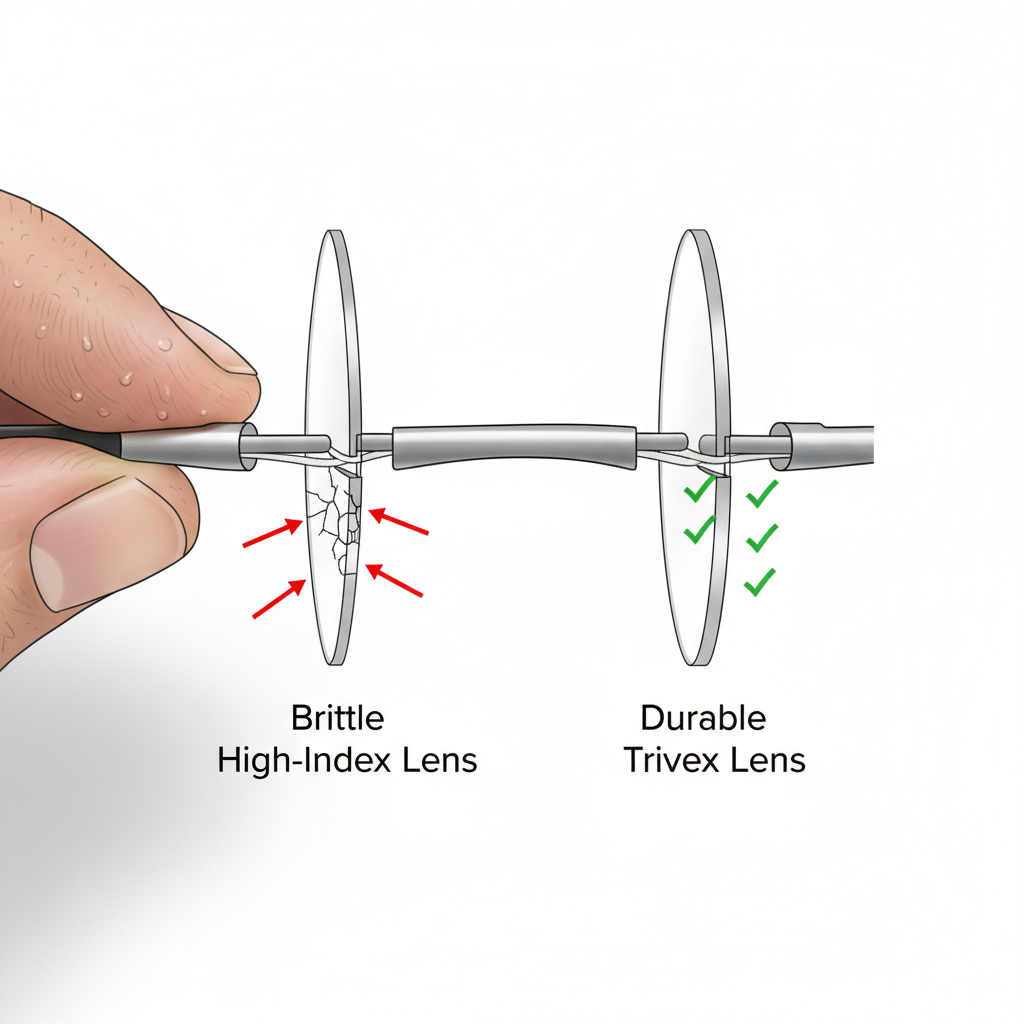
- Material Failure: Standard high-index lenses (like 1.60) are often brittle and prone to chipping or developing stress fractures along the mounting groove over time.
- Trivex's Superiority: Trivex has superior tensile strength, making it highly resistant to the specific stress of a semi-rimless mount.
- The Trifecta: Trivex combines this tensile strength with exceptional optical clarity (low chromatic aberration) and impact resistance, making it the safest and sharpest choice.
- Practical Rule: For semi-rimless frames, Trivex is the recommended material, especially for prescriptions with a cylinder (astigmatism) correction greater than -1.00, which creates uneven pressure points on the lens.
The Physics of Failure: Why Some Lenses Crack Under Pressure
To understand why material choice is so critical, you need to look at the engineering of a semi-rimless frame. The top part of the lens is secured by the metal or acetate frame front, but the bottom is held entirely by a thin monofilament cord. A groove is cut into the entire edge of the lens, and this cord sits snugly inside it, pulled taut to secure the lens.
This design places the lens itself into a structural role. It’s no longer just a passive optical element; it’s an active component bearing a load. The pressure is concentrated entirely within that tiny, precision-cut groove.
This is where problems arise with inferior or mismatched materials:
- Standard Plastic (CR-39): While optically sound for full-rim frames, CR-39 is too brittle for the demands of a semi-rimless mount. It is highly susceptible to flaking and chipping along the groove where the cord applies pressure.
- High-Index Plastics (1.60, 1.67): These materials are popular for their ability to make strong prescriptions thinner. However, this thinness comes at the cost of durability. Based on common patterns from optical lab repairs, 1.60 high-index lenses are particularly notorious for failing in semi-rimless mounts. It's common to see micro-cracks spiderwebbing from the groove within 6 to 12 months of normal wear. The material is simply too brittle to withstand the constant tensile force.
- Polycarbonate: Polycarbonate is known for its incredible impact resistance, a quality that makes it a go-to for safety glasses and children's eyewear. However, its tensile strength is lower than Trivex's, and it is a softer material that can flex or warp over time under the wire's tension. More importantly, polycarbonate has poor optical quality. Its low Abbe value leads to significant chromatic aberration, which manifests as distracting color fringing in your peripheral vision.
Trivex: The Engineered Solution for Strength and Clarity
Trivex was originally developed for military applications, specifically for helicopter windshields and fighter jet canopies. The goal was a material that was optically pure, incredibly durable, and lightweight. This unique origin story produced a material perfectly suited for the unique challenges of semi-rimless eyewear.
Trivex delivers a "trifecta" of properties that make it the ideal choice:
- Superior Tensile Strength: This is the core of its advantage. Trivex is a urethane-based monomer that, when cast-molded, results in a molecular structure that is incredibly resistant to being pulled apart. It handles the constant tension from the nylon cord without developing the stress fractures that plague more brittle high-index materials.
- Unmatched Impact Resistance: Like polycarbonate, Trivex is a safety-grade material that meets the impact resistance standards set by the FDA (21 CFR 801.410). This means it can withstand the "drop ball test," ensuring your lenses won't shatter from an accidental drop or impact. This makes it a durable and safe choice for any lifestyle, from the office to the weekend.
- Exceptional Optical Clarity: This is where Trivex truly distances itself from polycarbonate. Optical clarity is measured by the "Abbe value." A higher value means less chromatic aberration (color fringing). As noted in optical industry comparisons, Trivex has an Abbe value of around 43, which is very close to the human eye and results in crisp, clear vision. Polycarbonate, with an Abbe value of just 30, produces significantly more distortion.

A Practical Guide for Choosing Your Lenses
When you're investing in a new pair of semi-rimless glasses, the lens material should be a primary consideration, not an afterthought.
Expert Heuristic: Based on extensive experience in lens fitting and troubleshooting, a reliable rule of thumb is to default to Trivex for any semi-rimless frame, especially if your prescription has a cylinder (CYL) value greater than -1.00.
Why the specific focus on astigmatism? A prescription with a significant cylinder component means the lens has different curvatures at different angles, resulting in varying thickness across the lens. This creates uneven pressure points along the groove where the nylon cord sits. A brittle material is more likely to crack at these stress points, whereas the robust tensile strength of Trivex accommodates this uneven pressure flawlessly.
The Importance of Craftsmanship
Even the best material can fail if not handled correctly. The edging process for semi-rimless lenses requires immense precision. The groove's depth and angle must be perfect. A groove that is even a fraction of a millimeter too deep can cause the lens to fit loosely and rotate in the frame, while a groove that is too shallow can create excessive tension and risk a fracture. This is why purchasing from a reputable source with experienced lab technicians is crucial for the longevity of your eyewear.
Built to Last: The Smart Choice for Minimalist Frames
While the sleek, lightweight design of semi-rimless frames is appealing, their durability is entirely dependent on the material you choose for your lenses. Standard plastics and brittle high-index materials are simply not engineered to withstand the constant tensile force inherent in the design. They represent a compromise that often leads to premature failure.
Trivex, by contrast, is not merely an "upgrade"; it is the structurally appropriate material for the task. Its unique combination of tensile strength, impact resistance, and optical purity ensures that your glasses will not only survive daily wear but will also provide the clearest, most comfortable vision possible. By investing in Trivex, you are protecting your frame, ensuring your safety, and getting the superior visual experience you deserve.
Disclaimer: This article is for informational purposes only and does not constitute professional medical advice. Please consult with a qualified eye care professional for any personal health concerns or before making any decisions related to your vision or eyewear.


