








Trivex vs. Polycarbonate: The Best Choice for Rimless Drills
TL;DR: Trivex vs. Polycarbonate for Rimless Frames
- Trivex is the superior choice for most rimless drill-mounts. It offers exceptional optical clarity (less color fringing), is the lightest material available, and has superior tensile strength that resists cracking around the drill points.
- Polycarbonate is a budget-friendly, high-impact alternative. It provides excellent safety and is thinner than Trivex, but at the cost of optical purity (noticeable chromatic aberration) and a higher risk of developing stress fractures over time.
- For rimless and semi-rimless styles, the choice is not an upgrade—it's a structural necessity. Standard plastic or glass lenses cannot withstand the stress of drill mounting and will fail.
The Unseen Weakness of Minimalist Eyewear
Rimless and semi-rimless glasses represent the peak of minimalist design. They offer an unobstructed field of view and a barely-there aesthetic that many wearers love. However, this minimalist construction creates a critical point of failure: the mounting points. In these designs, the lenses are not supported by a frame; they are the frame. Hardware is mounted directly into the lens material through small drill holes.
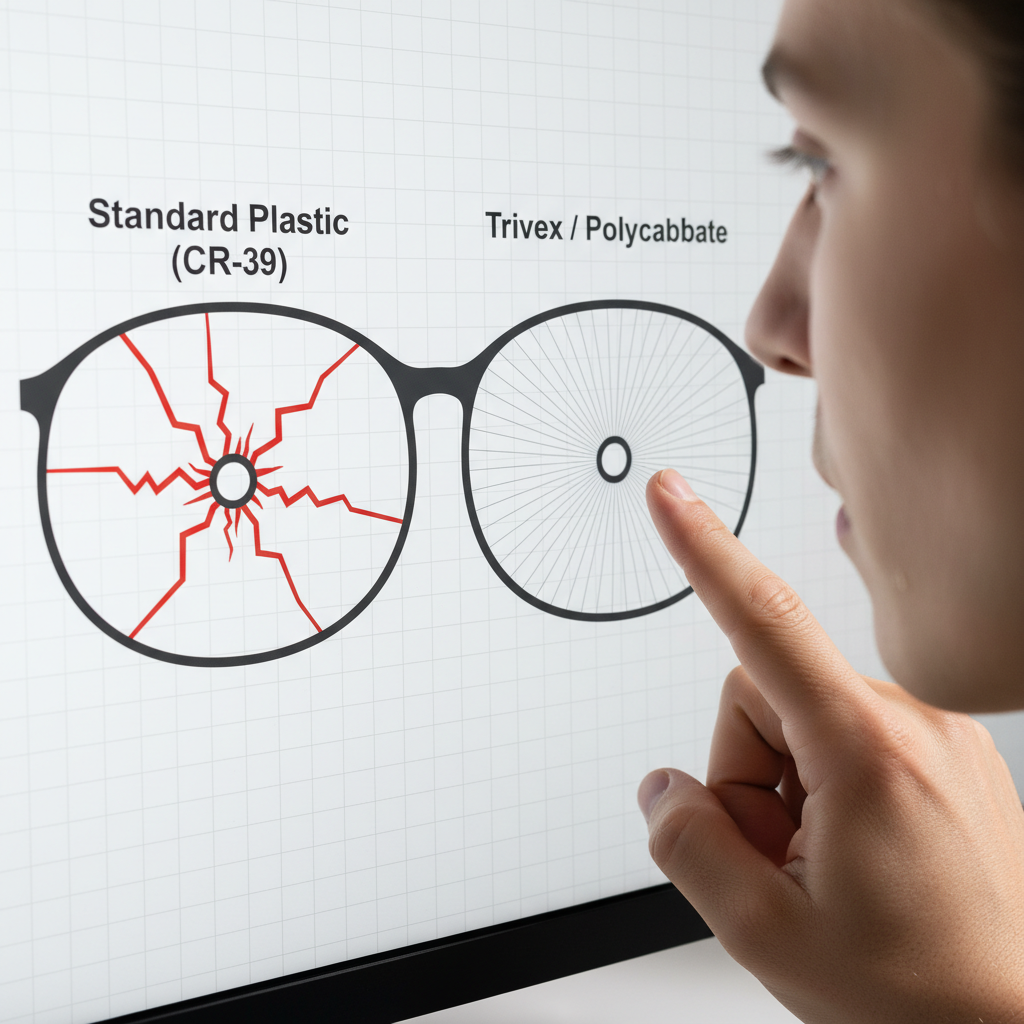
This engineering reality places immense, concentrated stress on the lens material. While all spectacle lenses sold in the U.S. must meet a baseline for impact resistance, as mandated by the FDA, the specific stress of a drill-mount is a different challenge altogether. Standard plastic (CR-39) or glass lenses, while optically excellent for full-frame glasses, lack the tensile strength to handle these pressure points. They are prone to cracking, chipping, or shattering at the drill site, rendering the eyewear useless and potentially unsafe.
This is why the choice of lens material for a rimless style is non-negotiable. Only two materials are universally recommended for this application: Polycarbonate and Trivex. Both are celebrated for their exceptional impact resistance and durability, but they are not created equal. Your choice between them will directly impact your visual experience, long-term comfort, and the durability of your investment.
Head-to-Head: A Material Showdown
When evaluating Polycarbonate and Trivex for drill-mount frames, we must look beyond basic impact resistance. The key differentiators are tensile strength (how it handles being pulled and stressed), optical clarity, and weight.
| Feature | Polycarbonate | Trivex |
|---|---|---|
| Abbe Value (Clarity) | ~30 (Low) | ~45 (High) |
| Tensile Strength | Good | Excellent |
| Weight (Specific Gravity) | 1.20 (Very Light) | 1.11 (Lightest) |
| UV Protection | 100% Inherent | 100% Inherent |
| Refractive Index | 1.59 (Thinner) | 1.53 (Slightly Thicker) |
Durability and Tensile Strength: The "Drillability" Factor
Tensile strength measures a material's ability to resist breaking under tension. This is the single most important property for the longevity of a drill-mounted lens.
-
Polycarbonate: Famous for its use in "bulletproof glass," polycarbonate is incredibly tough and impact-resistant. However, it is also a softer, more flexible material. While this flexibility helps absorb impact, it can be a disadvantage at the mounting point. Over time, the constant, tiny movements and pressures of daily wear can cause micro-fractures, or "spider-webbing," to develop around the drill holes. Lab technicians note that its softness can also lead to flexing during the drilling process, requiring a highly precise technique to avoid compromising the lens.
-
Trivex: Developed initially for military applications, Trivex boasts superior tensile strength. It is a more rigid material that better resists the pulling and torsional forces exerted by the mounting hardware. According to insights from optical lab technicians, Trivex is far less prone to cracking or chipping during the high-stress drilling and screw-tapping process. This inherent resistance to stress fractures makes it a more reliable and durable foundation for rimless eyewear.
Optical Clarity: The World Through Your Lenses
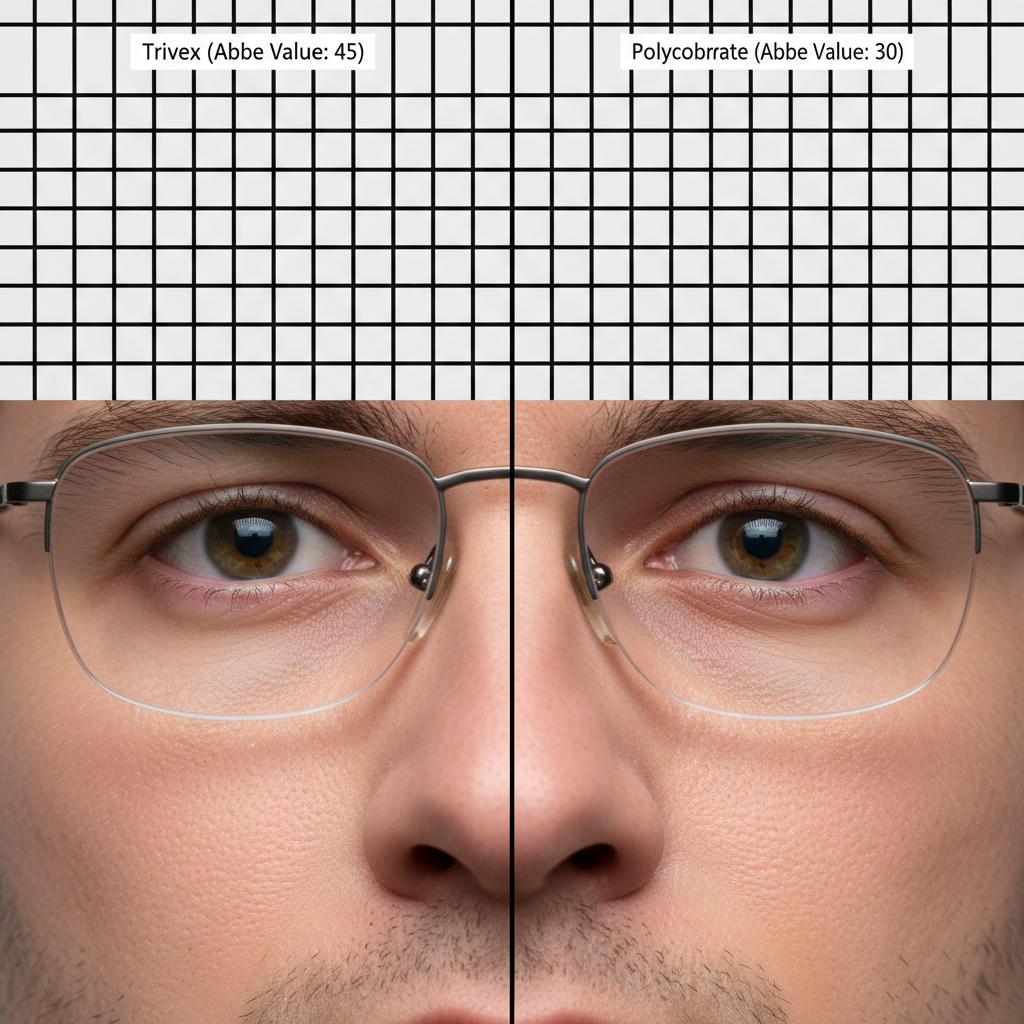
The optical purity of a lens material is measured by its Abbe value. A higher Abbe value means less chromatic aberration—the distracting color fringing or "rainbows" that can appear around high-contrast objects, especially in your peripheral vision.
-
Polycarbonate: This is Polycarbonate's most significant drawback. It has a very low Abbe value of around 30. For many wearers, this results in noticeable color distortion, particularly in higher prescriptions or when looking away from the lens's optical center. While some people may not notice it, those sensitive to visual quality often find it bothersome.
-
Trivex: Trivex shines with an Abbe value of approximately 45, which is very close to the optical purity of standard CR-39 plastic lenses. As confirmed by Hoya Vision, this high value translates to a crisp, clear visual experience with virtually no distracting color fringing. For anyone who values pristine vision, Trivex is the clear winner.
Weight and Comfort: The All-Day Difference
For eyewear you wear all day, every gram matters. The weight of the lenses is a primary factor in overall comfort, preventing pressure marks on the nose and reducing fatigue.
-
Trivex: With a specific gravity of 1.11 g/cm³, Trivex is the lightest of all commercially available lens materials. This ultra-lightweight nature is a massive benefit in any pair of glasses but is especially noticeable in rimless designs where the lenses are often larger. For individuals with moderate to high prescriptions, the weight savings can be the difference between comfortable all-day wear and constant adjustments.
-
Polycarbonate: Polycarbonate is also very lightweight (specific gravity of 1.20 g/cm³), making it significantly more comfortable than standard plastic or glass. However, it is approximately 10% heavier than Trivex. While still a great lightweight option, it doesn't quite reach the feather-light standard set by Trivex.
The Technician's Take: An Inside Look from the Lab
Beyond the spec sheets, the real-world experience of optical technicians reveals the practical superiority of Trivex for drill-mount applications. These insights, gathered from professionals who handle these materials daily, highlight nuances that consumers never see.
Methodology Note: The following observations are based on anecdotal but consistent feedback from experienced lab technicians and are not from a controlled study. They represent common "on-the-bench" realities.
- Drilling Dynamics: When drilling Polycarbonate, its softness can cause the material to "grab" the drill bit, and the heat generated requires careful management. Trivex, by contrast, drills cleanly and predictably. However, it requires a slightly slower drill speed to prevent heat from melting the edges of the hole, which could compromise the screw threading.
- Crack Propagation: The most cited advantage of Trivex is its resistance to crack propagation. If a tiny imperfection occurs during drilling, it is highly unlikely to spread. With Polycarbonate, a small fissure is more likely to develop into a full-blown star crack over time under the stress of the mounting.
- Chemical Resistance: Trivex is virtually immune to damage from common household chemicals, including acetone and alcohol. Polycarbonate, on the other hand, can be severely damaged by these substances, which can cause it to cloud or become brittle. This gives Trivex a significant edge in long-term, real-world durability.
The Final Verdict: A Framework for Your Decision
For rimless and semi-rimless glasses, both Polycarbonate and Trivex are safe, effective choices that are vastly superior to any other material. The best choice for you depends on your priorities.
You should choose Trivex if:
- You demand the highest level of optical clarity and are sensitive to color fringing.
- You want the lightest, most comfortable glasses possible, especially if you have a moderate-to-high prescription.
- You are investing in a premium frame and want the maximum long-term durability against stress cracking.
You should choose Polycarbonate if:
- Your primary concern is impact safety on a tighter budget.
- You need the thinnest possible lens for a very high prescription (due to its higher refractive index).
- You are not particularly sensitive to the minor visual imperfections caused by a low Abbe value.
Ultimately, while Polycarbonate is a reliable workhorse, Trivex represents the pinnacle of performance for minimalist eyewear. It delivers on the promise of a barely-there look without compromising on visual quality or long-term structural integrity. If you are considering a strong prescription, understanding how these materials affect weight and aesthetics is crucial, a topic explored further in our guide on using strong prescriptions with rimless frames.
Frequently Asked Questions
1. Is Trivex really worth the extra cost? For rimless and semi-rimless frames, yes. The investment translates directly into better visual clarity, improved comfort due to the lighter weight, and significantly higher durability and resistance to stress fractures at the mounting points, extending the life of your eyewear.
2. Can I get coatings like anti-reflective or photochromic on Trivex and Polycarbonate lenses? Absolutely. Both materials are compatible with all major coatings. An anti-reflective coating is highly recommended to complement the clarity of Trivex and to reduce the internal reflections that can be more noticeable in Polycarbonate.
3. Are Trivex and Polycarbonate scratch-proof? No material is completely scratch-proof. Both are inherently softer than glass and require a factory-applied scratch-resistant hard coat. This coating is standard on virtually all modern Polycarbonate and Trivex lenses and is essential for daily-wear durability.
4. For the same prescription, which material is thinner? Polycarbonate has a higher index of refraction (1.59) compared to Trivex (1.53). This means that for the exact same prescription, a Polycarbonate lens will be slightly thinner. However, the superior optical quality and lower weight of Trivex often make it the more comfortable and visually pleasing choice, even if it's marginally thicker.
Disclaimer: This article is for informational purposes only and does not constitute medical advice. Consult with a qualified optician or optometrist to determine the best lens material for your specific prescription and lifestyle needs.


