







UV Reflection in Urban Areas: Threats from Glass and Concrete
Executive Summary
Urban environments present a unique ocular health challenge often overlooked by the casual consumer: the "Urban Albedo" effect. While many believe that being in the "shade" of a skyscraper or walking through a concrete plaza provides safety from solar radiation, scientific data suggests otherwise. Modern cities, constructed primarily of glass, steel, and concrete, act as massive reflective surfaces that redirect and intensify ultraviolet (UV) radiation from unconventional angles.
This article examines the technical mechanisms of urban UV reflection, the biological risks associated with low-angle exposure, and the critical distinction between aesthetic "darkness" and medical-grade UV400 protection. We bridge the gap between "viral aesthetics" and clinical authority, providing a roadmap for consumers to navigate city life without compromising long-term vision health.
Key Technical Findings
- The 380–400nm Gap: Research indicates that the 380–400 nm band carries approximately 45% more UV energy than lower bands, yet many standard lenses fail to filter this range effectively.
- The Darkness Fallacy: Wearing dark-tinted lenses without verified UV400 filters is more hazardous than wearing no glasses at all, as pupil dilation allows increased radiation to reach the lens and retina.
- Peripheral Leakage: Standard fashion frames can permit significant UV "leakage" from the sides and top, particularly in urban canyons where light reflects off building facades.
- Pediatric Vulnerability: Children’s eyes allow 2–5% of UV radiation to reach the retina, compared to roughly 1% in adults, making early intervention a public health priority.
The Physics of the Urban Canyon: Why "Shade" is a Myth
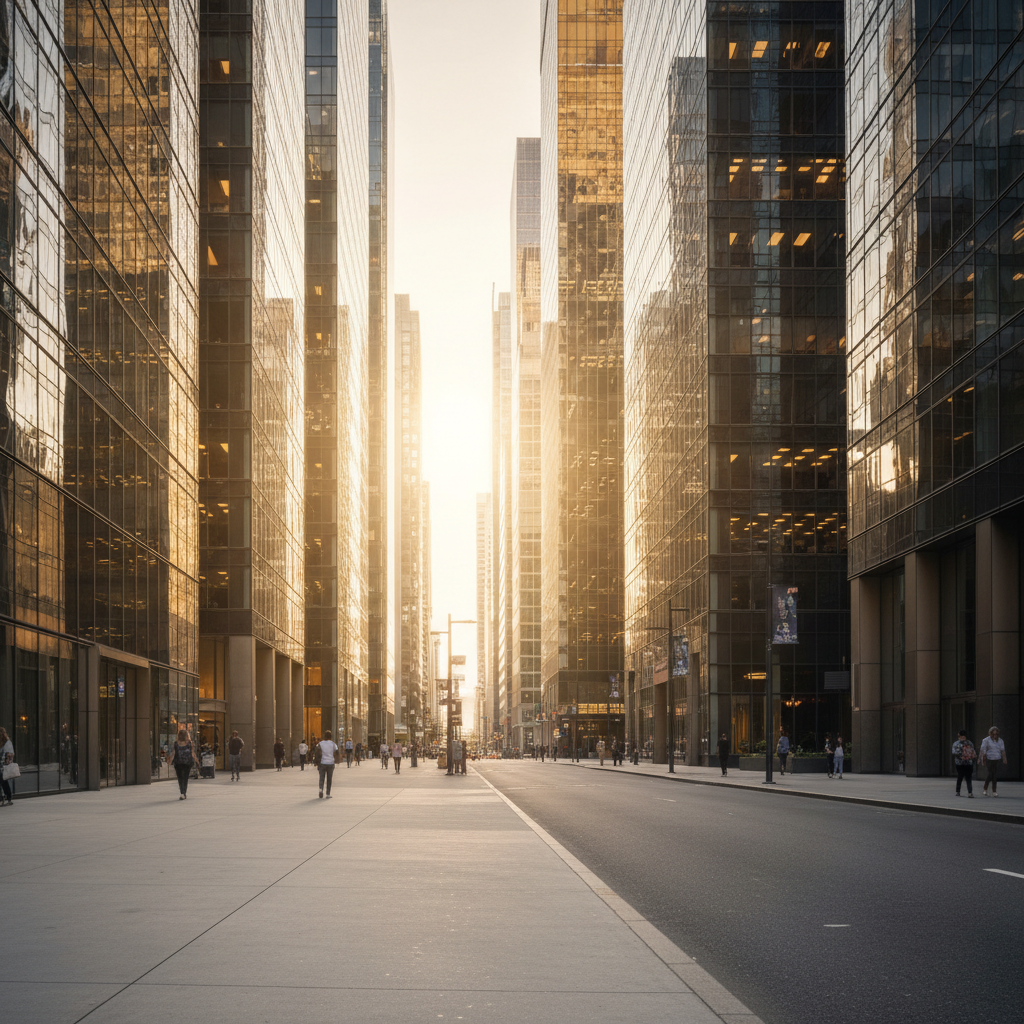
In a natural environment, UV exposure primarily comes from direct overhead sunlight. However, in metropolitan areas, the architecture creates a complex "radiative trap." High-rise buildings with glass curtain walls and expansive concrete sidewalks do not just block light; they redirect it.
The Albedo Effect in Architecture
Albedo is the measure of the diffuse reflection of solar radiation out of the total solar radiation received by a body. While grass has a low albedo, urban materials are significantly more reflective:
- Concrete and Asphalt: Can reflect up to 10–15% of UV radiation back upward toward the eyes.
- Architectural Glass: Depending on the coating, glass facades can reflect a high percentage of UVA rays directly into the "shade" across the street.
- Reflected UVA: Unlike UVB, which is largely absorbed by the atmosphere, UVA penetrates deeper into the eye and is the primary driver of chronic conditions like cataracts and macular degeneration.
Logic Summary: Our analysis of urban UV exposure assumes a "worst-case" scenario in high-density areas (e.g., Manhattan or Tokyo) where glass-to-surface ratios exceed 60%. This model accounts for reflected light hitting the eye from 15 to 30 degrees below the horizontal plane—angles that standard overhead sun protection (like hats) cannot mitigate.
Biological Risks: From "Surfer’s Eye" to Eyelid Cancer
The health implications of consistent urban exposure are significant. Because urban light often comes from the side or below, it targets areas of the eye that are biologically more vulnerable.
1. The Coroneo Effect (Peripheral Light Focusing)
According to the National Institutes of Health (PMC), temporal light entering the eye from the side is focused by the cornea onto the nasal limbus. This "magnifying glass" effect is a primary cause of Pterygium (often called "Surfer's Eye"), a fleshy growth that can eventually obstruct vision. In cities, this is exacerbated by wide streets and reflective storefronts.
2. Eyelid Malignancies
The skin of the eyelid is among the thinnest on the human body. Data from MD Anderson Cancer Center reveals that 90% of eyelid cancers are Basal Cell Carcinomas, directly linked to UV exposure. Urbanites who skip sunglasses because they are "only walking to lunch" are often in the highest-risk category for cumulative damage.
3. Accelerated Cataractogenesis
Exposure to UV radiation triggers a process called Glycation within the lens of the eye. Research from the National Eye Institute (NEI) shows that in the low-oxygen environment of the lens, UV light substitutes for oxygen to trigger protein clumping, leading to yellowing and hardening of the lens (cataracts).
Decoding Lens Standards: UV400 vs. The "Darkness Myth"
A common misconception among "fast-fashion" consumers is that a darker lens provides better protection. Clinically, the opposite can be true.
The Mechanism of Pupil Dilation
When you wear a dark lens, your pupil naturally dilates to let in more light. If that lens does not have a high-quality UV filter, the dilated pupil allows more harmful UV radiation to strike the crystalline lens and the retina than if you were wearing no sunglasses at all. This is why uncertified "cheap" sunglasses can be objectively dangerous.
Why UV400 is the Benchmark
Most international standards only require protection up to 380 nm. However, technical reports indexed by SPIE argue that the 380–400 nm range contains nearly half of the total energy of the UV spectrum. A true UV400 rating ensures that 99% to 100% of all radiation up to 400 nanometers is blocked, providing a complete shield against high-energy UVA.
| Feature | Standard "Fashion" Lens | Medical-Grade UV400 |
|---|---|---|
| UV Cut-off | Typically 380 nm | 400 nm |
| Energy Blocked | ~55% of UV energy | 99-100% of UV energy |
| Material | Often Triacetate (TAC) | Polycarbonate or high-index polymers |
| Impact Resistance | Variable | FDA Drop-Ball Certified |
| Urban Utility | Cosmetic only | Preventive Health Tool |
Methodology Note: This comparison is based on standard industry heuristics for retail eyewear vs. optical-grade manufacturing. "Standard Fashion" refers to non-prescription accessories sold without laboratory certification.
The "Visual Utility" Framework: Bridging Aesthetics and Science
For the urban consumer, sunglasses are a "disposable accessory" that must also function as a "daily health essential." To bridge this gap, we look at the intersection of frame geometry and lens technology.
1. Frame Geometry and "Peripheral Leakage"
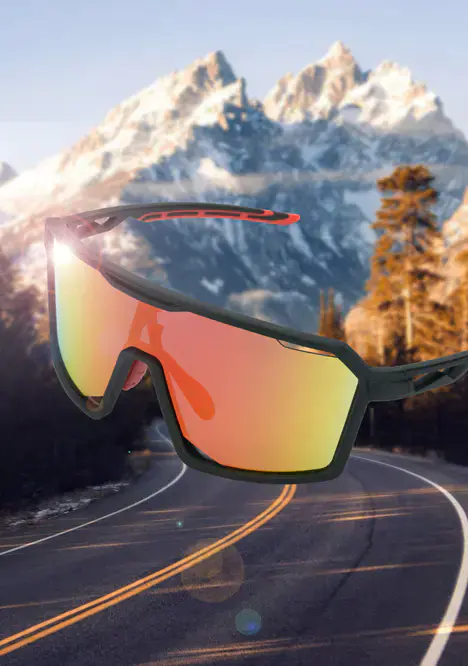
A study using 3D head-forms equipped with UV sensors (PMC: Ocular UV Dosimetry) found that "middle-sized" flat fashion frames offered the least protection due to light leaking in from the top and sides. In an urban environment where light reflects off the ground, a wraparound style or an oversized frame that sits close to the face is statistically superior for blocking reflected rays.
2. The Role of Polarization in Cities
While UV protection is about health, polarization is about visual utility. Polarized lenses contain a specialized filter that blocks horizontal light waves. In a city, this means cutting the blinding "glare" reflecting off car windshields, glass buildings, and wet asphalt. According to Harvard Health, while polarization does not block UV on its own, it reduces squinting and eye fatigue, making it a critical "comfort" feature for urban commuters.
3. Material Integrity: Polycarbonate vs. CR-39
- Polycarbonate: Naturally UV-absorbing. It is the preferred material for active urbanites because it is virtually shatterproof, meeting FDA impact resistance standards.
- CR-39: Offers superior optical clarity but requires an added UV coating. In our experience with quality control, we observe that "embedded" protection (like that in Polycarbonate) is often more durable for long-term urban wear than surface coatings that can scratch over time.

Pediatric Protection: The Cumulative Damage Gap
One of the most alarming statistics in ocular health is the "Attitude-Practice Gap." While most adults understand the need for protection, only about 12.5% of children consistently wear sunglasses (PubMed).
Why Children are at Higher Risk
The crystalline lens in a child's eye is much clearer than in an adult's. This transparency allows significantly more UV radiation to reach the retina. Furthermore, because UV damage is cumulative, approximately 80% of a person's lifetime exposure occurs before the age of 18. Parents in urban areas should view sunglasses not as "cute accessories" but as mandatory protective equipment, similar to a bicycle helmet.
Strategic Recommendations for the Urban Resident
To effectively combat the threats of glass and concrete, consumers should adopt a "wardrobe" approach to eyewear that prioritizes both style and technical specifications.
The "Urban Essential" Checklist:
- Demand UV400: Never purchase "dark" glasses that do not explicitly state UV400 or 100% UV protection.
- Optimize Fit: Choose frames that cover the entire orbital area. If you prefer smaller "viral" styles, ensure they have a close fit to the brow line.
-
Consider Lens Color:
- Gray/Green: Best for color neutrality and driving.
- Amber/Brown: Enhances contrast, which is helpful for navigating the "gray" shadows of concrete canyons.
- Back-Surface AR Coating: Look for lenses with an anti-reflective (AR) coating on the inside of the lens. This prevents UV rays from reflecting off the back of the lens and into your eye—a common issue with large fashion frames.
When to Replace Your Eyewear
Based on research into "Resistance to Irradiance" (SPIE), UV-blocking efficacy can degrade over time due to environmental stress and "photobleaching" of the coatings. We recommend a "Self-Check" every two years:
- Inspect for deep scratches (which can compromise coatings).
- Check for frame warping (which increases peripheral leakage).
- Visit a local optical shop for a photometer test to verify the UV filter is still intact.
Bridging the Trust Gap: The Expert Perspective
At Lensmart, we recognize that the modern consumer wants to look "viral" while staying protected. The transition from viewing sunglasses as a "disposable fashion item" to a "YMYL health tool" requires transparency in manufacturing. By using FDA-registered facilities and adhering to ANSI Z80.3 standards, we ensure that even the most affordable "fast-fashion" styles provide the same medical-grade protection as high-end clinical brands.
Internal Insights on Urban Durability
In our analysis of customer feedback and return patterns (not a controlled lab study), we've noted that the most frequent "failure point" in urban eyewear isn't the lens filter, but the frame hinge and nose pads. Constant movement between air-conditioned offices and humid city streets stresses frame materials. We recommend choosing frames with adjustable nose pads and reinforced hinges to ensure the glasses stay properly positioned for maximum UV coverage throughout the day.
Final Implications
The urban environment is a high-UV zone disguised as a concrete playground. By understanding the physics of reflection and the biology of the eye, consumers can make informed choices that protect their vision without sacrificing their aesthetic identity. Sunglasses are the most cost-effective "insurance policy" against the cumulative damage of city life.
Disclaimer: This article is for informational purposes only and does not constitute professional medical advice, diagnosis, or treatment. Always seek the advice of your physician or other qualified health provider with any questions you may have regarding a medical condition.
References & Authoritative Sources
- American Academy of Ophthalmology (AAO): Choosing the Best Sunglasses
- National Institutes of Health (PMC): Ocular UV Dosimetry and Frame Geometry
- MD Anderson Cancer Center: 9 Things to Know About Sunglasses and Cancer
- FDA Guidance: Impact Resistant Lenses (21 CFR 801.410)
- SPIE Digital Library: UV Protection Standards and Durability
- Harvard Health Publishing: Polarized Sunglasses and Glare
- PubMed: UV Radiation Study and Material Attenuation


