




Are Darker Sunglass Lenses More UV Protective?
The Darkness Deception: Why Your Darkest Sunglasses Might Be the Least Safe
It’s a common assumption: the darker the sunglass lens, the better it protects your eyes from the sun. We often reach for the deepest, most opaque shades, believing we’re getting maximum safety. However, this belief is a dangerous misconception. The color or darkness of a lens has almost nothing to do with its ability to block harmful ultraviolet (UV) radiation. In fact, a pair of dark, stylish sunglasses without proper UV protection can be more hazardous than wearing no sunglasses at all.
This guide will dismantle that myth. We'll explore the critical difference between the tint that provides visual comfort and the invisible shield that delivers true UV safety. Understanding this distinction is the key to making an informed choice that protects your long-term eye health.
TL;DR: Your Quick Guide to Sunglass Safety
- Lens Darkness is for Comfort, Not Safety: The tint of a lens, measured as Visible Light Transmission (VLT), only reduces brightness and glare. It does not block invisible UV rays.
- UV Protection is Invisible: True safety comes from a UV filter, often a clear coating or a property of the lens material itself, that blocks harmful UVA and UVB radiation.
- The "UV400" Standard is Key: This label means the lenses block light rays up to 400 nanometers, providing 100% protection against the entire UV spectrum.
- Dark Lenses Without UV Filters are Dangerous: They cause your pupils to dilate, allowing more damaging UV radiation to enter your eye than if you wore no sunglasses at all.
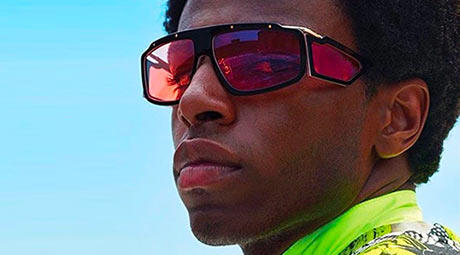
- Frame Shape Matters: Wraparound or oversized frames prevent UV rays from leaking in around the sides, top, and bottom.
Visible Comfort vs. Invisible Danger: VLT and UV Protection Explained
To choose safe sunglasses, you must understand that you are managing two different kinds of light: the visible light that causes glare and the invisible ultraviolet light that causes damage. These are handled by two separate lens properties.
What is Visible Light Transmission (VLT)?
Visible Light Transmission (VLT) refers to the percentage of visible light that passes through a lens to your eye. A very dark lens might have a VLT of 10%, meaning it blocks 90% of visible light. This is what makes your eyes feel more comfortable in bright sun.
VLT is about comfort and performance in different conditions:
- Very Dark Lenses (8-18% VLT): Ideal for intensely bright conditions like a day at the beach, on the water, or in the snow.
- Medium Lenses (18-40% VLT): Excellent all-purpose tints for everyday driving and outdoor activities.
- Light Lenses (40%+ VLT): Best for overcast days, low-light conditions, or for those who are sensitive to light but don't need extreme darkness.
While VLT makes your vision more comfortable, it has no bearing on UV protection. A lens with 10% VLT can still let 100% of UV radiation pass through if it's not properly treated.
The Real Protector: UV400 and Why It's Non-Negotiable
Ultraviolet (UV) radiation is an invisible form of light with a shorter wavelength than visible light. It's divided into UVA and UVB rays, both of which can cause significant damage to your eyes and the surrounding skin. This damage is cumulative over a lifetime and is linked to conditions like cataracts, macular degeneration, and even eyelid cancers, which account for up to 90% of Basal Cell Carcinomas according to MD Anderson Cancer Center.
The protection against this threat is a feature you can't see. It's either a special coating applied to the lens or, increasingly, an inherent property of the lens material itself. Modern polycarbonate lenses, for instance, naturally block 100% of UV rays without any extra coating.
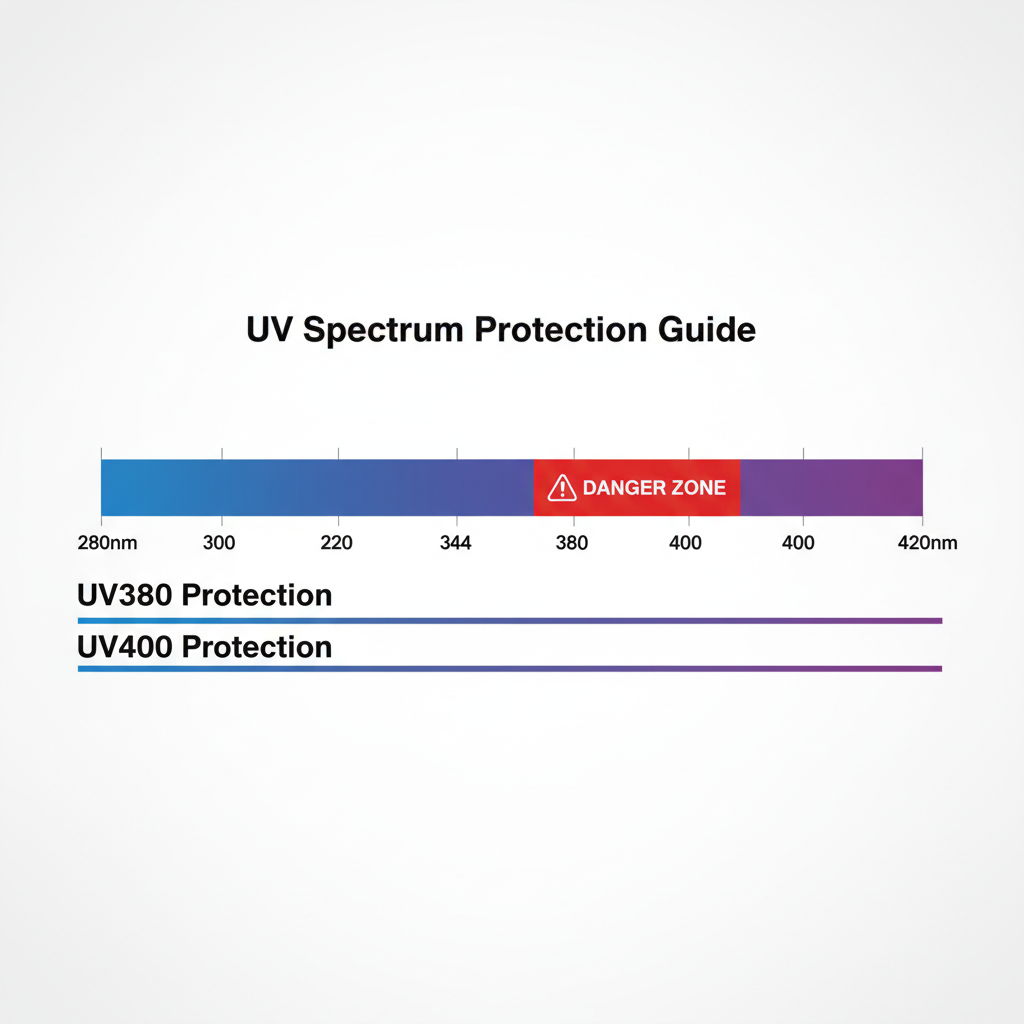
The gold standard to look for is a label that says "UV400" or "100% UV Protection." This certifies that the lenses block all light with wavelengths up to 400 nanometers. This is crucial because some older standards only protected up to 380 nm, leaving a dangerous gap. Research has shown that the 380-400 nm range contains nearly 45% of the sun's UV energy, making UV400 protection an absolute necessity.
Debunking the Myth: The Danger of the Dark, Unprotected Lens
Here is the most critical takeaway: wearing dark sunglasses without certified UV protection is worse than wearing none at all.
When you are in a bright environment, your pupils naturally constrict to limit the amount of light entering your eye. However, when you put on dark lenses, you trick your eyes. Your pupils open up—or dilate—to let more light in, compensating for the darkness of the tint. If those lenses lack a UV filter, your dilated pupils create a wider entryway for harmful UVA and UVB rays to flood into your eye and damage the sensitive structures within. This phenomenon is what experts call the "darkness fallacy."
How to Be a Savvy Sunglass Shopper: A Verification Checklist
With so much misinformation out there, it can be hard to feel confident in your purchase. A 2022 study published in the journal Cureus found that 47% of people who don't wear sunglasses cited "uncertainty in the efficiency of UV protection" as the main reason, highlighting a massive trust gap. Here’s a practical checklist to ensure you're getting the real deal.
Your 4-Point Sunglass Safety Checklist
| Feature | What to Look For | Why It Matters |
|---|---|---|
| 1. UV Protection Label | Look for a sticker, tag, or etching on the lens that explicitly states "UV400" or "100% UVA/UVB Protection." | This is the only way to be certain the lenses have the necessary filter. Vague terms like "UV absorbing" or "sun blocking" are not sufficient. |
| 2. Lens Material | Modern materials like polycarbonate have UV protection built directly into the lens material. | This is superior to a simple coating, which can become scratched or degrade over time, as noted in studies on lens aging. |
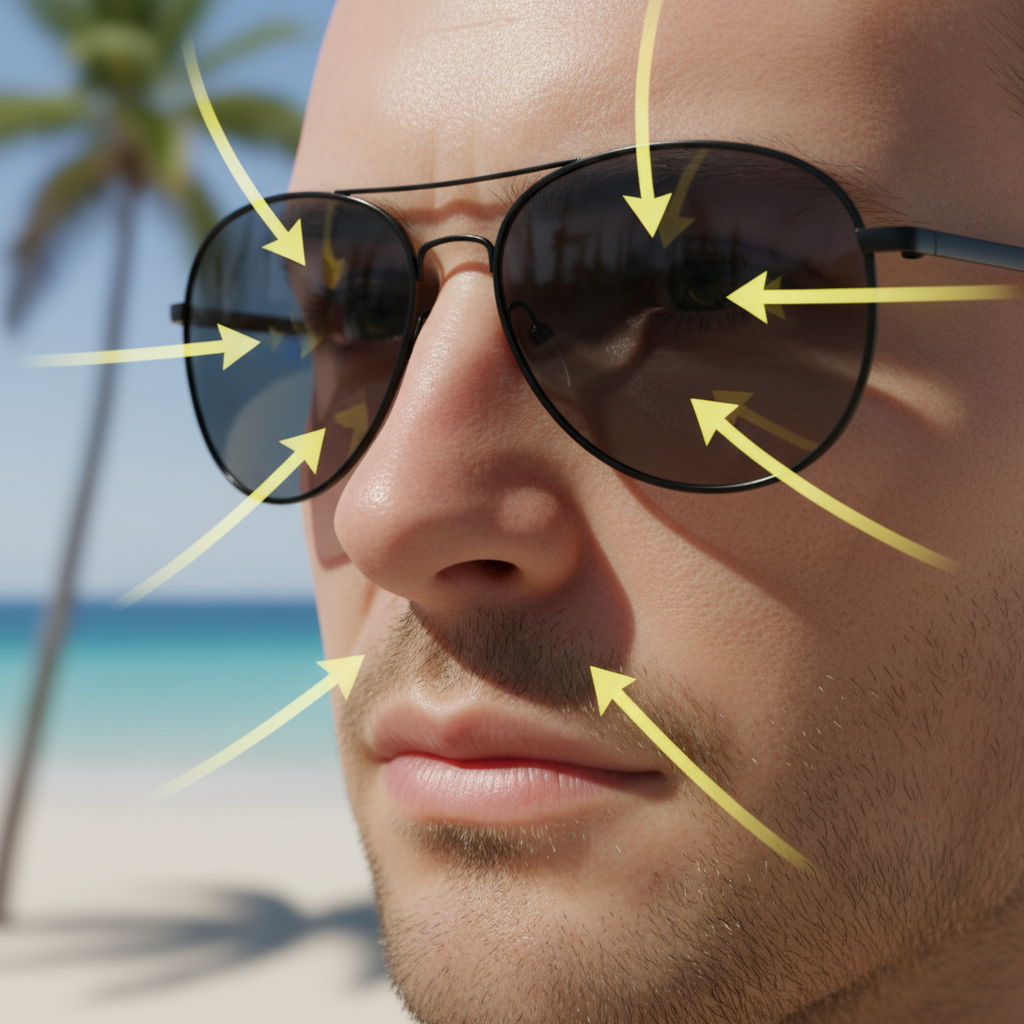
| 3. Frame Geometry | Choose oversized or wraparound styles that fit closely to your face. | A significant amount of UV radiation can leak in from the periphery (sides, top, and bottom) of standard frames. A study using 3D models confirmed that wraparound styles offer near-total protection from this peripheral exposure. |
| 4. Optical Quality | Check for distortion. The American Academy of Ophthalmology suggests a simple home test: look at a straight line, like a floor tile. Move the glasses slowly. If the line wiggles or bends, the lenses are poor quality. | Poor optical quality won't harm your eyes, but it can cause headaches and eye strain. |
Beyond UV: Making Sense of Tints and Coatings
Once you've guaranteed UV400 protection, you can focus on features that enhance visual comfort and performance. These are cosmetic or functional choices that have no impact on UV safety.
Choosing a Lens Tint for Your Lifestyle
Different lens colors filter visible light differently, which can enhance your vision for specific activities.
- Gray/Green: These are neutral tints that reduce overall brightness without distorting color perception. According to the American Optometric Association, gray lenses are ideal for driving and general use.
- Brown/Amber: These tints enhance contrast and depth perception by filtering out blue light. They are excellent for activities like fishing, golfing, and skiing, where spotting details against a bright background is important.
- Yellow/Orange: These significantly increase contrast in low-light conditions like fog or haze, but they also cause notable color distortion. They are popular with cyclists and pilots are often warned against them.
Are Polarized or Mirrored Lenses Better?
These are two of the most misunderstood features.
- Polarized Lenses: Polarization is a special filter that only blocks horizontal light waves, which are the primary cause of glare reflecting off flat surfaces like water, pavement, or the hood of a car. As Harvard Health explains, polarization is purely for reducing glare and improving visual comfort and clarity. It does not provide any additional UV protection.
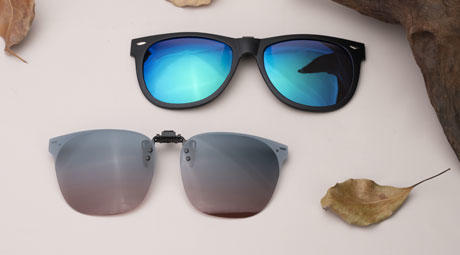
- Mirrored Lenses: A mirror coating is a reflective layer applied to the outside of the lens. It reduces the amount of visible light entering the eye by reflecting it away, making it useful in very bright conditions. Like polarization, a mirror coating is a VLT feature for comfort, not a UV safety feature.
Wrapping Up: See Clearly and Safely
The most important decision you can make when buying sunglasses has nothing to do with how dark they are, what color they are, or how much they cost. It is about verifying one simple, crucial fact: do they provide UV400 protection?
By prioritizing the invisible shield over the visible tint, you move from being a passive consumer to an informed protector of your own health. Remember the key takeaways: ignore the darkness, demand the UV400 label, and choose a frame that provides ample coverage. Your eyes will thank you for it for years to come.
Frequently Asked Questions (FAQ)
Q: Do I need to wear sunglasses on a cloudy day? A: Yes. Up to 80% of the sun's UV rays can penetrate through clouds, haze, and fog. The American Academy of Ophthalmology stresses the importance of wearing protection even on overcast days, as UV damage is a year-round threat.
Q: Can the UV protection on sunglasses wear off over time? A: It can, especially with older or lower-quality lenses that rely on an external coating. Studies have shown that prolonged exposure to the sun can cause the UV-blocking properties of some lenses to degrade, a process known as photobleaching. If your sunglasses are old, scratched, or you are unsure of their quality, it is wise to have them tested at an optical shop or invest in a new pair with embedded protection.
Q: Are more expensive sunglasses better at blocking UV? A: Not necessarily. Price is often determined by brand name, frame materials, and design—not UV protection. An inexpensive pair of sunglasses can offer 100% UV400 protection, while a pricey designer pair might not. The UV400 label is the great equalizer; it's the only standard that matters for safety.
Q: My child won't keep sunglasses on. Are they really necessary? A: Yes. UV damage is cumulative, and children's eyes are more vulnerable than adults' because the lenses inside their eyes are clearer, allowing more UV radiation to reach the retina. The Mayo Clinic recommends that children begin wearing sunglasses as early as 6 months old. Look for durable frames with a strap to help keep them in place.
Disclaimer: This article is for informational purposes only and does not constitute medical advice. Please consult with a qualified eye care professional for any concerns about your eye health.
References
- American Academy of Ophthalmology (AAO): Choosing the Best Sunglasses
- American Optometric Association (AOA): UV Protection
- Harvard Health Publishing: Polarized Sunglasses
- MD Anderson Cancer Center: 9 things to know about sunglasses, eye protection and cancer
- Mayo Clinic: Why sunglasses are a must-wear
- PMC (Public Library of Science): Ocular UV Dosimetry & Frame Geometry
- PMC (Public Library of Science): Public Awareness of UV Harm (Bakkar et al.)


