








Why You Need UV-Protective Glasses on Cloudy Days
It is a typical gray Tuesday morning. You step outside, glance at the overcast sky, and instinctively leave your sunglasses on the hall table. After all, if you don't have to squint, your eyes are safe, right?
This is the single most common—and dangerous—misconception in eye care.
As a technical content strategist who has analyzed eyewear standards for years, I have seen the lab reports that consumers rarely get to read. The data is clear: the comfort of a cloudy day is a biological trick. While clouds block the visible light that causes glare, they allow invisible ultraviolet (UV) radiation to pass through with alarming intensity. In fact, under certain conditions, cloud cover can actually enhance UV exposure through scattering, creating a "cloud effect" that catches unwary pedestrians off guard.
In this guide, we will dismantle the myths surrounding lens darkness and protection. We will look at the physics of UV400 filtration, explain why "cheap" doesn't always mean "unsafe" (provided you know what to look for), and give you a checklist for ensuring your eyes are protected 365 days a year—regardless of the weather forecast.
The Invisible Threat: Why Clouds Don't Count
The sun emits energy across a spectrum. The part we see (visible light) makes us squint. The part we don't see (UV radiation) cooks our cells. The danger lies in the disconnect between these two.
The 80% Rule
According to the American Academy of Ophthalmology (AAO), clouds do not block UV rays effectively. Up to 80% of the sun's UV rays can penetrate thin cloud cover. This means that on a hazy day, your eyes are receiving nearly the same dosage of radiation as they would on a sunny beach day, but without the warning signal of brightness to make you look away or seek shade.
I have spoken with dispensing opticians who report a specific pattern: clients coming in with "gritty" eyes or photokeratitis (sunburn of the cornea) after spending a full day gardening or working outdoors under an overcast sky. They didn't feel the burn happening because the ambient light wasn't bright enough to trigger a squint reflex.
The Scattering Effect
It gets more complex. UV rays are shorter and scatter more easily than visible light. On partly cloudy days, a phenomenon known as "broken cloud effect" can occur. Sunlight reflects off the sides of clouds, focusing radiation and occasionally increasing UV levels to above what they would be on a completely clear day.
Key Takeaway: Your eyes cannot detect UV radiation. Relying on brightness to decide when to wear sunglasses is like relying on the smell of smoke to tell you if a pan is hot—by the time you sense it, the damage is often done.
The "Darkness Fallacy": Why Tint $\neq$ Protection
One of the most persistent myths I encounter is the belief that darker lenses offer better protection. This is not just wrong; it is potentially hazardous.
The Pupil Paradox
Here is the biological mechanism you need to understand: Your pupil is a variable aperture. In bright light, it constricts (shrinks) to limit light entry. In dim light, it dilates (opens) to let more light in.
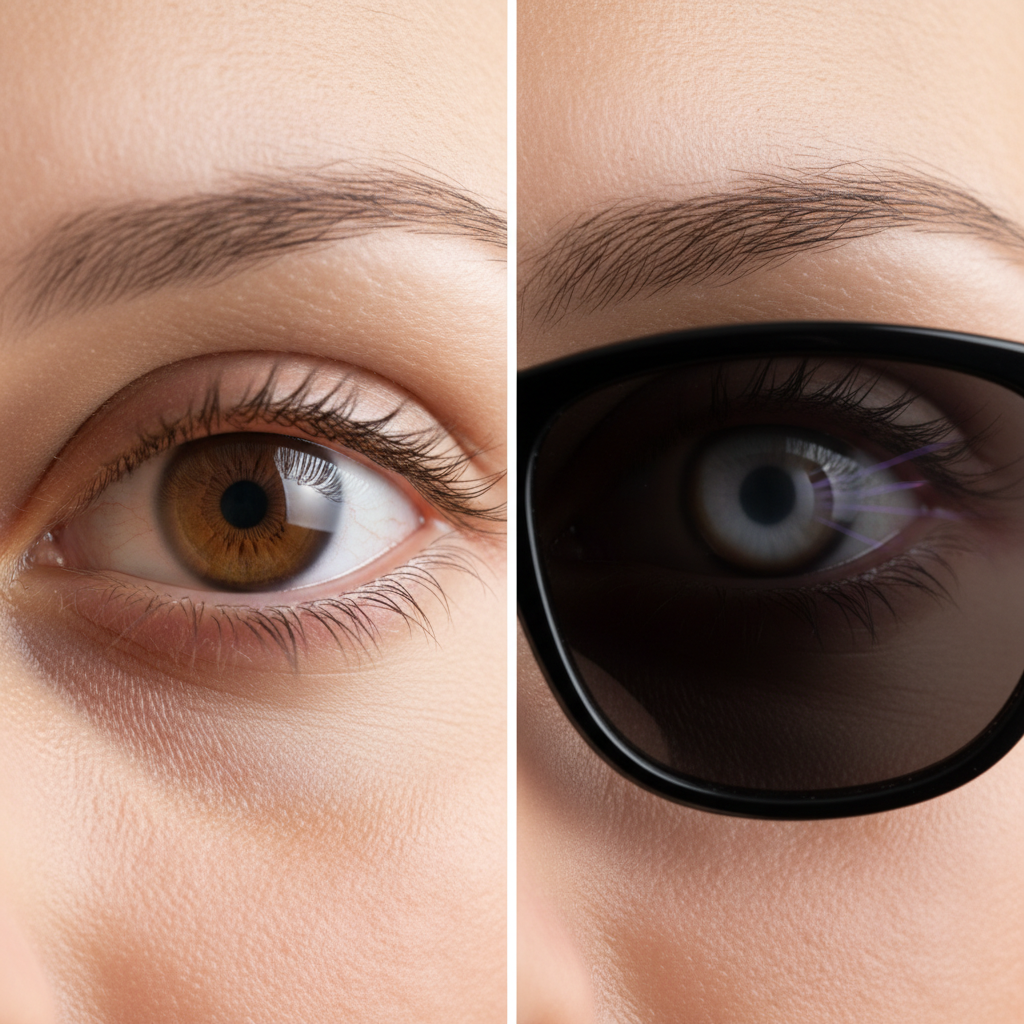
If you wear dark sunglasses that lack proper UV filters, you are effectively creating a dark room for your eyes. Your pupils dilate to adjust to the tint. However, because the lenses don't block UV, that wide-open pupil now allows a massive amount of UVA and UVB radiation to flood into the lens of the eye and the retina.
According to MD Anderson Cancer Center, wearing dark lenses without UV blocking is actually worse than wearing no sunglasses at all. When you wear nothing, your natural squint and pupil constriction provide at least some defense. Dark, non-blocking lenses disable these natural defenses.
Debunking the Price Myth
A study on public awareness of UV harm found that 47% of people who don't wear sunglasses cite "uncertainty in the efficiency of UV protection" as a main reason. There is a deep-seated belief that affordable glasses are inherently unsafe.
This is where the industry needs transparency. UV protection comes from a chemical treatment (dip) or the lens material itself (like polycarbonate), not the price tag. A $15 pair of glasses with a verified UV400 rating is infinitely safer than a $300 pair of designer shades that only offers cosmetic tinting.
UV400 vs. UV380: The Safety Standard You Must Know
When shopping for eyewear, you will see stickers that say "100% UV Protection" or "UV400." These are not just marketing buzzwords; they refer to specific wavelengths.
The Nanometer Gap
Ultraviolet light is measured in nanometers (nm).
- UV-B (280–315 nm): The primary cause of sunburn and corneal damage.
- UV-A (315–400 nm): Penetrates deeper, linked to premature aging and cataracts.
Many older international standards only required protection up to 380 nm. However, a technical report on Solar UV Protection highlights that the 380–400 nm band contains significant high-energy radiation. Lenses that stop at 380 nm let this "leak" through.
UV400 means the lens blocks all light rays with wavelengths up to 400 nanometers. This covers both UVA and UVB entirely.
Pro Tip: The "Drop Ball" Safety Check
Protection isn't just about radiation; it's about impact. In the US, the FDA mandates that all eyewear must pass the "Drop Ball Test"—where a steel ball is dropped on the lens to ensure it doesn't shatter into sharp shards.
- Glass lenses offer great optics but can shatter.
- Polycarbonate lenses are naturally impact-resistant and typically have UV protection built into the material structure, not just a coating. This makes them the superior choice for safety, especially for active use.
Comparison: Which Lens Type Do You Need?
To clarify the confusion between polarization, tint, and UV protection, I've compiled this comparison based on optical physics and safety standards.
| Feature | What It Does | Does It Block UV? | Best Use Case |
|---|---|---|---|
| UV400 Treatment | Blocks radiation up to 400nm. | YES (100%) | Essential for every pair of glasses. |
| Dark Tint (Grey/Black) | Reduces visible brightness; keeps eyes comfortable. | NO (unless combined with UV filter) | Bright sunny days; driving. |
| Polarization | Filters horizontal glare from water/roads. | NO (unless combined with UV filter) | Fishing, driving, snow sports. |
| Photochromic (Transition) | Darkens automatically in sunlight. | YES (Most are UV400 by default) | Everyday wear; moving indoors to outdoors. |
| Clear Polycarbonate | Transparent impact resistance. | YES (Material naturally blocks UV) | Safety glasses; cloudy days; night work. |
The "Coroneo Effect": Why Frame Fit Matters
You have the right lenses, but what about the frame? In my experience fitting thousands of frames, this is where most people fail. Light doesn't just come from the front; it reflects off the ground, buildings, and water, entering your eye from the sides, top, and bottom.
Peripheral Light Focusing
Research into Ocular UV Dosimetry describes a phenomenon called the Coroneo Effect. Light entering from the temporal side (the side near your ear) is refracted by the cornea and focused intensely onto the nasal side of the eye (near the nose). This concentrated spot of UV radiation is a primary cause of pterygium (surfer's eye), a growth on the white of the eye.
The Fix:
- Wrap it up: Choose "wraparound" styles that curve with your face. This blocks lateral rays.
- Go Big: Oversized frames (large oculars) reduce the gap between the frame and your cheekbone/brow.
- Check the Vertex: The closer the glasses sit to your eyes (vertex distance), the less light leaks in. If you can fit a finger easily between the frame and your eyebrow, the gap is too big.
Expert Warning: Lens Aging and Photobleaching
Here is an industry insight that few retailers share: UV protection is not permanent.
A study on UV Protection Standards revealed that lenses can undergo "photobleaching" or "aging" when exposed to prolonged sunlight. After roughly 50 hours of intense simulator exposure (equivalent to many months of real-world use), some lenses showed a decrease in UV-blocking efficacy.
My Advice:
- Replace your cheap sunglasses every 2 years. If you wear them daily, the UV coating may degrade, or surface scratches may compromise the filter.
- The "Tile Test" for Distortion: Hold your glasses at arm's length and look at a square tiled floor through the lenses. Move the glasses. If the straight lines of the tiles wave or wiggle, the lenses have optical distortion, which can cause headaches.
Frequently Asked Questions (FAQ)
1. Can I just wear clear glasses on cloudy days?
Yes, if they are UV400 rated. Many clear prescription lenses and safety glasses are made of polycarbonate, which naturally blocks UV. However, standard cheap "fashion" clear lenses (like fake glasses) usually filter nothing. Always check the specs for "UV400" or "100% UV Protection."
2. Are polarized lenses better for UV protection?
No. Polarization filters glare (reflected light), not UV rays. While polarized lenses are fantastic for visual clarity near water or while driving, the polarization film itself does not block UV. You need a lens that is both polarized and UV400.
3. Do children really need sunglasses?
Absolutely. Children's pupils are larger, and their crystalline lenses are clearer than adults', allowing more UV to reach the retina. Cumulative damage starts in childhood. The Mayo Clinic advises that sun protection is critical for kids to prevent long-term issues like macular degeneration.
4. How can I test if my glasses are actually UV400?
You cannot test this with your eyes. The "UV flashlights" sold online are often inaccurate. The most reliable method is to take your glasses to a local optical shop. Most opticians have a photometer (a UV meter) and will test your lenses for free in seconds.
Wrapping Up: Make Protection a Habit, Not a Weather Choice
The decision to wear sunglasses shouldn't depend on whether you see a shadow on the ground. UV radiation is a constant environmental factor, present rain or shine.
By understanding that darkness does not equal protection, and by prioritizing UV400 certification over brand names, you take control of your long-term eye health. The next time you see a gray sky, remember the 80% rule. Grab those frames—not because the sun is bright, but because the radiation is there.
Disclaimer: This article is for informational purposes only and does not constitute medical advice. If you experience persistent eye irritation, vision changes, or sensitivity to light, please consult a qualified eye care professional.


