





How UV Rays Penetrate the Eye: A Journey from Cornea to Retina
Executive Summary
Most people understand that ultraviolet (UV) radiation is harmful to the skin, but few realize the precise and cumulative damage it inflicts on our eyes. This article maps the journey of UV light, photon by photon, as it penetrates the eye's structures. We will explore how different wavelengths—UVA and UVB—pose unique threats to the cornea, lens, and retina, leading to conditions ranging from temporary "sunburn" of the eye to irreversible diseases like cataracts and macular degeneration. Understanding this biological pathway is the first step toward appreciating why comprehensive, certified UV protection is not a seasonal accessory, but a daily, non-negotiable component of long-term health.

The First Line of Defense: The Cornea and Conjunctiva
When UV radiation first hits the eye, it encounters the cornea—the transparent outer dome—and the conjunctiva, the clear membrane covering the white of the eye. This frontal surface acts as the eye's primary shield, absorbing the majority of high-energy UVB radiation. However, this defense is not without cost.
Intense, short-term exposure, common during a day at the beach or skiing without proper eyewear, can overwhelm the cornea's absorptive capacity. The result is photokeratitis, a painful inflammation akin to sunburn on the eye. Symptoms include pain, redness, a gritty feeling, and extreme sensitivity to light. According to the World Health Organization (WHO), photokeratitis is a significant acute effect of UV radiation [WHO: Ultraviolet radiation Fact Sheet].
Chronic, long-term exposure carries a different set of risks. It is a primary driver of pterygium (often called "Surfer's Eye"), a fleshy growth on the conjunctiva that can extend onto the cornea and interfere with vision. Research into the "Coroneo Effect" explains that light entering from the side of the eye is focused onto the nasal region of the cornea and conjunctiva, a common site for these growths [PMC: Photoprotection of the Eye (Review)]. This highlights a critical flaw in many standard sunglasses: a lack of side protection. Clinical observation confirms that up to 50% of ocular UV exposure can come from reflected or peripheral light, bypassing the front of the lenses entirely.

The Internal Filter: The Crystalline Lens and Cataracts
UV rays that bypass the cornea next encounter the crystalline lens, a clear structure located behind the pupil that focuses light onto the retina. The healthy lens is a powerful secondary filter, absorbing almost all remaining UVB and a significant portion of UVA radiation. This protective function, however, leads to its own degeneration over a lifetime.
Chronic exposure to UV radiation is a major cause of cataracts, a clouding of the lens that impairs vision. The WHO estimates that approximately 10% of the 15 million cases of blindness due to cataracts worldwide can be attributed to UV exposure [WHO: Ultraviolet radiation Fact Sheet].
The mechanism behind this damage is a chemical process. Research from the National Eye Institute (NEI) has shown that in the low-oxygen environment of the lens, UV light triggers a chain reaction of glycation, causing proteins to clump together. This clumping is what makes the lens yellow, hard, and opaque, forming a cataract [NEI: UV-Induced Glycation Mechanism].
With age, the lens's natural protective filters, such as kynurenine derivatives, decrease, making the eye more vulnerable. This age-related decline in natural protection is a key reason why the risk of cataracts increases as we get older [IOVS: Age-related UV filters in Human Lens].

The Final Destination: The Retina and Macular Degeneration
While the cornea and lens block most UV radiation, they are not a perfect barrier. A portion of UVA light, particularly in the 380-400 nm range, can penetrate to the retina—the light-sensitive tissue at the back of the eye responsible for detailed central vision. This is especially true for children, whose crystalline lenses are clearer and allow significantly more UV to pass through to the retina [The Impact of Ultraviolet Radiation on the Aetiology and Development of Uveal Melanoma].
This retinal exposure is linked to Age-Related Macular Degeneration (AMD), a leading cause of irreversible blindness in older adults. The damage is driven by photo-oxidation. UVA rays, along with high-energy visible blue light, react with a cellular waste product in the retina called lipofuscin. This reaction generates highly destructive molecules known as reactive oxygen species (ROS), which kill retinal cells [PubMed: Mechanisms of Ocular Light Damage (Roberts)]. A frightening discovery is that this damage continues even after you are out of the sun; oxidized lipofuscin products can continue to poison retinal cells in the dark [PMC: Lipofuscin-Mediated Dark Toxic Effect].
While the link between UV and AMD is considered less definitive than for cataracts, the evidence is strong enough that ophthalmologists recommend lifelong protection as a prudent measure [PMC: Evidence for Sunglasses in AMD (Review)].
Who is Most at Risk?
While everyone is susceptible to UV damage, certain factors significantly increase an individual's risk profile.
- Eye Color: People with light-colored eyes (blue, green, or hazel) are at a higher risk for both photophobia (light sensitivity) and UV-related cancers like uveal melanoma. According to Duke Health experts, this is because their irises contain less of the protective pigment melanin, which acts as a natural shield against harsh light [Myth or Fact: Blue Eyes Are More Sensitive to Light].
- Age: Children and adolescents are particularly vulnerable. Their wider pupils and clearer lenses allow more radiation to penetrate deeper into the eye. The Royal Australian and New Zealand College of Ophthalmologists (RANZCO) warns that by age 15, up to 80% of children already show signs of UV-induced eye damage, which is cumulative over a lifetime [RANZCO: Children's Eye Sun Safety].
- Environment and Behavior: UV intensity is higher at high altitudes, and surfaces like snow can double your exposure by reflecting rays from below. A common misconception is that clouds block UV; they do not. A practical guideline is the "Shadow Rule": if your shadow is shorter than you are, UV intensity is high and protection is critical.
Beyond the Basics: Ensuring True Protection
Effective UV protection is more than just wearing dark lenses. In fact, wearing improperly certified sunglasses can be more dangerous than wearing none at all. Dark lenses cause the pupils to dilate, and if they lack a proper UV filter, this dilation allows even more harmful radiation into the eye [MD Anderson: Sunglasses & Cancer Prevention].
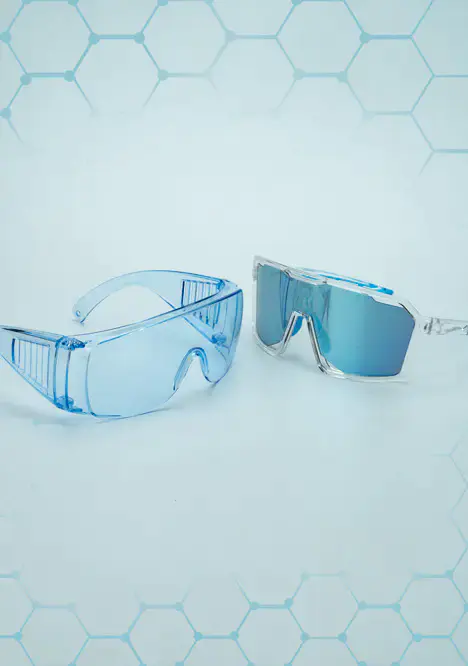
For true medical-grade protection, look for a "UV400" rating, which blocks 100% of UVA and UVB rays up to 400 nanometers. Furthermore, as demonstrated by 3D modeling studies, frame choice is crucial. Oversized or wraparound styles that fit closely to the face are essential for blocking the peripheral light that can account for a significant portion of total ocular UV exposure [PMC: Ocular UV Dosimetry & Frame Geometry].
Disclaimer: This article is for informational purposes only and does not constitute professional medical advice. Consult with a qualified eye care professional for any health concerns or before making any decisions related to your eye health.
References
- World Health Organization (WHO). "Ultraviolet radiation." https://www.who.int/news-room/fact-sheets/detail/ultraviolet-radiation
- Roberts, J. E. "Ocular phototoxicity." PubMed, 2011. https://pubmed.ncbi.nlm.nih.gov/21617534/
- Taylor, H. R. "Photoprotection of the Eye." PMC, 2013. https://pmc.ncbi.nlm.nih.gov/articles/PMC3872277/
- National Eye Institute (NEI). "New research sheds light on how UV rays may contribute to cataract." https://www.nei.nih.gov/about/news-and-events/news/new-research-sheds-light-how-uv-rays-may-contribute-cataract
- Duke Health. "Myth or Fact: People with Light-Colored Eyes Are More Sensitive to Sunlight." https://www.dukehealth.org/blog/myth-or-fact-people-light-eyes-are-more-sensitive-sunlight
- Royal Australian and New Zealand College of Ophthalmologists (RANZCO). "Protect children’s eyes from sun damage." 2025. https://ranzco.edu/wp-content/uploads/2024/02/Media-Release-Protect-childrens-eyes-from-sun-damage-2025.pdf
- Al-Robai, S. et al. "Ocular UV Dosimetry: The Effect of Sunglass and Contact Lens Wear." PMC, 2022. https://pmc.ncbi.nlm.nih.gov/articles/PMC6803516/


