










How UV Sunglasses Help Prevent Wrinkles & Skin Damage
Your Best Wrinkle Cream Might Be Your Sunglasses
The skin around your eyes is among the thinnest and most delicate on your entire body. This makes it uniquely vulnerable to photoaging—the premature aging caused by exposure to the sun's ultraviolet (UV) rays. While many invest in creams and serums, a critical skincare tool is often overlooked: a quality pair of sunglasses.
More than just a fashion accessory, the right sunglasses act as a primary shield against the UV radiation that accelerates the formation of fine lines, crow's feet, and sunspots. This article explores the science behind how UV rays damage the sensitive skin around your eyes and provides a detailed guide to choosing sunglasses that offer maximum protection, effectively making them a cornerstone of your daily skincare regimen.
The Unseen Damage: How UV Radiation Ages Your Eye Area
Sunlight contains different types of ultraviolet rays, primarily UVA and UVB, both of which play a significant role in skin damage. UVA rays penetrate deep into the skin, breaking down collagen and elastin, the proteins that give skin its firmness and structure. UVB rays primarily affect the skin's surface, causing sunburn and contributing directly to skin cancers.
The skin around the eyes, known as the periorbital area, has fewer oil glands and is exceptionally thin, making it one of the first places to show signs of aging. According to oncology experts at MD Anderson Cancer Center, up to 90% of cancers on the eyelid are basal cell carcinomas, directly linked to sun exposure. Beyond cancer risk, this constant UV assault leads to:
- Crow’s Feet: Fine lines that radiate from the outer corners of the eyes.
- Under-Eye Wrinkles: Loss of collagen leads to crepey, thin skin under the eyes.
- Hyperpigmentation: Sunspots or dark circles can be exacerbated by UV exposure.
- Loss of Firmness: The breakdown of elastin causes skin to sag.
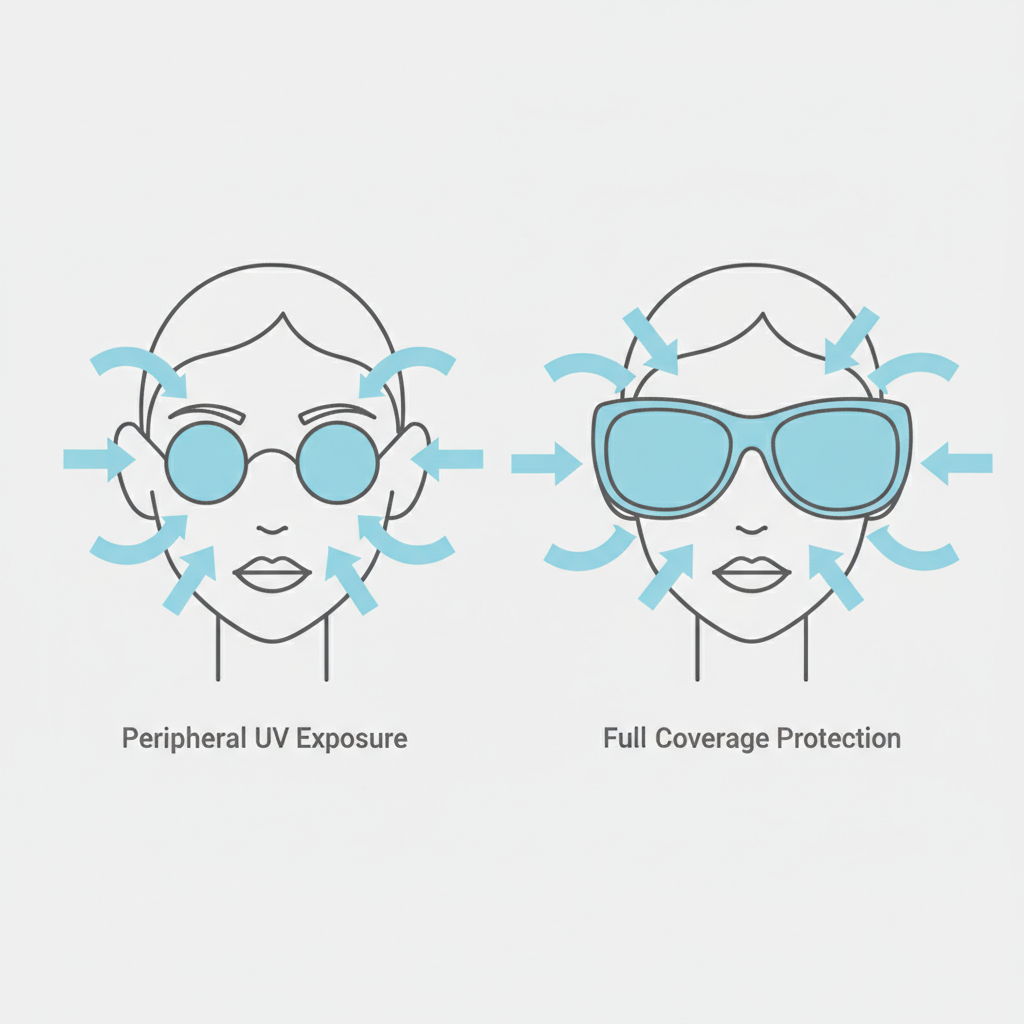
Compounding this is a phenomenon known as the "Coroneo Effect," where UV light entering from the side of the face is focused onto the nasal region of the eye and surrounding tissue. This peripheral exposure, detailed in a comprehensive review on eye photoprotection in the journal PMC, underscores why the physical coverage of your sunglasses is just as important as the lens technology.
Decoding the Labels: What 'UV400' and '100% UV Protection' Really Mean
Navigating the world of sunglass ratings can be confusing. However, understanding the terminology is essential for ensuring you're getting real protection. The most important label to look for is "UV400" or "100% UV Protection."
Common Myth Debunked: Darkness Does Not Equal Protection
A widespread and dangerous misconception is that the darkness of a lens indicates its level of UV protection. In reality, lens tint is purely for comfort and reducing visible light, not for blocking invisible UV radiation. Worse, wearing dark lenses without proper UV filtering is more dangerous than wearing no sunglasses at all. As experts at MD Anderson and other health institutions warn, the dark tint causes your pupils to dilate, allowing more damaging UV radiation to enter the eye and reach the surrounding skin.
The Gold Standard: UV400
The label "UV400" means the lenses block all light rays with wavelengths up to 400 nanometers. This covers all of the harmful UVA and UVB spectrum. Some older or less stringent standards may only certify protection up to 380 nanometers (UV380). While that sounds close, a technical report published by SPIE, the international society for optics and photonics, reveals that the 280–400 nm range contains 45% more UV energy than the 280–380 nm range. That 20-nanometer gap can leave your eyes and skin exposed to a significant amount of harmful radiation. Therefore, insisting on UV400 is non-negotiable for true protection.
To ensure consumer safety, non-prescription sunglasses are regulated as Class I medical devices by the FDA, which requires them to meet certain standards for impact resistance and truthful labeling.
UV Protection Label Comparison
| Label | Level of Protection | Is It Sufficient? |
|---|---|---|
| UV400 | Blocks light wavelengths up to 400nm. | Yes. This is the highest standard, blocking >99% of UVA and UVB rays. |
| 100% UV Protection | Generally synonymous with UV400. | Yes. Ensures full UVA/UVB blockage. |
| UV380 | Blocks light wavelengths up to 380nm. | No. Misses the critical 380-400nm range of high-energy UVA light. |
| "UV Absorbing" | Vague marketing term. Does not guarantee a specific level of protection. | No. Look for a specific UV400 or 100% UV Protection rating. |
| Polarized | Reduces glare from horizontal light. | No. Polarization does not provide UV protection on its own. A lens must be both polarized and UV400. |
It’s Not Just the Lenses: Why Frame Shape and Fit Matter
Even with the best UV400 lenses, you can be left vulnerable if your frames don't provide adequate coverage. As the Coroneo Effect illustrates, a significant amount of UV light can reach your eyes and skin from the periphery—the top, bottom, and sides of your glasses.
A groundbreaking study published in PMC used 3D head-forms with UV sensors to measure actual radiation exposure. The findings were stark: "middle-sized" fashion frames offered the least protection due to severe peripheral light leakage. In contrast, wraparound styles and goggles provided nearly 100% protection. This proves that frame geometry is a critical component of skin and eye safety.
For those seeking serious anti-aging benefits, a small, narrow frame is a poor choice. Instead, you should prioritize styles that create a physical barrier over the delicate periorbital skin.
Checklist for Choosing Skin-Protective Frames
Use this checklist to evaluate your next pair of sunglasses for maximum skin and eye defense:
- [ ] Certified UV400 Lenses: This is the first and most important check. Verify the label or product description.
- [ ] Go Big or Go Home: Choose oversized frames. A good rule of thumb is to find a lens with a vertical height of at least 38–45 mm to ensure it covers the area from your eyebrow to the top of your cheekbone.
- [ ] Mind the Gap: The frames should sit close to your face to minimize gaps at the top and sides. When you look in the mirror, you shouldn't see large spaces where light can stream in.
- [ ] Wrap It Up: For high-exposure activities like skiing, hiking, or spending time on the water, a wraparound style is the most effective choice for eliminating peripheral light leakage.
- [ ] Wide Temples: Frames with wider arms (temples) can add another layer of side protection from angled sun.
Beyond UV: Polarization, Coatings, and Materials
While UV400 is the key to safety, other lens features can enhance visual comfort and durability, contributing to a better overall experience.
Polarization vs. UV Protection
It's a common point of confusion, but polarization and UV protection are two different things. As explained by sources like Harvard Health, polarization is a special filter that blocks horizontal light waves, which we perceive as glare bouncing off surfaces like water, pavement, or snow. It dramatically improves visual comfort and clarity in bright conditions. However, a lens can be polarized without offering any UV protection. Always ensure a polarized lens is also rated UV400. For a deeper dive, our guide on polarized vs. non-polarized sunglasses can help.
Lens Materials and Coatings
- Polycarbonate Lenses: This material is a popular choice because it is lightweight, highly impact-resistant, and naturally blocks most UV radiation without needing a separate coating.
- Anti-Reflective (AR) Coatings: An AR coating on the back of your sunglass lenses is a valuable addition. A study on clear lens protection found that standard lenses can reflect UV radiation from the back surface directly into the eye. A specialized UV-absorbing AR coating mitigates this risk. You can learn more about which lens coatings are right for you.
Wrapping Up: Key Takeaways for Youthful Eyes
Treating your sunglasses as an essential skincare tool is one of the most effective strategies for preventing premature aging around the eyes. By prioritizing protection over passing trends, you can safeguard your skin for years to come.
- Always Choose UV400: This is the only standard that guarantees complete protection from UVA and UVB rays.
- Coverage is Key: Oversized and wraparound frames are not just a style choice; they are a functional necessity to block peripheral light that damages skin and eyes.
- Don't Be Fooled by Darkness: The tint of a lens has no bearing on its UV-blocking capability. Never use dark, uncertified glasses.
- Understand the Tech: Polarization reduces glare, but it is not a substitute for UV protection. Polycarbonate lenses and UV-absorbing back coatings offer superior defense.
Frequently Asked Questions (FAQ)
Do I still need to wear sunscreen around my eyes if I wear sunglasses? Yes. While large-coverage sunglasses are your first line of defense, it's wise to apply a mineral-based (zinc oxide or titanium dioxide) sunscreen formulated for the eye area as a backup, especially if you'll be in intense sun for prolonged periods.
How often should I replace my sunglasses? Research has shown that UV-blocking capabilities in some lens coatings can degrade over time with prolonged exposure to the sun (a process called photobleaching). Furthermore, daily wear can cause micro-scratches and coating degradation. A good practice is to replace your primary, everyday sunglasses every 2-3 years to ensure you're getting optimal protection.
Are expensive sunglasses better at blocking UV? Not necessarily. Price is often tied to brand name, frame materials, and design—not UV protection. An affordable pair of sunglasses with a certified UV400 label can be just as safe as a designer pair. The key is to verify the UV rating, not the price tag.
Disclaimer: This article is for informational purposes only and does not constitute professional medical advice. Please consult with a qualified healthcare provider or ophthalmologist for any health concerns, especially if you have pre-existing conditions.
References
- MD Anderson Cancer Center: 9 Things to Know About Sunglasses, Eye Protection and Cancer
- PMC (Photoprotection of the Eye: A Review): Photoprotection of the Eye
- SPIE Proceedings: UV Protection Offered by Sunglasses: A Study of the 280-400 nm Range
- FDA.gov: Guidance for Nonprescription Sunglasses
- PMC (Ocular UV Dosimetry): Ocular and Periocular Solar UV Exposure and the Impact of Sunglasses
- Harvard Health Publishing: Polarized sunglasses: Protecting your eyes from harmful glare


