








What Does the UV400 Label on Sunglasses Really Mean?
The UV400 label is the single most important feature for eye safety, yet it is often misunderstood as a marketing buzzword or confused with lens darkness. For many style-conscious buyers, the assumption is that a darker lens equates to better protection, or that a higher price tag guarantees safety. Neither is necessarily true.
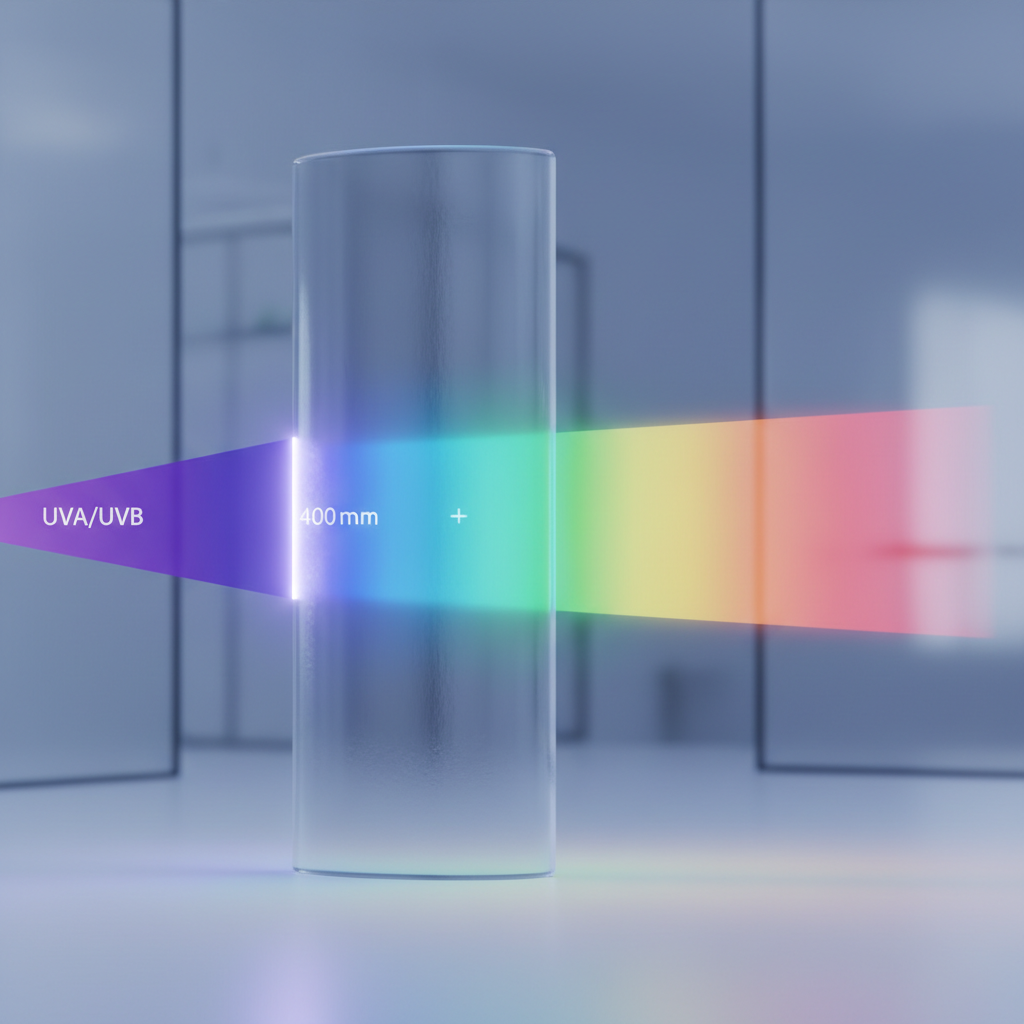
In the optical industry, safety is defined by physics and verified testing, not by brand prestige or the depth of a tint. The UV400 designation is a specific technical standard that guarantees your eyewear blocks light rays with wavelengths up to 400 nanometers. This covers 100% of UVA and UVB rays, the invisible high-energy radiation that causes long-term ocular damage.
This article decodes exactly what the UV400 standard means, how it differs from other "100% UV Protection" claims, and why checking for this specific label is the only way to ensure your eyes are truly shielded—regardless of whether you spend $20 or $200.
The Science of UV400: Why the Number Matters
To understand why UV400 is the gold standard, we must look at the ultraviolet spectrum. Ultraviolet (UV) radiation is measured in nanometers (nm). The sun emits three types of UV rays, but only two reach the earth's surface in significant amounts:
- UVB (280–315 nm): These highly energetic rays are the primary cause of sunburn and are strongly linked to the development of cataracts and photokeratitis (sunburn of the eye).
- UVA (315–400 nm): These rays penetrate deeper into the eye, reaching the lens and retina. They are associated with macular degeneration and premature aging of the skin around the eyes.
The "20nm Gap" Risk
A critical distinction in the eyewear industry is the difference between older standards and the modern UV400 requirement. Some international standards only require UV protection up to 380 nm. While this sounds close to 400, that 20-nanometer gap is significant.
According to a technical analysis on Solar UV Protection Standards, the 380–400 nm band contains approximately 45% more UV energy than the bands below it. Lenses that only block up to 380 nm allow this high-energy near-UV radiation to pass through to the eye. The UV400 standard closes this gap, ensuring that the cutoff point is at or above 400 nm, effectively blocking the entire harmful spectrum.
Debunking the "Darkness Fallacy"
One of the most persistent and dangerous myths in eyewear is that darker lenses offer better protection. This is scientifically incorrect and can actually lead to greater eye damage if the lenses are not properly treated.
The Pupil Paradox
The human eye has a natural defense mechanism: in bright light, the pupil constricts (shrinks) to limit the amount of light entering the retina. When you put on dark sunglasses, the visible light is reduced, causing your pupil to dilate (open wider) to let more light in.
If those dark sunglasses lack a proper UV400 filter, your dilated pupil acts like a wide-open funnel, allowing significantly more UV radiation to enter the eye than if you were wearing no sunglasses at all.
Key Takeaway: A clear lens with UV400 protection is safer than a pitch-black lens with zero UV protection.
Expert Insight: According to MD Anderson Cancer Center, wearing dark lenses without UV blocking is more dangerous than going without sunglasses because of this pupil dilation effect. This is why verifying the "UV400" certification is a health necessity, not just a feature.
Comparison: Tint Darkness vs. UV Safety
To clarify the relationship between what you see (tint) and what protects you (UV filter), we have compiled this comparison:
| Feature | Visible Tint (Darkness) | UV400 Filter (Safety) |
|---|---|---|
| Function | Reduces glare and visible brightness. | Blocks invisible ultraviolet radiation. |
| Mechanism | Dyes or polarization films absorb visible light. | Chemical absorbers or inherent material properties block wavelengths <400nm. |
| Visibility | Visible to the naked eye (Gray, Brown, Green). | Invisible (Clear lenses can be UV400). |
| Health Impact | Improves visual comfort; reduces squinting. | Prevents cataracts, macular degeneration, and pinguecula. |
| Verification | Can be seen by looking at the lens. | Requires a photometer or spectrometer test. |
Material Science: Embedded vs. Coated Protection
Not all UV400 lenses are created equal. The durability of the protection depends heavily on how the UV-blocking properties are integrated into the lens.
Embedded Protection (The Superior Choice)
High-quality lens materials, such as Polycarbonate and Trivex, have UV-blocking properties inherent to their chemical structure. The material itself absorbs UV radiation. Because the protection is "baked in," it cannot scratch off or wear away over time. This is the standard for safety eyewear and high-quality optical lenses.
Coated Protection (The Budget Risk)
In cheaper acrylic or CR-39 plastic lenses, the UV protection is often applied as a thin coating on the surface. While effective initially, this coating can degrade. A study on UV Protection Standards noted that lenses can lose efficacy due to "photobleaching" (exposure to sunlight over time) or physical abrasion. If you use abrasive cleaners or paper towels on these lenses, you might unknowingly strip away the protective layer.
Impact Resistance and Safety
Beyond UV protection, the physical safety of the lens is regulated. In the United States, the FDA mandates that all eyewear must pass an impact resistance test (the "drop ball test") under 21 CFR 801.410. When choosing sunglasses, particularly for children or sports, look for materials like Polycarbonate that naturally offer both UV400 protection and shatter resistance.
How to Verify Your Sunglasses Are Safe
Since you cannot "see" UV protection, how can a consumer verify that their affordable sunglasses are actually safe?
1. The Label is the First Step
Look for a sticker or tag that explicitly says "UV400" or "100% UV Protection." Be wary of vague terms like "UV Absorbing" without a percentage or wavelength specification.
2. Request a Transmission Curve
For the most transparent verification, reputable manufacturers or optical labs can provide a spectral transmission curve. This is a graph showing exactly how much light passes through the lens at every wavelength.
- What to look for: The line should be at 0% transmission from 280 nm all the way up to 400 nm. It should only start rising (allowing light through) after the 400 nm mark.
3. The "Tile Floor" Test for Optical Quality
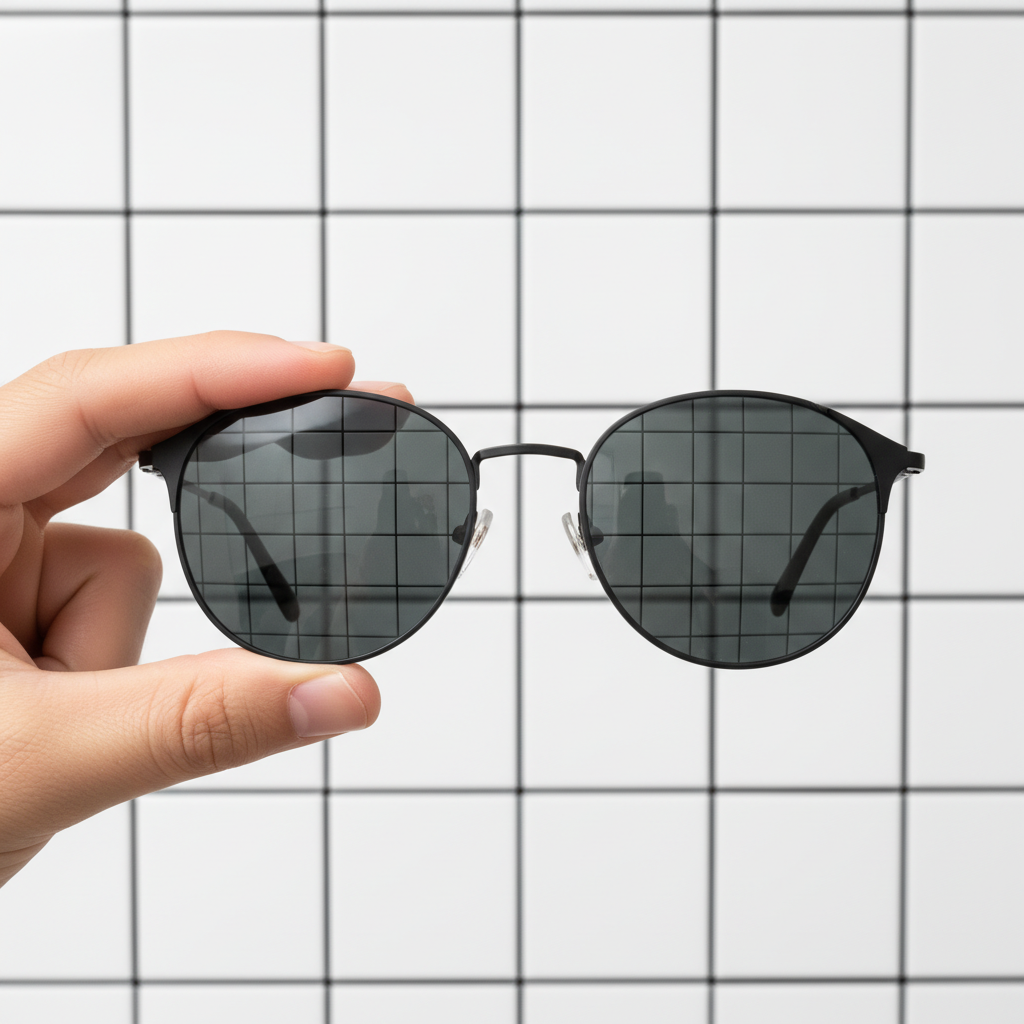
While this test checks for distortion rather than UV blocking, it is a good proxy for overall manufacturing quality. The American Academy of Ophthalmology (AAO) suggests holding the glasses at arm's length and looking at a rectangular pattern, like a tiled floor. Move the glasses side to side. If the lines of the tiles wiggle, bow, or distort, the lenses are optically imperfect, which can cause headaches and eye strain.
4. Professional Photometer Testing
If you are unsure about an old pair of sunglasses, take them to a local optical shop. Most opticians have a UV photometer—a device that measures the UV transmission of a lens in seconds. This service is often free and provides the only definitive "pass/fail" result for UV safety.
Wrapping Up: The Value of Verified Safety
The most important takeaway for any eyewear buyer is that price is not a proxy for protection. A $300 pair of designer sunglasses might offer the exact same UV400 protection as a verified $30 pair from a transparent manufacturer. The difference often lies in the brand name, frame materials, and marketing, not the safety of the lenses.
When shopping for your next pair, prioritize the UV400 label above all else. It is the scientific guarantee that your eyes are shielded from the entire spectrum of harmful ultraviolet radiation. By understanding the difference between tint and protection, and knowing how to verify lens quality, you can make smarter decisions that protect your vision for the long term without overspending.
Key Takeaways
- UV400 is Non-Negotiable: It blocks rays up to 400 nm, covering the dangerous UVA gap that older standards miss.
- Darkness $\neq$ Safety: Dark lenses without UV filters cause pupil dilation, increasing UV exposure and risk of damage.
- Material Matters: Polycarbonate lenses have embedded UV protection that won't scratch off, unlike some cheap surface coatings.
- Verify Quality: Use the tile floor test for distortion and check for specific "UV400" labeling rather than vague "UV Protection" claims.
Frequently Asked Questions (FAQ)
Does polarization add UV protection? No. Polarization is a filter that blocks horizontal glare (like light reflecting off water or roads), but it does not block UV rays on its own. However, most high-quality polarized lenses are also made with UV400 materials. Always check for both labels if you want glare reduction and safety.
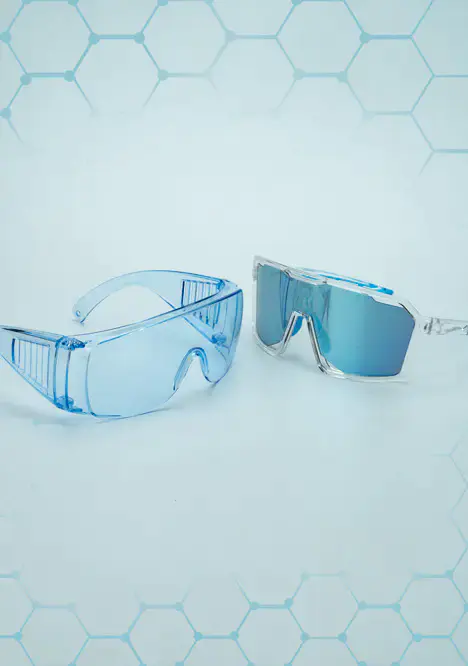
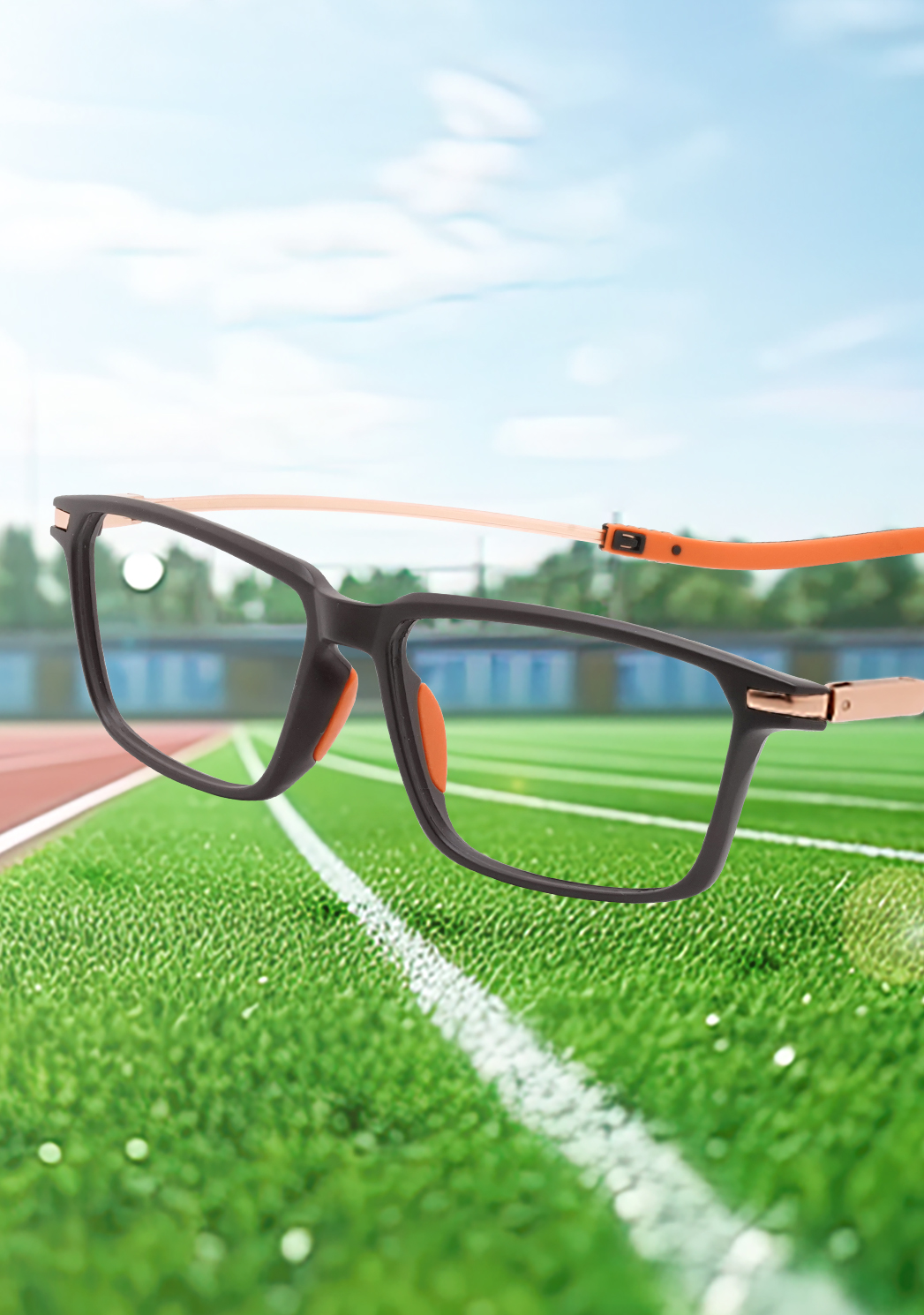
Do clear lenses have UV protection? Yes, they can. Clear prescription lenses or safety glasses can be made with UV400 materials (like polycarbonate) or treated with a clear UV-absorbing coating. This is why wearing clear prescription glasses can still protect your eyes from sun damage if they are properly specified.
Do sunglass coatings wear off? If the UV protection is a surface coating on a cheap plastic lens, yes, it can degrade over time due to scratches, heat, and cleaning chemicals. Lenses with embedded protection (like polycarbonate or Trivex) retain their UV-blocking ability indefinitely, although the lens surface itself may still scratch.
Is UV400 the same as 100% UV Protection? Practically speaking, yes. "100% UV Protection" usually implies blocking both UVA and UVB rays. However, "UV400" is the more technical and precise term, confirming the cutoff wavelength is 400 nm.
Disclaimer: This article is for informational purposes only and does not constitute professional medical advice. If you have specific concerns about your eye health or vision, please consult a qualified optometrist or ophthalmologist.


