







UVA vs. UVB: Which Wavelength Harms Deep Ocular Tissues More?
Executive Summary: Why "UV Protection" Isn't Always Enough
When choosing sunglasses, the term "UV protection" can be deceptively simple. While it implies safety, it doesn't tell the whole story. Not all ultraviolet (UV) rays are created equal, and consequently, not all protective lenses offer the same level of defense. The sun emits two primary types of UV radiation that reach us: UVB, known for causing surface-level burns, and UVA, a more insidious wavelength that penetrates deep into the eye's internal structures.
Understanding the distinct threat each type poses is fundamental to selecting eyewear that truly preserves your vision. This isn't merely about comfort or reducing glare; it's about making a critical health decision to prevent irreversible, long-term damage to your eyes. An effective pair of sunglasses must act as a full-spectrum shield against both the immediate and the cumulative dangers of solar radiation.
The Two Faces of Ultraviolet Damage: UVB vs. UVA
Solar UV radiation is a complex spectrum of light, but the two components that pose the most significant risk to our eyes are Ultraviolet-B (UVB) and Ultraviolet-A (UVA). While often grouped together, their wavelengths, energy levels, and the ways they damage ocular tissues are profoundly different.
UVB: The Sunburn Ray That Burns the Eye's Surface
UVB rays (280-315 nm) carry more energy than UVA rays. Think of them as the primary culprit behind a painful sunburn on your skin. This same intense, surface-level energy affects your eyes. The cornea, the eye's transparent outer layer, absorbs the majority of UVB radiation before it can travel deeper.
However, this absorption process is not harmless. Intense or prolonged exposure can lead to a condition called photokeratitis, which is essentially a sunburn of the cornea. Often called "snow blindness," it can cause severe pain, redness, and temporary vision loss. Furthermore, chronic UVB exposure is a primary environmental cause of pterygium (often called "surfer's eye"), a benign but irritating growth on the white of the eye that can extend onto the cornea and interfere with vision. Research highlights a mechanism known as the "Coroneo Effect," where UV light entering from the side of the eye is focused onto the nasal region—the most common site for pterygium to develop, as noted in a comprehensive review in Photochemistry and Photobiology.

UVA: The Silent Intruder That Reaches the Lens and Retina
UVA rays (315-400 nm) have less energy than UVB but are far more numerous, making up about 95% of the UV radiation that reaches the Earth's surface. Their longer wavelength allows them to bypass the cornea's defenses and penetrate deep into the eye, damaging the crystalline lens and, in some cases, the retina itself.
This deep penetration is what makes UVA so dangerous. The damage is cumulative and painless, occurring slowly over decades. This is the primary mechanism behind the formation of cortical cataracts. Groundbreaking research from the National Eye Institute (NEI) revealed how this happens on a molecular level. In the oxygen-poor environment of the lens, UVA radiation triggers a process called glycation, causing lens proteins to clump together, harden, and turn yellow, forming a cataract.
While the link between UV and cataracts is definitive, its role in Age-Related Macular Degeneration (AMD) is still under investigation but considered a significant risk factor. A 2011 review in Photochemistry and Photobiology by Dr. Joan E. Roberts points out that short-wavelength blue and violet light (400-440 nm), which lies adjacent to the UVA spectrum, is known to generate reactive oxygen species in the retina, a key driver of AMD. This makes blocking the entire UV and near-UV spectrum a prudent preventative strategy.
The "UV400" Standard: Demystifying the Numbers
With a clear understanding of the dual threats from UVA and UVB, the labeling on sunglasses becomes critically important. A simple "UV-blocking" sticker is not enough; the specific level of protection is what matters. The gold standard in eyewear is the UV400 rating.
What Does UV400 Mean and Why Is It Critical?
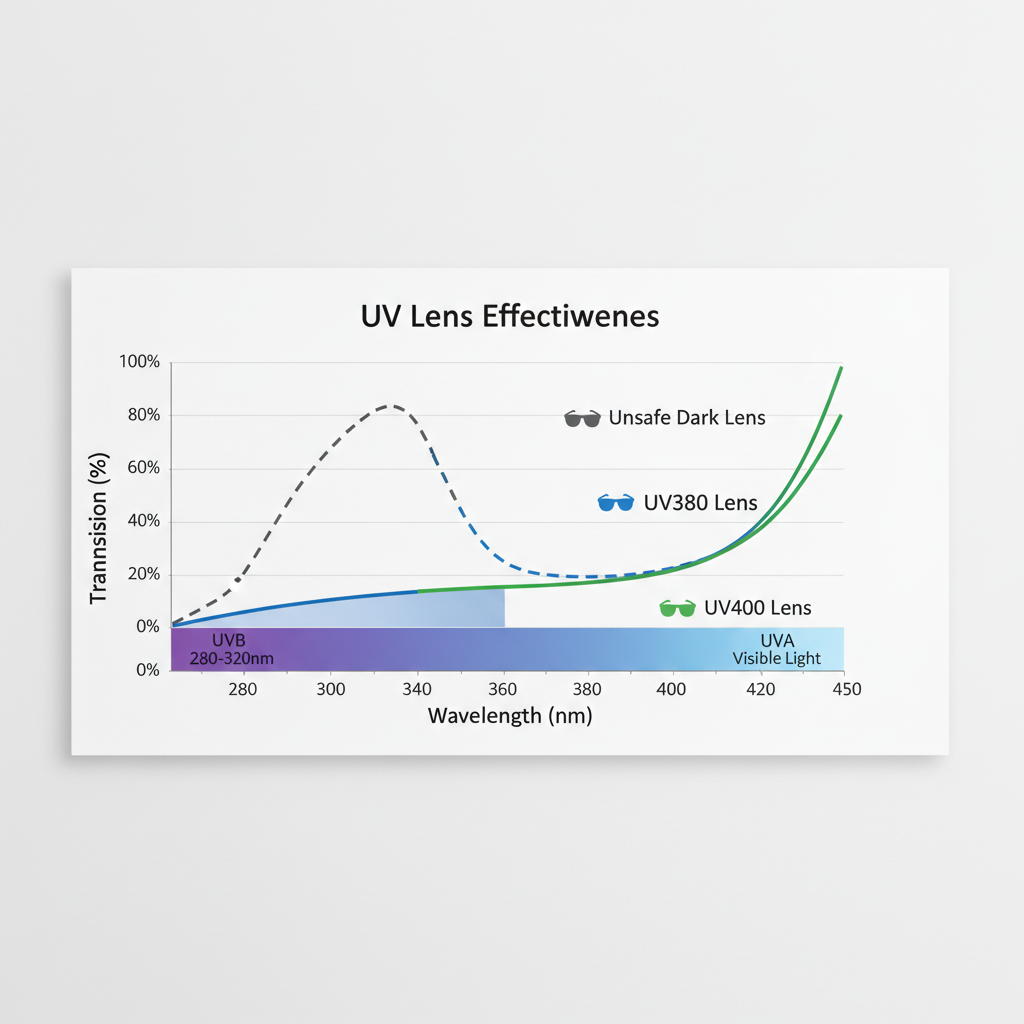
A UV400 rating signifies that the lenses block all light rays with wavelengths up to 400 nanometers. This single, simple standard ensures that your eyes are shielded from 100% of both UVA and UVB rays. It provides complete protection by filtering out every harmful, high-energy photon before it can reach any part of your eye, from the surface of the cornea to the delicate tissues of the retina.
The Hidden Danger of Sub-400nm Lenses
Some older or lower-quality standards for sunglasses only require protection up to 380 nm (UV380). While this seems close, that 20-nanometer gap between 380 nm and 400 nm is a critical vulnerability. Technical analyses, such as a report in SPIE, have shown that the 280–400 nm range contains significantly more UV energy than the narrower 280–380 nm range. This means a UV380 lens allows a band of the most energetic, deeply penetrating UVA light to pass directly into your eye.
This creates a dangerous situation known as the "Darkness Fallacy." As explained by experts at the MD Anderson Cancer Center, a dark tinted lens without a proper UV400 filter causes your pupil to dilate. This is your eye's natural response to low light. However, behind an inadequate lens, this widened opening allows even more of the unblocked UVA radiation to flood in, potentially causing more damage than wearing no sunglasses at all. This is why a faint, clear UV400 lens is safer than a very dark, non-UV400 lens.
Beyond the Lens: Factors That Determine Real-World Protection
Achieving true ocular safety involves more than just the lens rating. The frame design, lens material, and even how you care for your glasses play a crucial role in your overall level of protection.
Frame Geometry: The Overlooked Factor of Peripheral Leakage
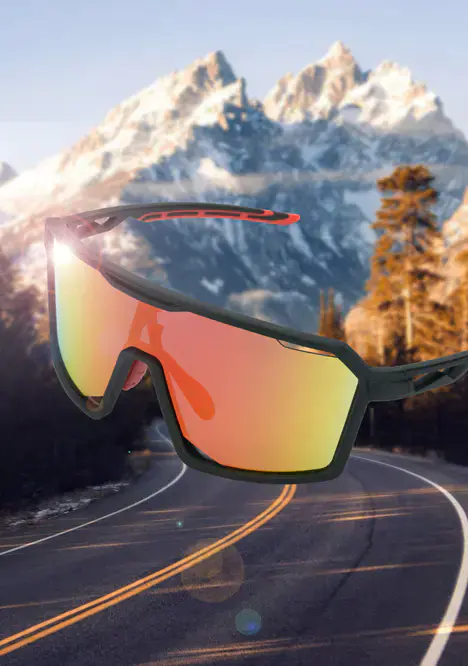
Even with perfect UV400 lenses, a significant amount of UV radiation can still reach your eyes by leaking around the edges of the frames. A 3D-sensor study published in Photochemistry and Photobiology found that standard, middle-sized frames can allow substantial "peripheral light leakage." For total protection, especially during high-exposure activities like skiing or being on the water, experts recommend oversized or wraparound styles.
A Practical Heuristic: The Thumb Rule A common rule of thumb used by opticians to check for a proper fit is to look straight ahead while wearing the glasses. If you can clearly see your thumbnail through the gap between the frame and your temple, the frame is likely too narrow, allowing harmful peripheral UV light to enter.
Lens Material Matters: Polycarbonate vs. Standard Plastic
The material a lens is made from determines its inherent protective qualities. Standard plastic lenses (CR-39) require a specific UV-blocking coating to be applied. In contrast, materials like polycarbonate and Trivex have UV absorption built directly into the polymer itself. This makes the protection an intrinsic property of the lens that cannot scratch off or wear away over time. As detailed in our guide on sunglass longevity, any scratch on a coated lens can compromise its protective barrier.
The Polarization Myth: Glare Reduction Is Not UV Protection
One of the most persistent misconceptions is that polarized lenses automatically block UV light. This is false. As confirmed by health experts at Duke Health, polarization and UV protection are two entirely separate technologies.
- Polarization is a film that filters out horizontal light waves (glare) reflected off surfaces like water or roads. It enhances comfort and visual clarity.
- UV Protection is a chemical treatment or inherent material property that absorbs high-energy UV photons.
While many high-quality sunglasses offer both, you must never assume a polarized lens is UV-safe. Always verify it has a separate UV400 rating.
Who is Most at Risk? Understanding Your Personal Vulnerability
While everyone needs UV protection, certain biological and age-related factors can place some individuals at a significantly higher risk of ocular damage.
The Melanin Shield: Why Light-Colored Eyes Need More Protection
Melanin, the pigment that determines eye, skin, and hair color, is a natural photoprotectant. Individuals with light-colored eyes (blue, green, or hazel) have less of this protective pigment in their irises and deeper ocular layers. A rigorous study on Uveal Melanoma (a type of eye cancer) published in the International Journal of Molecular Sciences identified light eye color as a significant risk factor. The lower melanin content provides a weaker shield against harsh light, leading not only to heightened light sensitivity (photophobia) but also a reduced ability to block damaging UV rays from reaching the retina.
The Cumulative Factor: Why Children's Eye Protection is Non-Negotiable
UV damage is cumulative over a lifetime, and protection is most critical during childhood. The crystalline lens in a child's eye is exceptionally clear, allowing a much higher percentage of UV radiation to pass through to the retina compared to an adult's lens. The same Uveal Melanoma study notes that ocular structures in children transmit significantly more UV light.
Despite this vulnerability, a German epidemiological study published in PubMed revealed a startling public health gap: only about 12.5% of children regularly wear sunglasses, compared to 50% of adults. Ensuring children wear proper, impact-resistant UV400 sunglasses from a young age is one of the most important investments you can make in their lifelong vision health.
A Practical Guide to Ensuring Total UV Defense
Navigating the world of eyewear can be complex, but ensuring your eyes are safe from UV radiation comes down to a few key principles. Use this checklist to make informed decisions:
- 1. Demand UV400: This is non-negotiable. Always look for a label or certification that explicitly states "UV400" or "100% UVA/UVB Protection."
- 2. Think Big and Wraparound: Choose frames that fit closely to your face and provide ample coverage to block light from the sides, top, and bottom. Apply the "thumb rule" to check the fit.
- 3. Prioritize Inherent Protection: Whenever possible, opt for lenses made from polycarbonate or Trivex, as their UV protection is built-in and cannot be compromised by scratches.
- 4. Don't Confuse Dark with Safe: Never use the darkness of the tint as a proxy for safety. A lens's color is cosmetic; its UV rating is a medical necessity.
- 5. Start Early: Protect the next generation. Equip children with high-quality, durable sunglasses and instill the habit of wearing them outdoors.
- 6. Verify, Don't Assume: Understand that features like polarization are separate from UV protection. Value them for the comfort they provide, but always confirm the UV400 rating independently.
Disclaimer: This article is for informational purposes only and does not constitute professional medical advice. The information provided is not intended to be a substitute for a comprehensive eye exam or a consultation with a qualified healthcare professional. Please consult your ophthalmologist or optometrist for any health concerns or before making any decisions related to your eye health and vision.
References
- Roberts, J. E. (2011). Ocular phototoxicity. Photochemistry and Photobiology, 87(4), 936-943.
- National Eye Institute (NEI). (2014). New research sheds light on how UV rays may contribute to cataract. https://www.nei.nih.gov/about/news-and-events/news/new-research-sheds-light-how-uv-rays-may-contribute-cataract
- Coroneo, M. T. (1993). Pterygium as an early indicator of ultraviolet insolation: a hypothesis. British Journal of Ophthalmology, 77(11), 734-739.
- Masili, M., & Schor, R. (2014). UV protection standards for sunglasses. SPIE Proceedings, 8930.
- Al-Robain, A. A., et al. (2021). The Impact of Ultraviolet Radiation on the Aetiology and Development of Uveal Melanoma. International Journal of Molecular Sciences, 22(8), 3959. https://pmc.ncbi.nlm.nih.gov/articles/PMC8038359/
- Sliney, D. H. (2019). Ocular dosimetry for ultraviolet radiation and the potential for peripheral light focusing. Photochemistry and Photobiology, 95(4), 1051-1057. https://pmc.ncbi.nlm.nih.gov/articles/PMC6803516/
- MD Anderson Cancer Center. (2023). 9 things to know about sunglasses, eye protection and cancer. https://www.mdanderson.org/cancerwise/9-things-to-know-about-sunglasses--eye-protection-and-cancer.h00-159699123.html


