











Vitamin A and Rhodopsin: Enhancing Your Night Vision
Executive Summary
Visual performance in low-light conditions—commonly referred to as night vision—is not merely a fixed trait of one's anatomy; it is a dynamic physiological process heavily dependent on specific nutritional foundations and optical precision. Central to this process is rhodopsin, a light-sensitive protein in the retinal rod cells that requires a continuous supply of Vitamin A for regeneration.
This article explores the biochemical "visual cycle," the critical role of Vitamin A in maintaining dark adaptation, and the practical implications for drivers and outdoor enthusiasts. We address the "Marginal Deficiency Paradox," where night vision degrades before any measurable change in standard visual acuity occurs. Furthermore, we contrast the efficacy of whole-food nutrition against sporadic supplementation, citing the AREDS2 study and metabolic conversion data. To ensure comprehensive safety, we also examine how optical accuracy and lens technology (such as UV400 protection and anti-reflective coatings) synergize with systemic health to stabilize prescriptions and enhance "Visual Utility."
The Biochemistry of Night Vision: The Rhodopsin Cycle
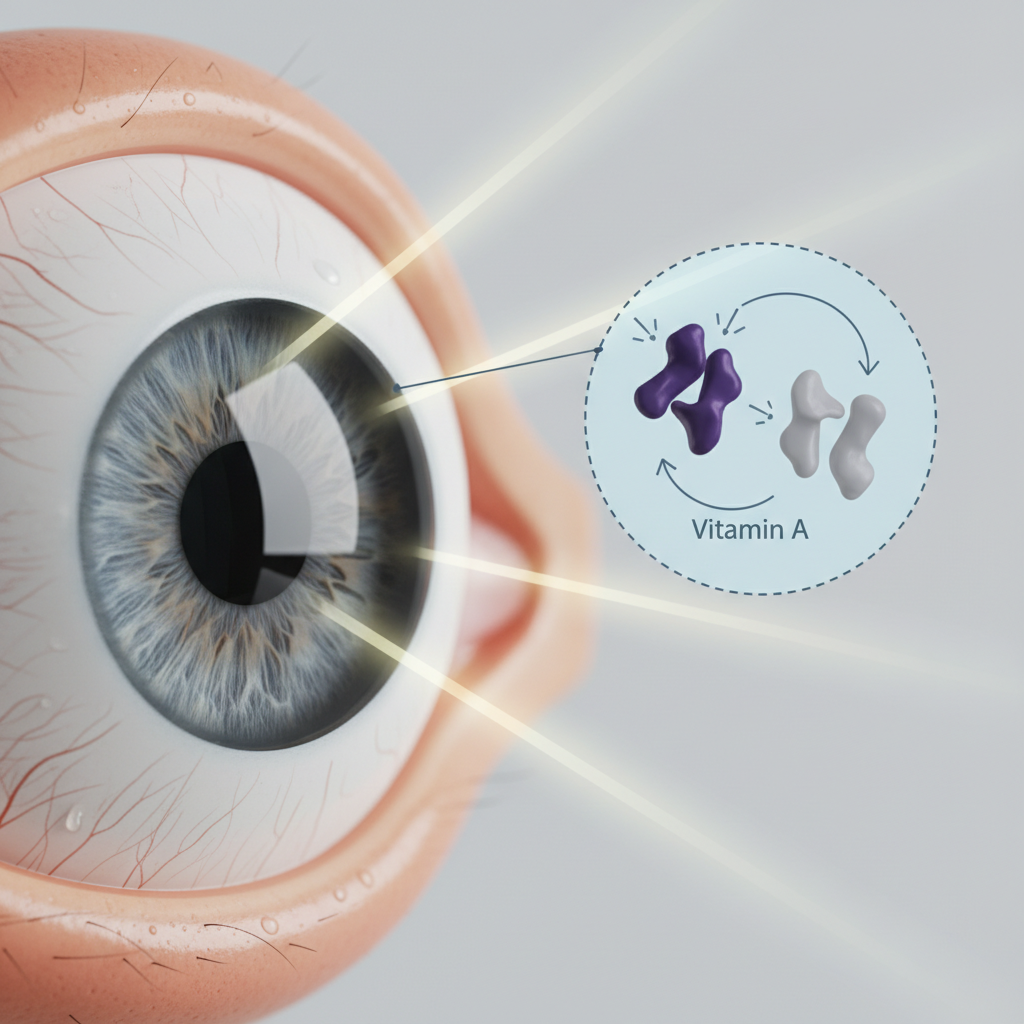
The human retina contains two primary types of photoreceptors: cones, which handle color and detail in bright light, and rods, which are responsible for vision in low-light environments. Rods are incredibly sensitive, capable of reacting to a single photon of light. However, their functionality depends entirely on a pigment called rhodopsin (also known as visual purple).
When light strikes the retina, rhodopsin undergoes a process called "bleaching." It breaks down into a protein (opsin) and a form of Vitamin A (retinal). To see again in the dark, the body must "reset" this pigment. This regeneration is a metabolic loop known as the Visual Cycle. Without an adequate, steady supply of Vitamin A, the regeneration of rhodopsin is delayed or incomplete. This delay manifests as "night blindness" (nyctalopia)—a condition where the eyes take an abnormally long time to adjust to darkness or fail to see clearly in dim environments.
The "Visual Utility" Perspective
For drivers, the speed of this regeneration is a critical safety metric. When oncoming headlights "blind" a driver, the rhodopsin in their rods is momentarily bleached. A robust visual cycle allows for rapid recovery. Conversely, a sluggish cycle increases the "recovery gap," leaving the driver visually compromised for several seconds—a dangerous interval at highway speeds.
The Marginal Deficiency Paradox: Why Your 20/20 Vision Might Lie
In clinical practice, we often observe a phenomenon we call the "Marginal Deficiency Paradox." Patients may pass a standard Snellen chart test with 20/20 visual acuity in a brightly lit exam room, yet report significant struggles with night driving, such as "halos" around streetlights or difficulty discerning shadows on the road.
This occurs because standard eye exams primarily test cone function under high-contrast conditions. Rod function—and by extension, Vitamin A status—is much more sensitive. According to the World Health Organization (WHO), Vitamin A deficiency is a leading cause of preventable vision impairment globally. Even in developed nations, "marginal" status (levels that are low but not yet at the threshold of clinical deficiency) can cause sub-clinical night vision impairment.
Logic Summary: Our assessment of night vision sensitivity assumes that rod-mediated dark adaptation is the first physiological system to fail under nutritional stress. This is based on practitioner observations where night driving complaints precede measurable changes in central visual acuity (not a controlled lab study).
Nutritional Foundations: Whole Foods vs. Supplementation
A common mistake is attempting to "fix" night vision with sporadic, high-dose Vitamin A supplements. However, the eye requires a stable, consistent supply rather than transient spikes.
The Bioavailability Challenge
Vitamin A comes in two forms: preformed Vitamin A (retinol) from animal sources and provitamin A (carotenoids like beta-carotene) from plants. A critical nuance often overlooked is the high variability in how individuals convert plant-based beta-carotene into usable retinol.
| Parameter | Estimated Range | Unit | Rationale / Source Category |
|---|---|---|---|
| Beta-Carotene Conversion Ratio | 3:1 to 28:1 | Ratio | PMC2854912 |
| Recommended Lutein Intake | 10–20 | mg/day | PubMed Meta-Analysis |
| Dark Adaptation Recovery | 2–5 | Minutes | Typical clinical observation |
| UV400 Protection Threshold | 100% | % | AOA Standards |
| Online Optical Failure Rate | ~44.8 | % | PubMed: Online Eyewear Accuracy |
Modeling Note (Reproducible Parameters): This conversion model assumes normal fat absorption. Individuals with malabsorption issues or specific genetic polymorphisms (such as BCO1 gene variations) may fall into the 28:1 range, meaning they require significantly more plant-based intake to achieve the same retinal levels as those with a 3:1 conversion efficiency.
Strategic Food Choices for Visual Utility
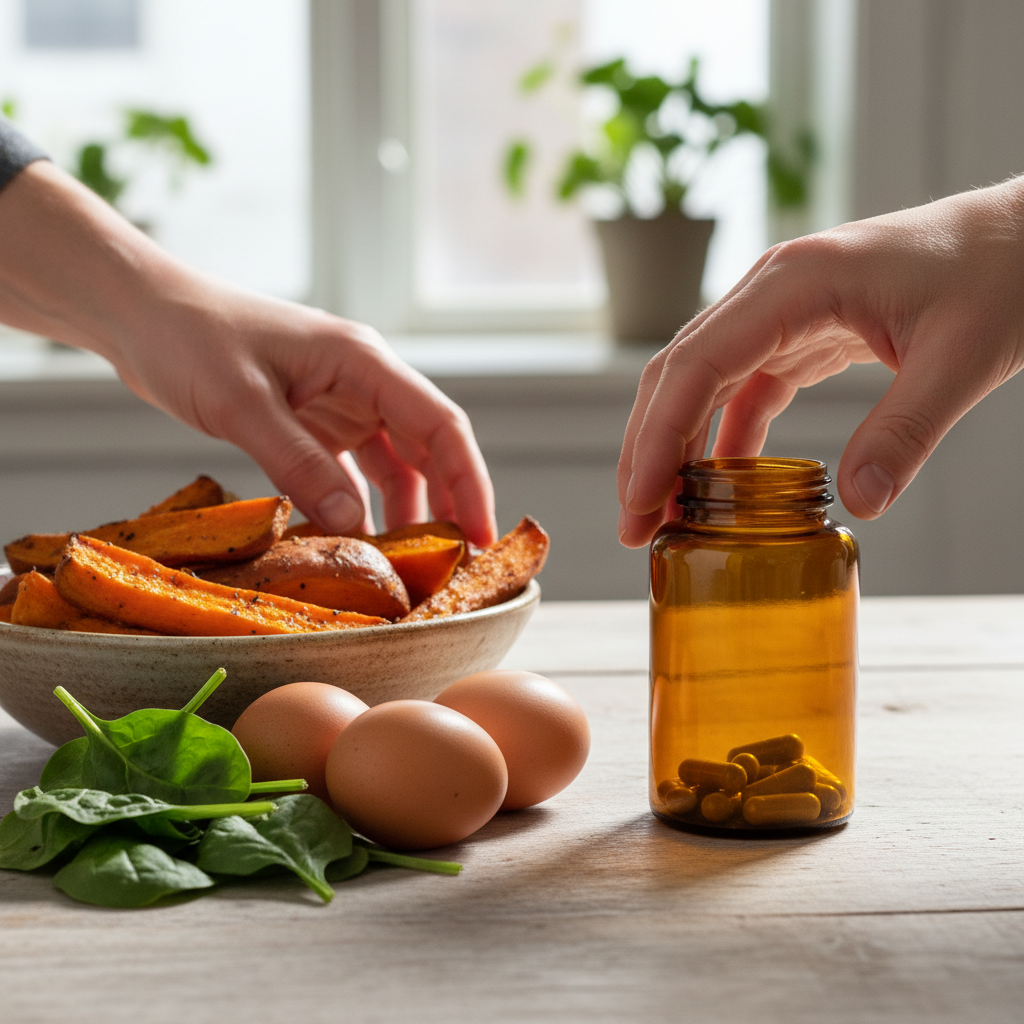
- Animal Sources (Retinol): Beef liver and egg yolks are highly bioavailable. Egg yolks are particularly valuable because they also contain lutein and zeaxanthin in a lipid matrix, which increases bioavailability compared to vegetable sources.
- Plant Sources (Carotenoids): Sweet potatoes, carrots, and spinach. To maximize absorption, these should be consumed with a small amount of healthy fat (e.g., olive oil).
- The "Saffron" Insight: Recent clinical trials have shown that saffron supplementation can improve retinal flicker sensitivity in early AMD patients, suggesting a role for specific phytonutrients in enhancing signal processing in the eye.
Optical Accuracy: The Partner to Nutritional Health
While nutrition builds the biological "engine" of vision, your eyewear acts as the "windshield." Even a perfectly nourished retina cannot compensate for poor optical quality.
The Hazard of Inaccurate Prescriptions
A study published in PubMed regarding online eyewear accuracy found that nearly 44.8% of glasses ordered online failed at least one optical tolerance or impact resistance test. For night drivers, the most critical failure is the misalignment of the optical center. If the lenses are not perfectly centered over your pupils, they can induce a "prism effect," causing ghosting, blur, and significant eye strain—symptoms that are magnified in low-light conditions.
To ensure your safety, it is essential to have a current prescription. Per the FTC Eyeglass Rule, your eye doctor must provide you with a copy of your prescription immediately after an exam, allowing you to seek high-quality, verified eyewear from reputable providers.
Lens Coatings and Night Vision
For those relying on Visual Utility, anti-reflective (AR) coatings are non-negotiable. Standard plastic lenses reflect about 8–10% of light, meaning less light reaches your retina. In a night driving scenario, this loss of light can be the difference between spotting a hazard and missing it. AR coatings increase light transmission to nearly 99%, while also eliminating the "starburst" effect around headlights.
Prescription Stability and Systemic Health
A frequent concern among our customers is the frequency of prescription changes. We often see patterns where rapid changes in vision correlate with systemic health fluctuations.
The "Sugar Sponge" Effect
High blood sugar levels can lead to the accumulation of sorbitol in the eye's lens. This process, known as the Polyol Pathway, causes the lens to swell and change its refractive power. This can lead to temporary "shifts" in your prescription. Maintaining stable blood glucose is therefore a cornerstone of maintaining prescription stability.
Chronic Inflammation and the Gut-Eye Axis
Emerging research into the Gut Microbiome and Eye Health suggests that systemic inflammation, often driven by a poor diet high in refined carbohydrates, can affect the ocular surface and potentially influence the progression of refractive errors like myopia. While more research is needed, a Mediterranean-style diet—rich in fish, vegetables, and healthy fats—has been shown to reduce the risk of advanced AMD by up to 40%.
Practical Action Plan for Enhanced Night Vision
To maximize your visual performance and safety, we recommend the following evidence-based steps:
- Prioritize Whole Foods: Aim for 2–3 servings of fatty fish per week (for Omega-3s) and daily intake of dark leafy greens or orange vegetables.
- Verify Your Prescription: Ensure your glasses are made to exact tolerances. If you experience headaches or "pulling" sensations, your drugstore reading glasses or low-quality online pairs may be to blame.
- Insist on AR Coating: If you drive at night, ensure your lenses have a high-quality anti-reflective coating to maximize light transmission.
- Protect Against UV: Cumulative UV damage is linked to cataracts. Ensure your daily eyewear provides UV400 protection, which blocks 100% of harmful UVA and UVB rays up to 400nm.
- Monitor Night Adaptation: If you notice a significant increase in the time it takes for your eyes to adjust to a dark room, consult an eye care professional to check your Vitamin A status and retinal health.
Strategic Implications for Long-Term Vision
The intersection of nutrition and optics represents the "frontier" of visual utility. By understanding that vision is a biological process that can be supported through diet and protected through precision engineering, you move from being a passive consumer to an active steward of your sight. Whether you are navigating a dark highway or enjoying a late-evening hike, the synergy of rhodopsin regeneration and accurate lens geometry ensures that your "Visual Utility" remains at its peak.
Disclaimer: This article is for informational purposes only and does not constitute professional medical advice, diagnosis, or treatment. Always seek the advice of your physician or other qualified health provider with any questions you may have regarding a medical condition. Never disregard professional medical advice or delay in seeking it because of something you have read on this website.
References
- National Eye Institute (NEI): AREDS2 Study Results
- Federal Trade Commission (FTC): Buying Prescription Glasses
- PubMed: Online Eyewear Accuracy Study
- World Health Organization (WHO): World Report on Vision
- American Academy of Ophthalmology (AAO): Mediterranean Diet and AMD
- Cleveland Clinic: How to Read Your Eye Prescription


