




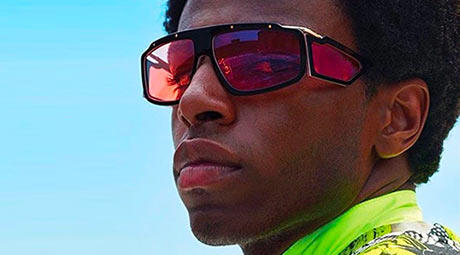




A Guide to Wraparound High Prescription Sunglasses
The Challenge of High-Performance Vision: A Guide to Wraparound Prescription Sunglasses
For those of us with strong prescriptions, finding sunglasses that offer both style and performance can feel like an impossible task. You want the full coverage and sporty aesthetic of a wraparound frame, but you're often told your prescription is too high, destined to cause a "fishbowl" effect of distorted vision. For years, this was a frustrating reality. The aggressive curve of a wraparound frame would bend light in ways that standard lenses simply couldn't correct for, especially with higher spherical powers or significant astigmatism.
However, modern lens technology has fundamentally changed the game. It is now possible to get crystal-clear vision in high-wrap frames, but it requires a specific combination of advanced materials, precision manufacturing, and expert measurements. This guide will walk you through the science behind it, what to look for, and how to get a pair of high-performance sunglasses that finally work with your prescription.
TL;DR: Key Takeaways
- The Problem: Traditional lenses in highly curved (wraparound) frames cause significant peripheral distortion, especially for prescriptions stronger than +/- 3.00 diopters.
- The Solution: A combination of high-index lens materials, aspheric lens designs, and digital "freeform" surfacing technology is required to create clear, distortion-free vision.
- Measurements are Critical: Standard measurements are not enough. Success depends on precise monocular pupillary distance (PD), vertex distance, and pantoscopic tilt to customize the lens for your eyes and the specific frame.
- Material Matters: Impact-resistant materials like polycarbonate are essential for safety in sports, while high-index plastics are key to reducing lens thickness and weight for stronger prescriptions.
Why Standard Lenses Fail in Wraparound Frames
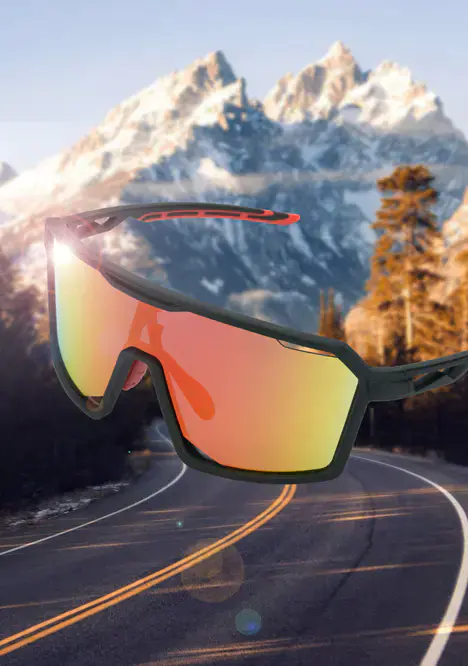
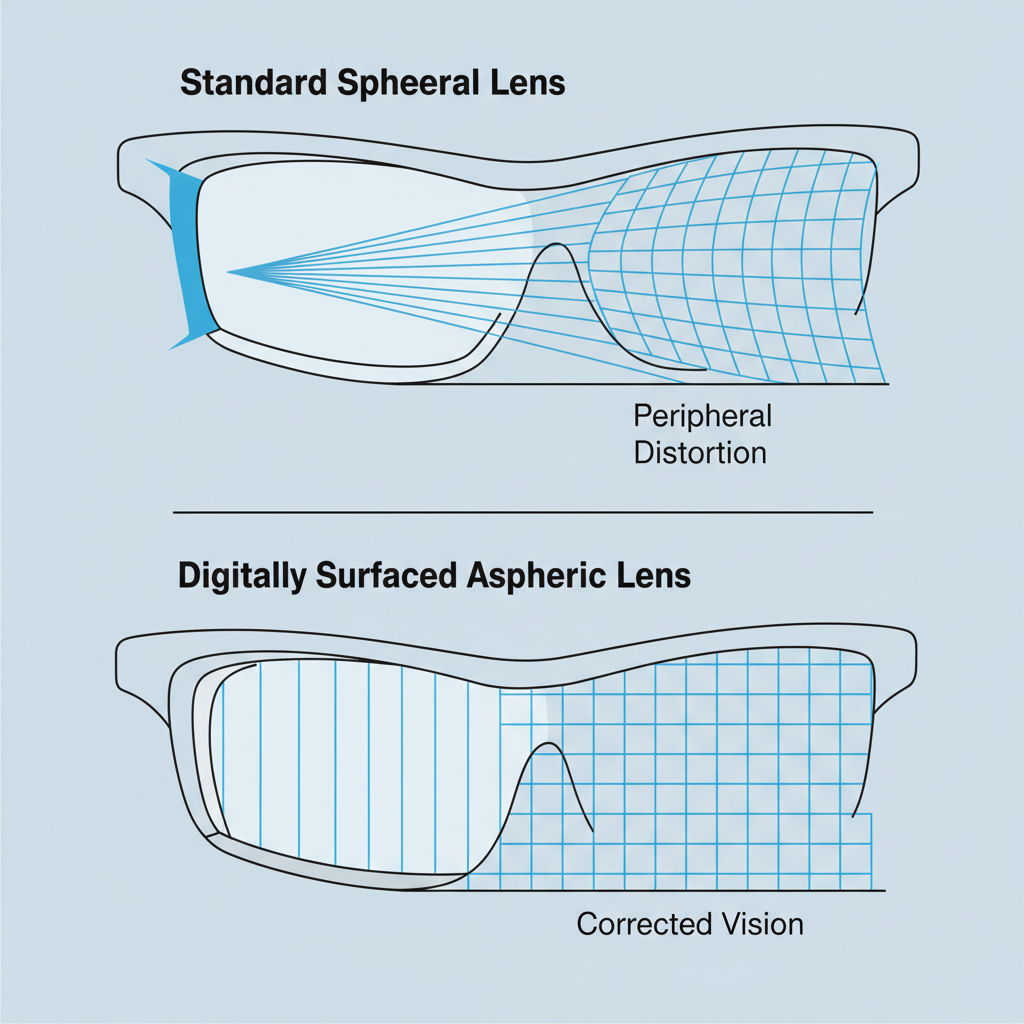
The core issue lies in the physics of light and the shape of the lens. A frame's curvature is measured by its "base curve." A flat fashion frame might have a 2-base or 4-base curve, while a true performance wraparound frame typically has an 8-base curve. When a standard, spherically ground lens is forced into that aggressive curve, optical distortions are inevitable.
Here’s what happens:
- Peripheral Distortion: As you look away from the center of the lens, the viewing angle becomes more extreme. This induces aberrations that can make straight lines appear curved and can cause a swimming or dizzying sensation. This is a common reason people feel that lens curvature affects their high prescription vision.
- Induced Astigmatism: The steep angle of the lens relative to your line of sight can create unwanted cylindrical power, essentially introducing astigmatism that isn't in your prescription and blurring your vision.
- Prismatic Effect: The curved lens can displace images, making objects appear to be in a different location than they actually are. This can affect depth perception and coordination, which is particularly dangerous in active sports.
For prescriptions with a cylinder value greater than -2.00 D, these effects are often magnified, making the glasses practically unusable. This is why a more advanced approach is not just a luxury, but a necessity.
The Technologies That Make High-Wrap Prescriptions Possible
Solving the distortion problem requires a multi-faceted solution where the lens material, design, and manufacturing process work together. Simply using a thin lens isn't enough; the lens itself must be intelligently designed to compensate for the frame's shape.
High-Index Materials and Aspheric Designs
The first step is choosing the right material. High-index lenses, with refractive indexes of 1.67 or 1.74, are denser and bend light more efficiently than standard 1.50 plastic. According to guidance from Ferris State University's College of Optometry, this increased efficiency means the lens can be made significantly thinner and lighter, which is crucial for comfort and aesthetics in any high prescription.
More importantly, these materials are often paired with an aspheric lens design. Unlike a standard spherical lens that has a uniformly curved front surface, an aspheric lens gradually flattens from the center to the edge. This sophisticated geometry helps to reduce the magnification or minification effect that can distort the appearance of your eyes and is a key first step in controlling peripheral aberrations.
Digital Surfacing: The True Game-Changer
The most critical innovation is digital surfacing, also known as freeform technology. Think of it as creating a custom optical map for the back surface of your lens. Using computer-controlled generators, optical labs can manipulate the lens curvature point-by-point to correct for the distortions induced by the frame's wrap angle.
This process accounts for:
- The Frame's Wrap Angle: How much the frame curves around your face.
- Pantoscopic Tilt: The vertical angle of the frame as it sits on your nose (typically between 4-8 degrees).
- Vertex Distance: The exact distance from the back of the lens to the front of your cornea.
By inputting these specific measurements along with your prescription, the lab’s software calculates a unique, compensated lens design that delivers clear vision across the entire lens, not just in the direct center. This level of customization is part of a precise manufacturing process, similar to what The Vision Council describes, ensuring every pair is tailored to the wearer.
A Practical Guide to Ordering Your Pair
Getting a successful pair of wraparound prescription sunglasses requires more than just clicking "order." It demands careful selection and providing the right information.
Expert Tip: Debunking the Myth
A common misconception is that wraparound prescription sunglasses are simply unavailable for high-power wearers. While this was largely true a decade ago, it's no longer the case. The limitation isn't the prescription itself, but whether the provider uses modern digital surfacing and insists on the precise measurements needed to execute it. If you've been told "no" before, it's worth seeking out a specialist who works with these advanced technologies.
Key Considerations for Your Wraparound Prescription
| Feature | Why It Matters | Expert Tip |
|---|---|---|
| Base Curve | Determines the amount of "wrap." Higher base curves (8+) provide more coverage but require more advanced lens compensation. | For very high prescriptions, a 6-base frame is often a safer starting point than an 8-base. It provides a good balance of coverage and optical feasibility. |
| Lens Material | Governs thickness, weight, and safety. Polycarbonate and Trivex offer superior impact resistance, while high-index plastics (1.67, 1.74) offer the thinnest profile. | Prioritize safety for active sports. Even if slightly thicker, polycarbonate is the standard for safety eyewear because it meets the FDA's impact resistance requirements and won't shatter. |
| Measurements | Precise measurements are non-negotiable. Monocular PD (the distance from your nose to each pupil individually) and vertex distance are essential for the lab to correctly position the optical center. | Always provide a monocular PD. A binocular (single number) PD can lead to errors in digitally surfaced lenses, causing eye strain. A 1 mm error can make a significant difference. |
| Frame Style | The frame must be deep enough to hold the thicker edge of a high-prescription lens. Semi-rimless or nylon-wire frames may not be suitable for strong minus lenses. | Look for full-rim plastic or metal frames with a deep "B" measurement (vertical height). This provides the structural support needed and helps hide edge thickness. |

What to Expect: The Adaptation Period
Even with the most advanced technology, there can be a brief adjustment period when you first wear your new wraparound sunglasses. Because the lenses provide a much wider field of corrected vision than you may be used to, your brain needs time to adapt. You might notice a slight feeling of "hyper-awareness" in your periphery for the first day or two. This is normal.
Start by wearing them for short periods during non-critical activities, like walking. Avoid driving or operating machinery for the first few hours until you feel fully comfortable and your depth perception has normalized.
Wrapping Up: Clarity and Coverage Are Within Reach
Getting a high prescription into a wraparound frame is a complex optical challenge, but one that modern technology has solved. By leveraging the power of high-index materials, aspheric designs, and digitally compensated surfacing, it's possible to achieve the sporty, high-coverage look you want without sacrificing visual clarity or comfort.
The key to success lies in understanding the technology and partnering with a provider who prioritizes precision. With the right lens design and exact measurements, you can finally enjoy the best of both worlds: high performance and high-definition vision.
Frequently Asked Questions (FAQ)
What is the highest prescription possible for wraparound sunglasses? This depends on the specific frame and lens combination, but many labs can now handle prescriptions up to +/- 8.00 sphere with up to -4.00 cylinder using digital surfacing. The key is managing expectations and potentially choosing a slightly less aggressive 6-base curve for very high powers.
Can I get progressive or bifocal lenses in a wraparound frame? Yes, digital surfacing technology is especially effective for progressive lenses. It allows for a wider, more natural-feeling reading corridor that is compensated for the wrap angle, reducing the "swim" effect common in older designs.
Are wraparound prescription sunglasses more expensive? Yes, they typically cost more than standard prescription sunglasses. The higher price reflects the use of premium high-index materials, advanced aspheric designs, and the complex digital surfacing process required to create a distortion-free lens.
How do I provide measurements like vertex distance? While monocular PD can be measured at home, vertex distance and pantoscopic tilt are best measured by a professional. However, many online systems use sophisticated algorithms and default values (like a 12mm vertex distance) that work well for the majority of users and frame styles. For the most complex prescriptions, an in-person measurement provides an extra layer of precision.
Disclaimer: This article is for informational purposes only and does not constitute professional medical advice. The information provided is not a substitute for a comprehensive eye exam or a consultation with a qualified optometrist or ophthalmologist. Always consult with a professional for any health-related concerns, especially if you have pre-existing eye conditions.
References
- Ferris State University. (n.d.). High Index Lenses. Retrieved from https://www.ferris.edu/optometry/patient-care/lensmaterial/high-Index-Lenses.htm
- U.S. Food and Drug Administration. (2023). Impact-Resistant Lenses: Questions and Answers. Retrieved from https://www.fda.gov/regulatory-information/search-fda-guidance-documents/impact-resistant-lenses-questions-and-answers
- The Vision Council. (n.d.). How Prescription Glasses and Contact Lenses Are Made. Retrieved from https://thevisioncouncilfoundation.org/protect-your-eyes/how-prescription-glasses-and-contact-lenses-are-made-crafting-your-perfect-eyewear/
- American Academy of Ophthalmology. (2023). How to Choose the Best Sunglasses. Retrieved from https://www.aao.org/eye-health/glasses-contacts/sunglasses-3


